Showing posts with label Lorena. Show all posts

Friday, June 13, 2014

Then and Now

For this month’s post, I decided to participate in a fun blog hop hosted by The Armchair Squid, Suze, Nicki Elson and Nancy Mock called Then and Now, where we’re supposed to watch a movie we loved when we were younger and see what we think of it now. Little did I know that the exercise would prove to be a lot more challenging than I expected. Why? You ask. What could be so hard about watching a movie and talking about it?

Well, first of all, there was the issue of choosing the film. My first impulse was to select a movie from one of my favorite directors, John Hughes, but as you can see here, I’m pretty much obsessed with the man, so how could I rewatch his films with fresh eyes when I never outgrew them? I went through a list of non-Hughes films and there were a few that I recalled fondly that I hadn’t seen in ages, but I was confronted with another problem: FEAR.

As I mention in this post last year, I have become a lot more critical of films and books since I started to write. As my expectations have grown, it’s increasingly difficult to find stories where I can lose myself and not think about what the director or writer were trying to do. My fear when watching a once-beloved film was that I would realize that it was not as wonderful as I remembered, and that nostalgia wouldn't be enough to forgive all the film’s flaws.

I pondered for a few days about movies that I used to like but wouldn’t be overly devastated if I discovered all their imperfections and I finally picked one that:

1) I was desperate to watch when it came out, but had to wait a few years due to my age;
2) was incredibly popular during my childhood years; and,
3) I hadn’t seen in a VERY long time.

So without further ado, I bring you...


Flashdance, for those who haven’t seen it, is the story of an 18-year-old girl who is a welder by day and dancer by night. She lives in a warehouse-turned-apartment with her massive dog and dreams of becoming a ballerina. The problem is she’s a self-taught dancer who doesn’t have the education nor the references to enter the prestigious dance school of her dreams. Her best friends also have goals of their own: one longs to be a professional ice skater while another one is a short-order cook who wants to become a stand-up comedian. As Alex witnesses her friends’ dreams collapse, she must find the strength to go along with hers, even it means swallowing her pride and having to face rejection.

My first reaction when I watched the film again was excitement over the soundtrack. My friends and I used to sing these songs to the top of our lungs (even though we didn’t know what exactly we were saying) and we used to play the tape over and over again during our first dance parties. I am convinced that a big part of Flashdance’s appeal was the music.

The second thing I noticed was how young Jennifer Beals was (I'd thought the character was in her twenties, but she was only eighteen). I also questioned details I'd never considered before: Where is Alex’s family? How did she become so independent at such a young age? How did she meet her mentor, Hanna, the lady who encourages her to apply to dance school? And how and why did her elder friend die? Last but not least, how did she learn to weld (and what on earth was she building)?

 
Another interesting observation is that this time around, her love interest Nick (Michael Nouri) didn’t seem as ancient as I remembered. When I first watched the film in my early teens, I was extremely disappointed with the actor selection (my apologies, Mr. Nouri) mainly because he was SO MUCH OLDER than the protagonist, but now I realize he HAD to be older in order to be her boss and help with her audition.

The other detail that blew my mind was how many sexual comments between Alex and Nick I had missed when I first saw the film (and how I may have been too young when I watched it!). I didn’t even think it was weird that she removes her bra in front of him!  (She probably wants to be more comfortable, I thought.)
 

Plot wise, it’s not the most complex or unpredictable story, but it follows a familiar underdog/Cinderella journey that pleases most audiences. It also offers a few positive messages. One, the 80s became a turning point for women’s fitness. In Flashdance, not only does Alex ride her bike everywhere, but she also works out at her home-gym (an impressive routine which I tried to mimic once but somehow was not as graceful as she was) and lifts weights with her friends. Two, Alex is a good role model. Despite her youth, she has a clear sense of right and wrong (something her best friend doesn’t always have). She initially declines Nick’s invitations because she “doesn’t date the boss,” she’s self-sufficient, doesn’t allow men to disrespect her and saves her best friend from ending up in a strip club for the rest of her life. In addition, she has sophisticated tastes like going to the ballet with her elder friend and eating lobster (in a very provocative manner!) But the best thing is that the film sends an encouraging message about following our dreams no matter how far-fetched and difficult they may seem.

In the end, I’m happy to report that I still found this film enjoyable.

 
What do you think of it?

Sunday, May 18, 2014

A Word with Diana Gabaldon and George R. R. Martin

Last weekend, my writing sisters and I attended a fun event sponsored by our city library and a local bookstore. A Word with Writers consists of a candid conversation between two acclaimed authors who share experiences and anecdotes about their writing. The inaugural lecture featured none other than the beloved Diana Gabaldon, the author of the Outlander series, and George R. R. Martin, the brains behind the successful Game of Thrones. They both had a lot to say about what inspired their work and what their writings processes are like. Here are some of the evening’s highlights.


About their backgrounds and what inspired their books:

Gabaldon’s background is very interesting because she’s a scientist with degrees in zoology, marine biology and ecology. She blames her father for this copious amount of studying since when she was young, he had told her that she was a “poor judge of character” and would probably marry badly. To avoid a life or poverty, he recommended that she became a self-reliant professional. Gabaldon obediently got her PhD.

In her mid-thirties, Gabaldon decided to write a novel, more as practice than anything (she didn’t intend for anyone to read her work). Since she was so good at doing research and she liked history, she decided it would be a historical novel. Now the only question was where/when should she set it? The answer came to her while she was watching an episode of Dr. Who and spotted a man in a kilt. She was so taken by this man that she decided to write about a Scotsman. Being that a novel requires conflict (to her own admission, this was all she knew about novel-writing) she settled on the Scottish wars against England during the 1700s. Of course, she needed a woman to create some sexual tension with this beautiful man. Claire came to Gabaldon through an image of a woman in a cave full of men. She was English and very different from other 18th century women. When Claire opened her mouth, she recited her full name. There was nothing Gabaldon could do to tame her modern spirit. She fought with her throughout the novel, but eventually gave up and told her: “Go ahead and be modern, I’ll figure out why later.”  In that sense, she confesses, the time-traveling element in Outlander was an accident.

In contrast, Ser George had always been a writer and a reader. He was a Sci Fi, Fantasy and Horror fan—which used to be the same genre—and as a child, he wrote and sold horror stories to other kids. He eventually earned a master's degree in journalism. For many years, he worked in Hollywood as a TV writer in shows such as The Twilight Zone and The Beauty and the Beast, but there came a time where he wanted to work on his own stories, and so he turned to novel writing. When asked about his inspiration, he mentioned Tolkien as a big influence.

About their writing processes:

Martin offered an interesting analogy for writers. He said there are two kinds of novelists: gardeners and architects. An architect designs a blueprint, plans how he’s going to develop it and then does it. A gardener digs a hole in the ground, throws seeds and water, and hopes something will grow. Martin admits he’s a gardener. When he started A Song of Ice and Fire, he didn’t have a clear idea of where he was going with the story. All he had was the first scene and characters who kept telling him what they wanted. But characters can be treacherous, he says, and like a gardener he sometimes has to pull out weeds—which might explain why he kills so many of them!

Following the same analogy, Gabaldon also calls herself a gardener. However, her process is not linear, like Martin’s, but “organic.” She gets an image in her head and fleshes it out into a scene. Once she has several chunks, or scenes, she stitches them together into a narrative. She admits that when she started she didn’t know anything about writing novels (she had, however, written a 400-page dissertation). So she set two rules for herself: a) she wouldn’t stop, no matter what, and b) she would do the best she could.

Before she was done with the first Outlander book, she found an agent who was so taken with her story he signed her on right away and sold her book in four days. She didn’t originally plan to write so many sequels, she just knew that “there was more.” Her agent originally got her a three-book deal, but the novels kept coming.  Her writing is so accidental that her next series following the adventures of Lord John, a secondary character in the Outlander series, came about because she was invited to participate in an anthology of short stories. Since she didn’t want to interfere with Outlander’s main characters and plot, she thought of Lord John—who then took a life of his own.

Martin agreed with Gabaldon in that he didn’t plan to write such a long series either, but he was happy to do it since readers nowadays love to follow characters for 10-15 years. He says his entire series is one continuous story told in several books.
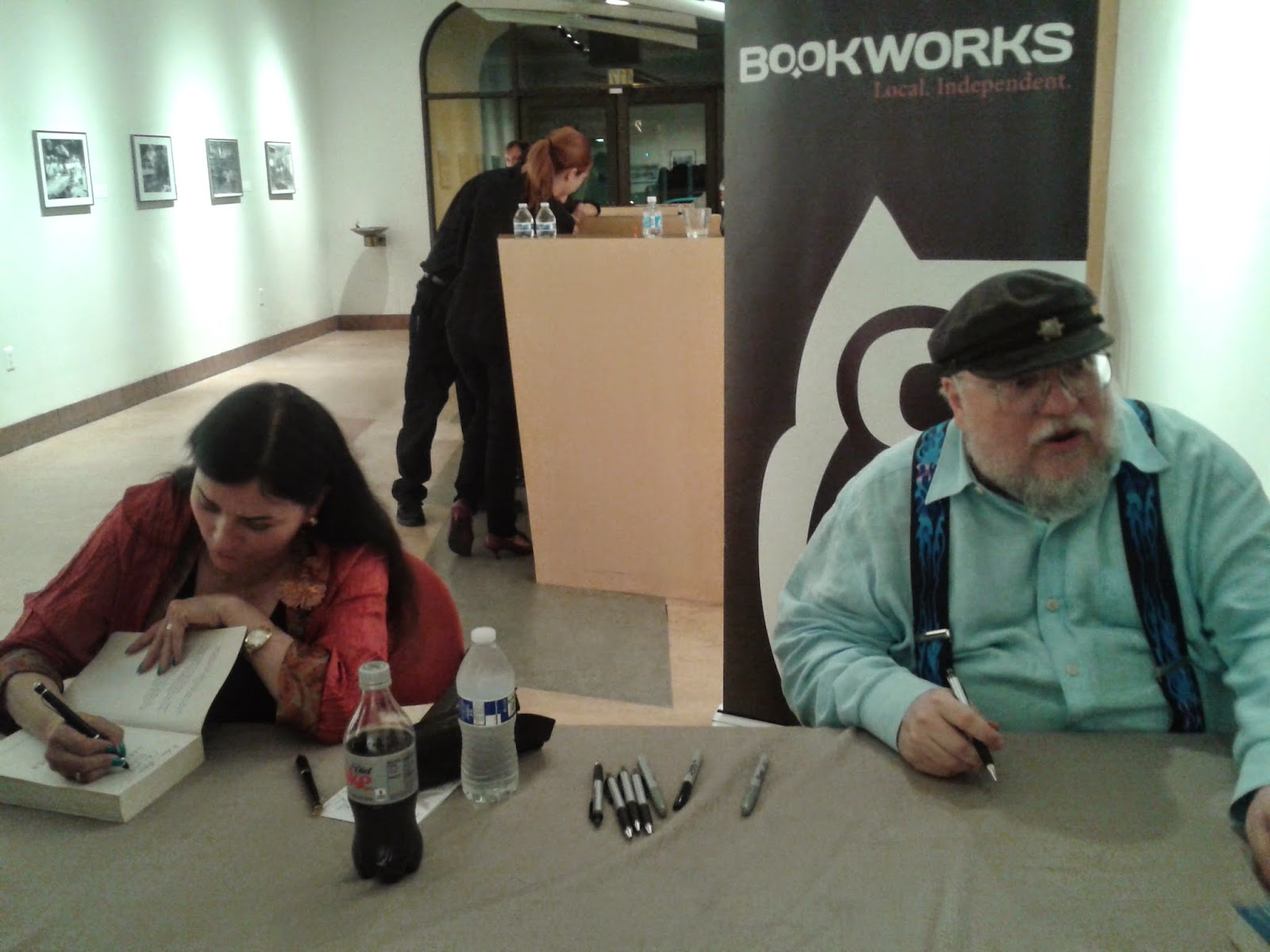

Diana Gabaldon and George R. R. Martin signing autographs

About their use of language:

Since Martin’s novels are set in a “quasi medieval world” he had to find a balance between modern syntax (so the audience wouldn’t be lost) and flavoring his text with archaic words to give the novel a proper context and avoid anachronisms. He called this the “common tongue of all fantasy novels.” He initially overused words like “mayhaps” or “forsooth,” but his editor objected. They reached a compromise by having the older characters use these terms and the younger ones employing a more modern language—as it tends to happen in real life.

Martin did not invent languages the way Tolkien did (he joked that Tolkien wrote The Lord of the Rings just so he could use his languages) but he made up five words of High Valyrian, and will make up a 6th if necessary. For the show, however, whole languages had to be invented since you can't just say, "She said in High Valyrian." Now when he writes a scene, he has to call HBO to ask how a character might say something in whatever language. The show hires people whose hobby is to invent languages with proper syntax and grammar to develop Dothraki and High Valyrian. As a funny anecdote, Martin mentioned that a fan once requested a High Valyrian dictionary.

Gabaldon mentioned that she has a few translators who help her with Gaelic, and she loves the sound of it.

About their TV shows:

Gabaldon announced that the Outlander series is now in production. The producer, who had previously worked in Battlestar Galactica, took two days to talk to her about the show. They decided that as a prologue, they would show a scene of Claire in a military hospital during WWII. Gabaldon had a blast inside the “Outlander world.” She admitted that at first she didn’t like the actor selected to play Jamie Fraser, but after seeing his audition she knew he would be absolutely perfect for the role (even though he accidentally said "OK" during a scene where Jamie was being pressured to marry Claire).

It took a lot longer to find Claire and poor Sam had to go through innumerable "chemistry tests.” Eventually, they found an actress who had the right chemistry with Sam and would play the perfect Claire. When someone asked Gabaldon if she would like to write for TV, she confessed she’s not a team player and likes to keep control of her writing.

Martin, on the other hand, mentioned that he writes one script per season and would love to write more, but he has yet to finish two 1500-page books. Yeah, you read correctly.

What’s interesting is that both shows will share actors. Apparently the BBC has churned out twenty or so actors, who participate in everything involving an English or Scottish accent. Every single one of them is in Game of Thrones, and, according to Martin, will appear in the Outlander series after they are killed off from GoT. (Ha!)

Anecdotes and questions:

Martin was asked which part of Westeros he'd choose to live in, if he could. He said Dorn. "It's warm, the women are warm and the food is spicy. It's New Mexico!"

Gabaldon mentioned that during an interview with a German reporter, tired to keep her tongue in check, she said she loved a man in a kilt because "you know he could have you up against a wall in 30 seconds."

When asked about their thoughts on self-publishing, neither one of them recommended it. Martin said writers are supposed to write, not publish or market books. He commented how sad it was to see writers desperately trying to sell their work in Bubonicon conferences and such, and how people often avoid them. Martin thinks that self-publishing is only a good idea for well-known authors whose names alone sell books.

They both acknowledged that it’s not easy to break into publishing, but the only thing a writer can do is keep writing.

In spite of the fans who wanted hints about how both series will end, neither Gabaldon nor Martin said a word. The only thing Gabaldon admitted to was having written the last scene ten years ago. “How I will get there is an entirely different question,” she said.


On a side note:
 
This has been a year of changes and exciting new opportunities for me. I would like to share some of them with you, my dear readers. First, I have a new agent for my generational saga (the first novel I wrote) the awesome Liza Fleissig of the Liza Royce Agency! Last but not least, my historical novel, The Black Letter, has made it to the Amazon Breakout Novel Contest Quarter Finals! If you’d like to take a look, you can find an excerpt here
 

Friday, April 25, 2014

The Cephalopod Coffeehouse: Waiting to be Heard


By now, you’ve probably heard of Amanda Knox. You may even have an opinion about her case and whether or not you think she was involved in the murder of her roommate, Meredith Kercher. My interest in the case started when Amanda was acquitted a couple of years ago, but it grew with recent developments (in January, her appeal was reversed). In addition to the popularity of the case, I became interested in her memoir as a source of research for my third novel since it also deals with an exchange student who gets into trouble abroad.

After all that has been said about Amanda on news shows, magazines, the internet and even a made-for-TV movie, Amanda finally gives us her version of the story. In a prose that is easy to follow and insightful, we meet Amanda a few months before she moves to Perugia, Italy. We get to know her parents, her siblings and her sometimes quirky and adventurous nature in her native Seattle, where she has planned in some detail her year of studies in Italy—a lifelong dream of hers.

Amanda is not very different from other people her age who travel abroad. I also traveled to Europe in my early twenties and Amanda seemed as ordinary as any other girl I met during my trip. I won’t go into too much detail about her story since: a) it’s all over the internet and b) if I tell you too much, you won’t want to read it (and if you’re interested in her story, I believe it’s worth reading. Especially because we’re so used to making quick judgments based on what the media tells us.)  I’ll just say that Amanda goes into great detail about those first months in Italy, the people she associated with, her relationship with her roommates, the boys she met, etc. She doesn’t portray herself as a saint as she admits to having smoked pot and engaged in sexual activity with two or three guys. This, she says, were mistakes the media and the prosecution exploited during her first trial.

Amanda claims her relationship with Meredith was good. According to her, they were confidents and friends who explored the city together and shared similar experiences (both were English speakers trying to find their way through a new culture and a new language). Then she describes the moment she met Raffaele—her then boyfriend and partner in this ordeal—their short-lived but intense relationship, the day Meredith died, the police interrogations, her two trials and her life in prison. She brings insight into a few things that are not explored much on the internet or news shows:
  • What, according to Amanda, happened during the interrogation where she accused her boss of killing Meredith (and later admitted to lying about it). She offers a theory as to why she lied that night.
  • During her appeal, there was an important testimony from a man who’d been imprisoned with Meredith’s convicted killer (Rudy Guede, who’s DNA was all over Meredith’s room). This man said Guede confessed to having raped and stabbed Meredith in conjunction with “a friend” (who wasn’t Raffaele or Amanda, which is what the prosecution alleges). In fact, Guede was supposedly having a moral dilemma as to what to say during their appeal. (Guede had a separate trial and conviction from Amanda and Raffaele.) This story made more sense to me than the prosecution’s theories of a “sexual game gone bad” or a “Halloween Eve sacrifice.”
  • Explanations as to why there were traces of Amanda and Raffaele’s DNA in a couple of items that the prosecution assigned as proof of their culpability.
  • Insights on the people in Amanda’s life in prison and outside. I was especially touched by three people in her life: a Catholic priest who befriended Amanda—an agnostic—during her hardest times in prison (Don Saulo); one of her best friends from Seattle who moved to Perugia to be near Amanda after she was sentenced to 26 years in prison (Madison) and Laura, an American inmate who grew up in Ecuador and became sort of a foster mom or older sister to her. Amanda’s family is also commendable as they never abandoned Amanda and during her four-year-ordeal always made sure someone was in Italy on visiting days. Her stepfather went as far as to move to Perugia for some time. Amanda’s story, as sad as it is, also serves as a testimony that goodness is sometimes found in the most unexpected places.
After reading Amanda’s memoir, I conclude that yes, she made MANY mistakes, primarily not taking the police interrogations seriously—she didn’t wait for a lawyer to be present and she never called the American embassy before answering questions in a language that she didn’t speak well. Her lying during one of her confessions, I admit, is hard to understand and made me wonder if she was covering up for something else (heavy drug use?) however, I do not believe she was involved in Meredith’s attack. It just doesn’t make sense. Our civilization has become SO reliant on technology that sometimes we drop common sense out the window. The prosecution claims that a girl like Amanda—with no prior convictions and a model student who came from a good family—is guilty of murdering (savagely) and raping her friend (when she doesn’t even have the *right* equipment, if you know what I mean). What we do know is that there is no motive. The prosecution claimed Amanda and Meredith argued over the bathroom’s cleanliness, but only a psychopath would kill over this, right? Not to mention the fact that there is no evidence of her presence in Meredith’s room. The prosecution claimed Amanda and Raffaele wiped their own DNA in the room but left Guede’s, as though it was possible to see DNA! Plus, there was no proven relationship between Guede and Amanda or Raffaele (Raffaele said he’d never met the man and Amanda said she saw Guede once or twice with her downstairs neighbors but couldn’t even remember his name.) 

I truly believe that Amanda’s problems stemmed from her immaturity and naivety at the time of her trip. Not only was she cavalier about who she spent time with (including working at a bar with people she barely knew) smoking pot on a regular basis and having sex with guys she’d just met. Unfortunately, this is not uncommon in people her age. When I moved to the US to go to college, I had the fortune of having a couple of family members here to guide me through the process of moving to a different country and start a new life as an adult. Also, my parents came with me and helped me settle in the dorms. When Amanda arrived to Italy, she had nowhere to live and found her new roommates on a bulletin board. I know, LOTS of college kids do this, but this doesn’t mean it isn’t dangerous. ESPECIALLY in a different country where you barely speak the language and you don’t know the “rules of the land.”

By the end of the book, however, you see Amanda as a different woman. Not sure this has to do with the fact that Amanda is a writer (currently studying Creative Writing in Seattle) and she knows that in every journey, the hero must show change and growth, or that she truly matured with all the hardship she went through, but her transformation was evident to me.

Have you been following this case or read her memoir? Do you believe in her innocence? What do you think will happen now that her appeal got reversed? Do you think the US will extradite her to Italy? Do you think it’s fair that she was tried twice for the same crime?

Check out these coffeehouse reviews!

1.The Armchair Squid2.My Creatively Random Life
3.Wishbone Soup Cures Everything4.Valerie Nunez and the Flying Platypi
5.Huntress6.Servitor Ludi
7.MOCK8.StrangePegs -- Mrs. Frisby and the Rats of NIMH
9.Words Incorporated10.Agatha Friggin' Christie
11.Ed&Reub12.The Writing Sisterhood
13.Read, Write, Repeat14.V's Reads
15.The Cephalopod Coffeehouse: April 2014 16.Debi O'Neille, writing against the wind

Sunday, April 20, 2014

Trimming the Fat (aka Expendable Scenes) in Your Novel

 
I don’t blame you if you don’t want to read this post. Revisions can be dreadful, overwhelming, confusing and frustrating for many writers and the idea of doing them (or reading about them) may sound as fun and exciting as standing in line at an airport security check point. But revisions have a strange quality, they can also be infinitely satisfying once you figure out what needs to be done and the end result is a stronger manuscript.

One of the reasons why revisions are so difficult is because you must tackle several elements at once: character development, plot progression, pace, prose (to include style, grammar and dialogue), among other monsters. Today, I’m going to focus on what constitutes the structure of your novel: scenes.

Since your novel is basically a sequence of scenes with transitional sentences/paragraphs/thoughts, it's essential to evaluate each and every one of them as both a unit and a part of a whole. My writer friends tease me because I’m ruthless with them (“If I were you, I would delete this scene” is my motto!) But there is a good reason for my callousness. More often than not, a pacing issue is the result of a scene—or several—that aren’t serving an important purpose in your novel. These “problem scenes” are difficult to spot because we often grow so attached to them. (Very often we need someone else to point them out.)  So how do we determine if a scene is important enough to keep or if it’s more problematic than useful?

Here are the five questions I ask myself when evaluating a scene.

1. Is the scene active or reflective?

Ideally, you should have a good balance between active and reflective scenes. Active scenes being the ones where something important happens (an action that moves the story forward), and reflective scenes are those where the character ponders on his situation, informs other characters of his problem or fills the reader with backstory and/or information dumps. In my experience, agents and editors often complain that novels are “too slow.” This problem may be the result of too many introspective scenes or instances where characters engage in ordinary activities. Arguably, you will need more active than reflective scenes to create a good progression, but the balance of active vs. reflective heavily depends on the genre you’re writing (though the consensus seems to be that even in literary fiction there must be enough action to keep the reader’s interest). In genres such as adventure and thrillers, most of your scenes should be active, but in Women’s Fiction, for example, it’s tolerated and even expected to have many introspective scenes to reflect the author’s voice and the character’s personality. Once you figure out if your scene is active or reflective, determine whether or not you have too many of one or the other. Perhaps you have too many reflective scenes in a row and the pace would benefit from moving them around (if it doesn’t affect your sequence of events, of course). The same goes for active scenes. Perhaps it’s time to give your character a coffee break from all the chaos surrounding him!

2. Is the scene repetitive?

Do you have similar scenes throughout your book? In other words, have you used the same setting many times before, have you had similar conversations or too many scenes between the same characters? Perhaps it’s just a matter of condensing two scenes together.

3. Is an entire scene necessary to convey this information?

Sometimes we hold on to a scene because we think that the information shared on a particular line of dialogue is vital but we don’t realize that an entire scene may not be necessary in order to divulge this one, tiny, bit of information. When I’ve recommended my friends to cut scenes that are dragging forever, I try to spot what is important about them and suggested they move this information elsewhere. But what about “show, don’t tell,” you may ask? As you know, “showing” (in this case, enacting a scene) is fundamental for a reader to identify with a character or situation, but not all events are equally interesting or deserve this much attention. It’s your job to determine which events are relevant enough to turn into a scene.

4. What purpose is this scene serving?

It’s important for a writer to understand why a scene deserves to take room in his or her novel. Is the scene in question advancing the story? Enlightening the reader about the character’s past or his quirky personality? Developing a bond or conflict between characters? If you don’t understand the purpose of a scene you’re holding on for dear life, you may have a problem.

5. If I remove this scene, will it affect the flow of my novel?

I may have told you that my first novel started as a telenovela for the Latin American market. As you know, soap operas have tons of characters and last A VERY LONG TIME. Therefore, writers have the luxury of penning what I call “peripheral scenes.” These are scenes where secondary characters catch up with the main action, or where the heroine ponders her decision with friends, or where a subplot between secondary characters develops (but does nothing for the main plot). When I translated my soap opera to English and formatted it as a novel, I had tons of scenes like these (no wonder my novel was over 143,000 words!) In novels, these scenes are sometimes hard to spot because they can be considered “bonding scenes” between characters. A good test is to evaluate if your novel will suffer if you remove a particular scene. From my experience, it probably won’t. Readers are smart and will catch up with the action without you having to over explain how things came to be. If you’re doubting the validity of a scene, you’re probably on to something.

In conclusion, the trick to revisions (especially if you’re going to do them on your own) is to be honest with yourself—which can be difficult considering your emotional attachment to your work. As a critique partner, I have noticed that many writers are very resistant to deleting superfluous scenes. (Sometimes they’re more willing to kill a character than a beloved scene!) I think it has to do with the fact that these scenes become familiar to us and it becomes harder to envision our novels without them. However, many times after the deed is done, writers realize how much better their novel flows and they don’t look back (it’s happened to me several times). It’s rare that after deleting a scene, a writer will bring it back (at least not in its entirety).

What do you think? Do you have an emotional attachment to your scenes or are you ruthless when it comes to evaluating (and getting rid of them)?

Sunday, March 23, 2014

Interview with Agent Christa Heschke


Hey, writers! Looking for an agent to represent your YA/NA/Children's book? Agent Christa Heschke of McIntosh & Otis, Inc. is still open to new clients, and she has kindly agreed to answer my questions about her preferences and the current state of the publishing industry. Check out what she has to say and get those query letters ready!

Hi Christa, welcome to The Writing Sisterhood!


Q: Writers are always curious about what goes on behind agencies’ closed doors. Could you share with our readers what a day in the life of a literary agent is like?

A: Every day is very different, as we’re a full service agency, so we handle pretty much everything for our authors personally, such as contracts, foreign rights and other subsidiary rights (some agents have different people at their agency who do these types of things for them and don’t handle personally). Each day generally starts with me going through my emails, answering questions, checking in with editors on submissions, payments etc. then throughout the day I’ll have phone calls, meetings and lunches with editors, negotiate deals, work on contracts etc. Of course, all of these things don’t happen every day, so this is just to give you an idea of what may cross my desk.

Q: About how many submissions do you receive per week? What do you look for in a query letter? 

A: About 75 submissions a week, sometimes more. Well, first thing I look for in a query is that it’s a genre I am currently looking for. My current wish list is on my blog and on the M&O website under Agents.  Next, I look to see if it’s something that’s new or different. If you send me something that sounds like a knockoff I likely won’t read on. Make sure your letter is professional and not too conversational. I’ll also look to see if the project is a standalone or a series and if the author has written anything else or has a website so I can learn more.

Q: Will you be open to adult fiction in the near future? 

A: No. We have two great adult agents here. If I ever were to fall in love with an adult project I would co-agent with one of my colleagues. The adult world and children’s world are very different and working in children’s I’m not regularly meeting adult editors or expanding my contacts there.

Q: What is one of the most common problems you see in the manuscripts you receive?

A: I still see a fair amount of projects that are trying to chase trends. If you’re writing something only because you think it will sell a lot of copies because it’s similar to Twilight and Twilight sold a lot of copies you’re often hurting your own chances. Writing for trends can lack passion. When you have an idea for a novel and can’t get it out of your head, that’s passion. You’re not thinking of the endgame, just that you need to write it. Those are always the best books, if you ask me, and you can feel it when you read. Writing for trends can be formulaic and it’s often too late. Books take 18-24 months to publish on average and if there are already 10 books on mermaids and you’re only now writing one, many editors may have already had their fill of it.

The other problem I see a lot is a story that reads like a first draft and isn’t fully realized. Find critique partners or have a friend read your novel before sending it out. It’s best to send a project that has gone through revisions and is as good as you think it can be before sending to agents.

Q: Would you take on a client based on his/her potential even if the manuscript is not ready to be sold? 

A: Yes! I have never instantly sent out a manuscript after taking on a client. We always at least do a bit of tweaking. I wouldn’t take something on though that needed a lot of work. If I liked it and saw potential I’d likely ask for a revise and resubmit. It’s important to make sure an author is good at revision before taking them on.

Q: Why do you think YA fiction has become so popular in the last few years? There also seems to be a preference for fiction with supernatural/fantastic elements. Do you think these trends will continue for much longer? 

A: YA fiction is often hopeful. It’s about teens who are at the beginning of their lives. There’s so much promise. It’s about growth and becoming who you’re meant to be, first experiences and making mistakes. Anyone can relate to that even as adults. It’s just so accessible and often more fast paced than an adult novel. Depending on who you ask, the response will probably vary, but those are some of the main things. Paranormal and dystopian is on the way out; we’re seeing ends to series mostly in these genres now and I can’t think of too many editors or agents looking for it. In fact, many are specifically saying they aren’t considering it.  Not too many standalones or beginning of series these days.  I think everything is shifting back towards contemporary, but I also think people are trying to figure out what the next big thing will be. Magical realism is pretty highly sought after. There’s been some sci-fi, horror, thriller and light fantasy that has been doing well and editors and agents are still looking for those genres.

Q: Writers are often times frustrated with how difficult it is to get the attention of industry professionals. What do you think is the most effective method for a writer to get noticed: conferences, blogs, query letters, contests? 

A: That’s a hard question. Meeting an editor or agent at a conference certainly helps as we generally will put priority on those submissions.  Networking is always helpful. Join writing groups or book clubs with other writers. If any of the writers are published or become published they may recommend you to their agent. Referrals always get priority. Send your best work. It likely won’t be that first novel. Many writers have several novels under their belt before submitting to agents or editors. You keep getting better with practice. Make sure the book you submit is polished and as good as it can be. Have friends and critique partners give you opinions. Sending an agent every project you have isn’t going to get you noticed. Most agents frown on it unless they specifically ask to see more work.  Send the project you think is the best fit for that agent. An online presence is nice to see but it doesn’t sway me either way unless it’s particularly negative towards editors/agents/the industry. Try to keep your online presence professional and positive.   Contests are good too. I’ve found some of my clients that way.  It’s hard work to get noticed and you really have to dedicate yourself to it and not let yourself be troubled too much by rejection. It’s all about finding that right person to champion your work and it may take some time to find them.

Q: How do you feel about writers posting excerpts of their unpublished novels and/or creating websites for them? 

A: I think short excerpts are fine.  It can help get you some readers/fans who will buy your book once you are published.  I don’t think an entire website dedicated to an unpublished book is necessary. I’d stick to an author site or blog and you can talk about your work there. But, be wary as there are people out there who steal ideas so I’d say less is more.

Q: Do you think e-books present a threat to traditional books or they can happily co-exist? 

A: They can happily co-exist. I think there was some worry about it, when they first started becoming popular, but I hope that there will always be those book lovers who enjoy holding a real book. It’s such a different experience.

Q: Finally, what are your top three authors of all time? What are your top three books?

A: That is so hard to answer! I have a lot of authors and books I really enjoy. I always was a big RL Stine fan (Fear Street specifically), I loved Corduroy as a kid and The Teeny Tiny Woman (it’s an early reader). My parents said that I would act it out while I was reading it.  The Hobbit is another favorite. I also am a big Bruce Coville and Garth Nix fan.  Oh and can’t forget Jane Austen!

Thank you, Christa, for those very insightful answers!

For more information about Christa and what she's looking for, check out her blog and her agency's website.

Sunday, February 23, 2014

Interview with Author Delilah Dawson (and Book Giveaway!)

Here at the The Writing Sisterhood we're always happy to welcome other writers and share their successes with our wonderful readers. Prolific author Delilah Dawson has just released her latest novel, Wicked After Midnight and has agreed to answer some questions about her work and her publishing experience. The best part is that Delilah is giving away 3 copies of her e-novella THE DAMSEL AND THE DAGGERMAN! All you have to do is leave a comment below, fill out the quick form and you'll automatically enter the giveway. The contest ends on Saturday, March 1. Good luck everybody! UPDATE: Winners have been chosen. Please scroll down to see if you're one of our winners!


Hi Delilah, welcome to The Writing Sisterhood!

Thanks so much for having me!

Q: Please tell us about your new book. What is it about?

A: Wicked After Midnight is the final book in the Blud trilogy and can be summed up as steampunk vampire Moulin Rouge. The series takes place in a fantasy world where most of the animals and many of the people drink blood, where pets are clockworks and fashion is dominated by thick corsets, high collars, and gloves. Demi Ward is a blood drinker and circus contortionist from our world who sets out to become a star in the cabarets of Paris. It's a dark, twisty, glittery, sexy adventure.

Q: Could you share what your publication process has been like?

A: I didn't grow up knowing I wanted to be a writer—I assumed that writers were called to their destiny, like doctors or nuns. Then, in 2009, when my second child was almost a year old, I was living on three hours of sleep a night and basically broke my poor brain. All the signals that told me I couldn't write a book disappeared, and I knocked out my first draft in a couple of months. After exhaustive online research and edits, I queried that book, a quirky women's fiction, receiving over 50 rejections and some kind agently feedback that the writing was solid but the story was fatally flawed. I scrapped that book and wrote a middle grade. After over 30 rejections, I received offers of representation from two amazing agents. It was a difficult and painful decision, but I chose the one who handled lots of different genres, since I knew my next book was fantasy for adult audiences. My agent didn't sell the middle grade, but we worked on the fantasy, turned it into a romance, and sold it to Pocket at auction in a three-book deal. That book was Wicked as They Come. Since then, I've sold three e-novellas, a Big Six anthology story, a commissioned comics e-novella, three YA books, and several short stories and comics. I love being an author and finally feel like I'm doing what I was meant to do. More books are always in the works!

Q: Everything supernatural/fantastic seems to be more popular than ever. Why do you think that is? 

A: What I want most in a book is an escape. I don't want to think about mortgages and cancer and PTA dues. I want to be transported away from my worries and straight to a magical place full of possibility and adventure. I like the fast pace and creative worldbuilding of fantasy, and supernatural elements tap into the accepted cultural shorthand to make strange creatures seem familiar. Almost all of my books are built on fantasy, so I hope the trend continues.

Q: Could you explain what exactly is “steampunk”?

A: Steampunk has as many definitions as it does admirers. Some people describe it as Victorian science fiction or like the Wild Wild West movie but... good. Even if people can't describe it, they usually know it when they see it: corsets, top hats, and technology based on gears. The steampunk in my books arose naturally from the worldbuilding. Since all the prey animals, including horses, are vicious predators, the people must travel using trains, dirigibles, submarines, and horseless carriages and keep clockwork animals as pets. The best steampunk, in my opinion, go deeper than just the aesthetics of the Victorian world with cogs glued on and helps to inform the society, mores, fashion, and everyday life throughout the story.

Q: YA has recently become a crossover genre, with more and more adults reading it. That's put pressure on YA authors to write for two distinct audiences in one book. Do you feel that pressure?

A: Yes, but I don't see it as a negative. I like the immediacy, feelings, and excitement of YA books, along with a bit of snark and humor. And I like writing romance with themes of feminism, independence, and falling for men who balance passion with intelligence. Therefore, getting your YA peanut butter in my Romance chocolate is not a bad thing—it's a great thing. I did need some coaching regarding YA dialog, as my brain is definitely stuck in the 90s crossed with now. But I think people who like the Blud series will find the same dark whimsy and adventure with a touch of horror when they read my YA books.

Q: What inspires your stories?

A: Every story is different. Wicked as They Come was inspired by Buffy the Vampire Slayer and the album Like Vines by the Hush Sound. Wicked as She Wants was inspired by a reimagining of Princess Anastasia as the most dangerous woman around. Wicked After Midnight was inspired by my love for Baz Luhrman's Moulin Rouge. And Servants of the Storm, my August YA debut, was inspired by a combination of a trip to Savannah, a girl's picture from a fashion magazine, a viewing of The Tempest, and an afternoon in the basement during a tornado. My agent says I'm like a gun, that if you point me in a direction and shoot, I'll find a target.

Q: If you had to define your work in one word, what would it be?

A: WHIMSYDARK

Q: Who are your three favorite authors?

A: They used to be strangers whose books I like, but now that lots of my friends are authors, this question is far more challenging! If you're looking very simply at the books I wait for all year and read in a big rush the second they're out, it would be Cassandra Clare, Tiffany Reisz, and Diana Gabaldon. If you want a list of the authors who are my favorite people, we're going to need a bigger boat. ;)

Q: What advice would you give writers trying to get published? Did you ever feel like giving up?

A: My best advice is just a reminder that it's not over until you stop writing. Writing is not like a video game where you get a certain number of guys before GAME OVER, where you have to run a specific course. There are infinite paths, infinite ways to write, infinite times you can query a new book, and tons of ways to level up your skill set. I'm sure I had moments, right after form rejections from “dream agents” or rejections on full manuscripts, when I felt wronged and furious and done, but nothing keeps me going like hope. I would get a rejection and immediately send out a new arrow, knowing that one day, I would hit the target. And, yeah, I still have doubts and down days and times during writing when I feel like an untalented phony who will never succeed. But I keep going anyway, and the great days far, far outnumber the bad.

Q: Do you have plans for your next novel yet? 

A: Good gravy, yes! Servants of the Storm debuts in August, and I can't wait to unleash it on the world. I'm working on two first drafts, one a dark and twisty women's fiction and the other a YA Weird West adventure. I have a geeky YA contemporary marinating before its first revision, and we're in talks to shape the sequel of my 2015 YA. And I have an anthology story due in March. I've never been so busy, and I've never been so happy.

Thanks Delilah!


a Rafflecopter giveaway

Thursday, January 30, 2014

The Cephalopod Coffeehouse: The Infatuations


Ever since I started writing in English, I’ve been reading mostly American and British authors. Not only as a tool to become more proficient in the language, but also to understand what’s selling in English-speaking markets and how their stories are told. Once in a while, though, I’ll dig into world literature and look at what’s selling outside the US, mostly in Latin America and Spain.

This month I ran across a Spanish author called Javier MarĂ­as, who is apparently making waves across the Atlantic. From what I understand, there’s even Nobel Prize talk. His latest work, The Infatuations (in Spanish, Los Enamoramientos) is a literary novel (but honestly, what Spanish/Latin American author doesn’t write literary?) with elements of crime, obsession and love—or more specifically, elements of “falling in love,” which is not the same thing, according to the author. As Alfaguara (the Spanish publisher of this novel) indicates on its website, this is "a book about the state of being in love, which seems to justify everything."


The plot is simple: MarĂ­a Dolz is a book editor who’s been watching a couple at a cafĂ© every morning for years (whom she affectionately calls “The Perfect Couple”) until one day, they stop coming. By chance, she learns that the Perfect Husband (Miguel) had been stabbed to death. When MarĂ­a sees the Perfect Wife again at the cafĂ©, she approaches her for the first time and offers her condolences. The now-widow invites her to her home for a chat and opens her heart to MarĂ­a (known to them as “The Prudent Young Woman”). At the widow’s house, MarĂ­a meets a family friend (Javier) and from the prudent, distant observer she once was, MarĂ­a becomes entangled in the lives of these strangers until their fate lies in her hands.

Oddly, in this novel—which may seem so intriguing and juicy—the plot is not the most important thing. As the author himself tells us through one of his characters (in reference to another novel):

“What happened is the least of it. It’s a novel, and once you’ve finished a novel, what happened in it is of little importance and soon forgotten. What matter are the possibilities and ideas that the novel’s imaginary plot communicates to us and infuses us with, a plot that we recall far more vividly than real events and to which we pay far more attention.”

The author’s philosophy comes through in his work since, for example, we know very little about his protagonist. We come to know how MarĂ­a thinks and feels, but little to nothing about her past, her family or even her age. We’re stuck in this one anecdote of her life, this brief season where we learn the bare minimum about her (where she works and some of the people she associates with) in order to understand her choices and actions. This is a novel where the human condition (our fear of death, our unfulfilled desires, the things we do for love, the process of grieving after losing someone) becomes the focus of the story.

I found the novel to be both refreshing and frustrating. While the prose is engaging and identifiable (as I mentioned earlier, the author analyzes in great deal feelings and experiences most of us have had) he repeats his discourse in a way that the plot becomes sometimes static. I did enjoy his reflections and repeated motifs (he uses the same examples to illustrate his views on injustice and grief) but at the same time, I wanted the action to move along, I wanted to see the characters interact in different ways—as opposed to being told what they did and simply witnessing their philosophical conversations in almost every scene, which leads me to my other objection: the characters sounded (mostly) the same in their views of life (sort of cynical) and they all engage in super long monologues.

Despite my grievances, the novel is also refreshing and here’s why: the story doesn’t follow “the hero’s journey” or any predictable pattern (even though the reader is definitely intrigued to know what will happen and what did in fact happen to Miguel). It’s more of a “slice of life” type of story with no perceivable change in the protagonist or any of the other characters (aside from the end of a natural grieving process). I loved this because I am so tired of books and films that follow a formula as though it was a manual of instructions to install a dishwasher. It seems contradictory, doesn’t it? The same things that made it refreshing (the differences from the traditional storytelling model) also presented a source of frustration for me. In the end, though, the novel touches on much deeper issues than who killed Miguel and why or what will happen with the protagonist’s love life. It talks about how our perspective and memory may affect the truth (or what we perceive as such), it talks about how humans adjust to the loss of a loved one to the point where if that person were to come back, he or she may no longer have a place in our lives, and it talks about justice and impunity. In summary, it’s one of those novels that will leave you pondering for days and perhaps make you examine your own philosophies and fears.

Spanish edition of The Infatuations. Which cover do you like better?
Have you read this novel? If so, what did you think? Do you agree with the author in his assessment that ideas are more important than events in fiction? 

Check out these Cephalopod Coffeehouse reviews!

1.The Armchair Squid2.What's up, MOCK?!
3.Words Incorporated4.Scouring Monk
5.Huntress6.A Creative Exercise
7.Libby Heily8.Trisha @ WORD STUFF
9.Wishbone Soup Cures Everything10.mainewords
11.Julie Flanders12.Hungry Enough To Eat Six
13.Yolanda Renee14.M.J. Fifield
15.StrangePegs -- Turn Coat16.The Writing Sisterhood
17.Ed and Reub18.StrangePegs -- Vader's Offspring

Sunday, December 15, 2013

Before Sunrise, Before Sunset and Before Midnight: A Love Story Told in 18 Years

Warning: this review contains spoilers.

Most romantic stories only take a couple of hours to reach a happy resolution and rarely does the viewer get a chance to revisit the characters a few years later. This is not the case of Celine and Jesse, the protagonists of the nineties cult film Before Sunrise.  At a time where most romantic films follow a predictable formula and many viewers may feel manipulated with plot elements they’ve seen again and again: airport tension (analyzed in detail here), contrivances and misunderstandings, the trilogy of Before Sunrise, Before Sunset and Before Midnight is absolutely refreshing.

What’s different about this trilogy is that each of these films take place in the course of one day. All three movies use dialogue (and the passage of time) to move the story forward, they all have beautiful European scenery and the characters must make a decision by the end of each film. What’s also unique is that each film in this trilogy is produced at a nine year interval. Therefore, the characters have grown (in many cases with the audience) and their lives have entered different stages of life with their subsequent problems. I’ve never seen a trilogy that more realistically portrays life and love as these films have done.

But let’s start from the beginning, in this case: Before Sunrise (1995). Some call this a cult film. Well, I’m here to confess that I’m a member of this cult! I’m convinced that one of the reasons this story had such an impact on me was because I was at the same stage in life as these two main characters. Therefore, it was easy for me to identify with them. I mentioned in a recent post how much I admire simple stories (because it’s the opposite of what I write). Well, it doesn’t get any simpler than Before Sunrise.

Celine and Jesse falling in love in 1995

Celine (Julie Delpy) and Jesse (Ethan Hawke) are two passengers on a train to Paris. Jesse, an American, strikes a conversation with Celine, a French girl who is returning home from a trip to Budapest. The couple become quickly engaged in their talk and obviously attracted to one another. Jesse convinces Celine to get off the train with him in Vienna, where he’s supposed to catch a plane the next day to the US, arguing that in twenty years, when she’s stuck in a dull marriage, she would be wondering what would have happened if she’d picked another guy. Well, Jesse argues, this is her chance to realize that he himself (aka, “another guy”) is not that different from her future husband. Amused, Celine agrees. They spend an entire day and night walking and talking around the streets of Vienna, both knowing that they will have to say goodbye by sunrise, when Jesse has to get on his plane. Now, I know that I had mentioned “airport tension” as a clichĂ© in fiction. However, this is real airport tension as opposed to the sudden (and very overdone) decision of one of the characters in any random romantic comedy to move to another town causing the love interest to realize he/she is about to lose the love of his/her life forever.

In Before Sunrise, the deadline is established from the very beginning and being that the story itself—their conversations and actions—are treated very realistically, we know that it’s unlikely that the film will have a fairy tale ending (though the audience may be hoping for one!)

There is, really, no plot other than how a couple falls in love and what they are going to do about it come the end of the day. But being in my early twenties at the time the film came out, I must have been its perfect target audience. For me, their conversations were absolutely engaging and reflected some of my own thoughts and concerns about relationships and life in general. The film’s ending is open ended and it takes us nine years to know what really happened.

Fast forward to Before Sunset (2004) where we encounter Jesse in Paris. He’s become a successful author and is having a booksigning of his first novel, which was inspired by his fortuitous encounter with Celine in 1995. Well, who lives in Paris? None other than Celine, who has read the book and goes to the bookstore to meet Jesse. The couple resumes where they left of nine years prior. Although they’ve both reached different stages of their lives—he’s married and has a son, and she’s an independent professional—the attraction between them remains the same and not just on a physical level. Much like in 1995, they still have a lot to say as they walk along the streets of Paris, clarifying to the viewer what really happened after the open ending of Before Sunrise. The question here remains the same, will Jesse take his plane back to his wife and kid by sunset? Again, watching the couple’s banter is most entertaining, especially because the issues they now discuss are not the same as when they were twenty-something idealists who thought they could change the world.

Things are not so sunny and cheerful when Celine and Jesse meet again in 2004

This year I had the pleasure of watching the third installment of this love story, Before Midnight (2013). Again, the characters here mimicked my own stage in life with preteen children and marital quarrels. Yet, there was still a little bit of the magic of previous films in the way Celine teases Jesse as they walk along the Greek countryside during a family vacation. But there is a deadline here too—something has set off a possible breakup and a decision is about to be made before midnight. During the day, we’re exposed to the realities of their lives beyond the romanticism of the previous films and their breakup seems like a realistic possibility as the bumps in their marriage are slowly revealed.

Perhaps the most admirable trait of these films is the character consistency. Although it’s obvious that both Celine and Jesse have grown, their personalities remain the same (and so does their banter). I have often been disappointed with sequels or soap operas where the characters become unrecognizable by the end, but I was happy to see that this wasn’t the case here. Another strength of the trilogy is the dialogue. Unlike many romantic comedies where the dialogue is sometimes contrived and serves the plot (ex: artificial fights and misunderstandings) the dialogue here is actually engaging. I find it interesting that both Ethan Hawke (a writer in addition to being an actor) and French actress Julie Delpy co-wrote the second and third films with director Richard Linklater. Well, who would know those characters better than the actors performing them?

Will Jesse and Celine make it?

Now for the films’ down side. I don’t think the sequels would appeal to viewers who haven’t watched the first one. Whereas Before Sunrise can be a stand alone film, I don’t think the other two could do the same. (Correct me if I’m wrong!) It seems to me it would be similar to watching a soap opera or drama series halfway through. The other thing is that these films seem to have a small, niche audience. I’ve often wondered if the first film would have the same appeal to me now as it did when I was in my early twenties.

For those who have watched one or all the trilogy, do you think the audience’s age affects the perception and appreciation of these films? Did you mind their open-endings? Would you like to see Celine and Jesse again in nine years?

Ethan Hawke, Julie Delpy and director Richard Linklater writing Before Sunset.

Sunday, November 17, 2013

The Genius of Alfred Hitchcock (and what writers can learn from him)

by Lorena

The other day an old college friend of mine invited me to the Hitchcock Film Festival in a downtown theater I thought had closed down years ago. This art-deco building (circa 1927) has been presenting some of Alfred Hitchcock’s most famous films every Friday night for the last two months.

The movie we watched was Rope (1948) with James Stewart. It’s already been three weeks since I saw it and I’m still thinking about it. Funny because that same weekend I watched Gravity—an expensive display of special effects that Hitchcock could have only dreamed about—and a story that values life above all (almost the exact opposite of Hitchcock’s film).Yet, the movie that keeps popping into my head is Rope, one of Hitchcock’s lesser-known films and produced 65 years ago. Perhaps if I explain more, you’ll understand why this film impacted me.


Rope was inspired by a famous murder trial from the 1920s. Two affluent college students decide to kill one of their classmates for the simple thrill of killing. As followers of Nietzsche’s philosophy, they believe themselves to be intellectually superior to other mortals and therefore, above the moral laws of “ordinary” men. They think they can plan and execute the perfect crime and, to make it more thrilling, they hide the corpse inside a chest of books and invite the victim’s friends and parents to a dinner party. In very Hitchcock fashion, they set the dinner buffet on top of the chest. 

James Stewart plays the clever schoolmaster who inadvertently instilled this philosophy in the two murderers. Of course, one of the guys is terrified of getting caught, but the other one seems to almost want his former teacher to discover them so he can admire their “masterpiece” crime. The success of the film is in the juxtaposition of tension (anyone could open that chest since the hinge is broken), dark humor (not only in the party set up but also in the dialogue), the motive for the murder (I’ve never heard of something more original) and the Big Question of whether or not the guys will get caught.

The infamous chest where Philip (far left) and Brandon (far right) hide their friend's body

But this film was fascinating in both content and form. The entire story develops in real time, in one single setting, and the cuts are nearly unperceptive—one continuous scene with very subtle transitions (Hitchcock focuses on a jacket or an ornament to make his cuts seamless.) It’s no surprise that the film was adapted from a play. In addition to this novelty, we have another element that struck me as original: the camera tells its own story. 

Let me explain without ruining the film for those of you who’d like to watch it. Have you noticed how in children’s picture books sometimes there is the story the text tells you, but there are minor stories that you can only see in the illustrations? (this is where a very talented illustrator can thrive). Well, Hitchcock does something similar twice. While the characters are speaking, the camera is moving around them or is focused on another object, making the conversation inconsequential and the visual action what really matters. This is something I haven’t seen in contemporary film making. When dialogue is present in a film, it always supersedes anything that may be going on in a scene. 

Because I have a tendency to write complex novels with abundant characters, I always admire writers and directors who can tell simple stories. The plot here is simple: will the guys be successful at hiding their crime?

So here are some of the lessons I learned (as a writer) from this film:
  1. It’s okay to write a story that develops in a short amount of time (and how challenging that is!) 
  2. People can have the strangest motives for committing a murder (and the more original, the better).
  3. Keeping the tension in a story is key.
  4. Add humor whenever you can (even if it’s dark). 
  5. Plot twists and complicated storylines are not always required to write a gripping tale.
  6. Build a complex backstory (even if you don’t mention all the details) and the story and characters would seem more realistic and believable.
  7. For your ending, keep your audience guessing until the last possible moment.
  8. Suppress the desire to make your main characters a) always sympathetic, and b) always safe. Let them make mistakes.
And here are some of the lessons I learned (as a human):
  1. Life is extremely fragile and can end in an instant.
  2. There are a lot of crazy people out there.
  3. Never befriend someone who admires Nietzsche! 
And just for fun (and because I like lists) some of the trivia I learned about this film:
  1. James Stewart was not happy with this role.
  2. Hitchcock originally wanted Cary Grant for Stewart’s role, but he declined.
  3. The real-life case which inspired this film, Leopold and Loeb, was never discussed or acknowledged by Hitchcock to any of his writers or cast members. 
  4. The attorney who defended Leopold and Loeb, Clarence Darrow, delivered one of the most famous speeches there is against capital punishment—and saved their lives. Both got sentenced to life in prison (plus 99 years each for kidnapping).
  5. According to several online reviewers and the scriptwriter himself, there is a homosexual undertone in the film between the main characters (Leopold and Loeb were allegedly a couple). This may have been the reason why the film didn’t do so well in the box office and why Stewart was not entirely happy with it. 
  6. This film is said to have been a reaction to WWII and Hitler’s belief in the superiority of one race (man) over another. 
Nathan Leopold and Richard Loeb, the inspiration for Hitchcock's film

Are you a Hitchcock fan? Do you think there's a contemporary director who compares with him?

Friday, October 25, 2013

The Cephalopod Coffeehouse: Gone Girl


In a world where everything dark is in and chick lit is out, Gone Girl fits right in. This is one of those books that grabs you by the collar, shakes you up a bit and won’t let go until you raise your head 489 pages later and utter a “what the hell just happened?” to whoever might be standing (or sleeping) next to you. The odd thing is within the constraint of its genre (film noir, mystery) it offers some interesting insights about marriage and gender expectations.

The story is told by two narrators: husband Nick and wife Amy. Nick wakes up on his fifth anniversary with bitter thoughts about his wife. Due to their mutual layoffs, Amy—a once-successful-New Yorker with famous writer parents and a book series inspired by her (Amazing Amy)—has been dragged out of her milieu and transplanted in a small mid-western town to assume the role of perfect housewife. Amy, apparently, is not happy about the move and doesn't seem as Amazing as Nick once thought. The encounter between the two of them this particular morning promises to be explosive, but instead of a collision between these two forces, we’re taken to another scene—a few hours later—in the bar Nick now co-owns with his twin sister. After a disturbing phone call, Nick returns home to find that his wife is missing and the house has been broken into. The police comes in and questions Nick, but there is no trace of Amy.

The next chapter goes into one of Amy’s diary entries—five years prior—when she first met Nick and gives us an insight of what those earlier days were like.

In alternating chapters between the two narrators in two different timelines, we get a sense of who they are. Well, at least we think we do. Pretty soon, Amy’s disappearance turns into a media frenzy. Nick keeps saying the wrong things, gets caught in a few lies and can’t explain what he did the day of Amy’s disappearance between breakfast time and the bar. Even worse, he can't figure out the clues his wife left him on their anniversary's Treasure Hunt. Before he knows it, he becomes the number one suspect in her disappearance.

So far, it seems like a pretty standard Lifetime movie, right?

Wrong.

This novel is so cleverly written that halfway through the book it takes a twist that challenges everything you thought and believed. That, and the fact that Flynn’s style is so engaging and unique (particularly when it comes to Amy’s voice). Someone called it a nice blend between literary and commercial. I have to agree with this assessment. While the plot moves quickly, there are reflections about gender relationships and marriage that I believe many readers may feel identified with. Having said this, there were situations that seemed too convenient for one of the characters, plus I wasn’t fully satisfied with the ending—though I would say that it was original and unexpected.

Despite its qualities (voice, character complexity, interesting plot) this novel is not for everybody. Like the cover suggests, the book is somewhat sinister, the characters extremely flawed and not very likable, and some may even consider it contrived. But there is something about the premise—that famous hook—that makes you keep reading until the big question is answered. I recommend this book to those readers who love suspense, plot twists and murky characters.

If you've read this book, care to share your thoughts with me?


Check out these other reviews:

1.The Armchair Squid2.Subliminal Coffee
3.The Beveled Edge4.Blue Sky Gazing
5.Hungry Enough To Eat Six!6.Servitor Ludi
7.V's Reads8.Julie Flanders
9.Trisha @ WORD STUFF10.Rebecca @ The Dusty Cellar
11.Scouring Monk12.The Writing Sisterhood
13.The Random Book Review14.Wikes! Hikes on the Long Trail
15.Ed & Reub16.M.J. Fifield
17.StrangePegs -- Fortunately, the Milk18.StrangePegs -- "My Killbot Buddy"
19.Katie O'Sullivan20.Gladiator's Pen
21.Em Dashes and Ice Cream22.StrangePegs -- Fahrenheit 451
23.Words Incorporated24.http://sallys-scribbles.blogspot.co.uk
25.Spirit Called26.Denise Covey