Showing posts with label Game of Thrones. Show all posts

Sunday, May 18, 2014

A Word with Diana Gabaldon and George R. R. Martin

Last weekend, my writing sisters and I attended a fun event sponsored by our city library and a local bookstore. A Word with Writers consists of a candid conversation between two acclaimed authors who share experiences and anecdotes about their writing. The inaugural lecture featured none other than the beloved Diana Gabaldon, the author of the Outlander series, and George R. R. Martin, the brains behind the successful Game of Thrones. They both had a lot to say about what inspired their work and what their writings processes are like. Here are some of the evening’s highlights.


About their backgrounds and what inspired their books:

Gabaldon’s background is very interesting because she’s a scientist with degrees in zoology, marine biology and ecology. She blames her father for this copious amount of studying since when she was young, he had told her that she was a “poor judge of character” and would probably marry badly. To avoid a life or poverty, he recommended that she became a self-reliant professional. Gabaldon obediently got her PhD.

In her mid-thirties, Gabaldon decided to write a novel, more as practice than anything (she didn’t intend for anyone to read her work). Since she was so good at doing research and she liked history, she decided it would be a historical novel. Now the only question was where/when should she set it? The answer came to her while she was watching an episode of Dr. Who and spotted a man in a kilt. She was so taken by this man that she decided to write about a Scotsman. Being that a novel requires conflict (to her own admission, this was all she knew about novel-writing) she settled on the Scottish wars against England during the 1700s. Of course, she needed a woman to create some sexual tension with this beautiful man. Claire came to Gabaldon through an image of a woman in a cave full of men. She was English and very different from other 18th century women. When Claire opened her mouth, she recited her full name. There was nothing Gabaldon could do to tame her modern spirit. She fought with her throughout the novel, but eventually gave up and told her: “Go ahead and be modern, I’ll figure out why later.”  In that sense, she confesses, the time-traveling element in Outlander was an accident.

In contrast, Ser George had always been a writer and a reader. He was a Sci Fi, Fantasy and Horror fan—which used to be the same genre—and as a child, he wrote and sold horror stories to other kids. He eventually earned a master's degree in journalism. For many years, he worked in Hollywood as a TV writer in shows such as The Twilight Zone and The Beauty and the Beast, but there came a time where he wanted to work on his own stories, and so he turned to novel writing. When asked about his inspiration, he mentioned Tolkien as a big influence.

About their writing processes:

Martin offered an interesting analogy for writers. He said there are two kinds of novelists: gardeners and architects. An architect designs a blueprint, plans how he’s going to develop it and then does it. A gardener digs a hole in the ground, throws seeds and water, and hopes something will grow. Martin admits he’s a gardener. When he started A Song of Ice and Fire, he didn’t have a clear idea of where he was going with the story. All he had was the first scene and characters who kept telling him what they wanted. But characters can be treacherous, he says, and like a gardener he sometimes has to pull out weeds—which might explain why he kills so many of them!

Following the same analogy, Gabaldon also calls herself a gardener. However, her process is not linear, like Martin’s, but “organic.” She gets an image in her head and fleshes it out into a scene. Once she has several chunks, or scenes, she stitches them together into a narrative. She admits that when she started she didn’t know anything about writing novels (she had, however, written a 400-page dissertation). So she set two rules for herself: a) she wouldn’t stop, no matter what, and b) she would do the best she could.

Before she was done with the first Outlander book, she found an agent who was so taken with her story he signed her on right away and sold her book in four days. She didn’t originally plan to write so many sequels, she just knew that “there was more.” Her agent originally got her a three-book deal, but the novels kept coming.  Her writing is so accidental that her next series following the adventures of Lord John, a secondary character in the Outlander series, came about because she was invited to participate in an anthology of short stories. Since she didn’t want to interfere with Outlander’s main characters and plot, she thought of Lord John—who then took a life of his own.

Martin agreed with Gabaldon in that he didn’t plan to write such a long series either, but he was happy to do it since readers nowadays love to follow characters for 10-15 years. He says his entire series is one continuous story told in several books.


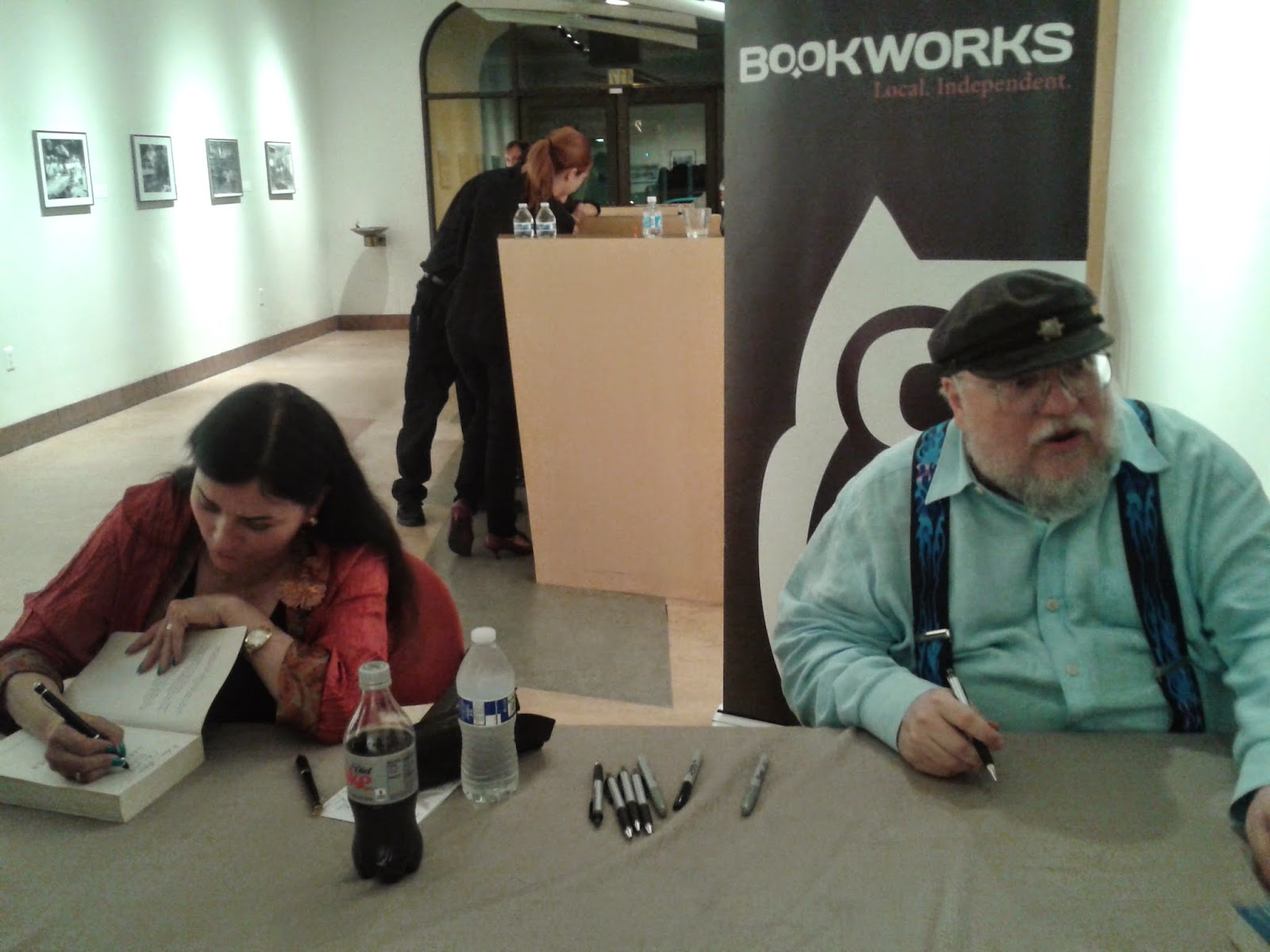
Diana Gabaldon and George R. R. Martin signing autographs

About their use of language:

Since Martin’s novels are set in a “quasi medieval world” he had to find a balance between modern syntax (so the audience wouldn’t be lost) and flavoring his text with archaic words to give the novel a proper context and avoid anachronisms. He called this the “common tongue of all fantasy novels.” He initially overused words like “mayhaps” or “forsooth,” but his editor objected. They reached a compromise by having the older characters use these terms and the younger ones employing a more modern language—as it tends to happen in real life.

Martin did not invent languages the way Tolkien did (he joked that Tolkien wrote The Lord of the Rings just so he could use his languages) but he made up five words of High Valyrian, and will make up a 6th if necessary. For the show, however, whole languages had to be invented since you can't just say, "She said in High Valyrian." Now when he writes a scene, he has to call HBO to ask how a character might say something in whatever language. The show hires people whose hobby is to invent languages with proper syntax and grammar to develop Dothraki and High Valyrian. As a funny anecdote, Martin mentioned that a fan once requested a High Valyrian dictionary.

Gabaldon mentioned that she has a few translators who help her with Gaelic, and she loves the sound of it.

About their TV shows:

Gabaldon announced that the Outlander series is now in production. The producer, who had previously worked in Battlestar Galactica, took two days to talk to her about the show. They decided that as a prologue, they would show a scene of Claire in a military hospital during WWII. Gabaldon had a blast inside the “Outlander world.” She admitted that at first she didn’t like the actor selected to play Jamie Fraser, but after seeing his audition she knew he would be absolutely perfect for the role (even though he accidentally said "OK" during a scene where Jamie was being pressured to marry Claire).

It took a lot longer to find Claire and poor Sam had to go through innumerable "chemistry tests.” Eventually, they found an actress who had the right chemistry with Sam and would play the perfect Claire. When someone asked Gabaldon if she would like to write for TV, she confessed she’s not a team player and likes to keep control of her writing.

Martin, on the other hand, mentioned that he writes one script per season and would love to write more, but he has yet to finish two 1500-page books. Yeah, you read correctly.

What’s interesting is that both shows will share actors. Apparently the BBC has churned out twenty or so actors, who participate in everything involving an English or Scottish accent. Every single one of them is in Game of Thrones, and, according to Martin, will appear in the Outlander series after they are killed off from GoT. (Ha!)

Anecdotes and questions:

Martin was asked which part of Westeros he'd choose to live in, if he could. He said Dorn. "It's warm, the women are warm and the food is spicy. It's New Mexico!"

Gabaldon mentioned that during an interview with a German reporter, tired to keep her tongue in check, she said she loved a man in a kilt because "you know he could have you up against a wall in 30 seconds."

When asked about their thoughts on self-publishing, neither one of them recommended it. Martin said writers are supposed to write, not publish or market books. He commented how sad it was to see writers desperately trying to sell their work in Bubonicon conferences and such, and how people often avoid them. Martin thinks that self-publishing is only a good idea for well-known authors whose names alone sell books.

They both acknowledged that it’s not easy to break into publishing, but the only thing a writer can do is keep writing.

In spite of the fans who wanted hints about how both series will end, neither Gabaldon nor Martin said a word. The only thing Gabaldon admitted to was having written the last scene ten years ago. “How I will get there is an entirely different question,” she said.


On a side note:
 
This has been a year of changes and exciting new opportunities for me. I would like to share some of them with you, my dear readers. First, I have a new agent for my generational saga (the first novel I wrote) the awesome Liza Fleissig of the Liza Royce Agency! Last but not least, my historical novel, The Black Letter, has made it to the Amazon Breakout Novel Contest Quarter Finals! If you’d like to take a look, you can find an excerpt here
 

Sunday, September 22, 2013

Nerd Love

Hi. I'm Stephanie, and I'm a nerd.

If you were born before 1970, you probably read that as a sort of whispered confession. If you were born after 1980, you probably read it as a boast. (In between? Depends on how tapped into pop culture you are.)

To be a nerd is no longer something to be ashamed of. Nerds are out, loud, and proud. We recognize fellow nerds immediately, not by the pocket protectors but by the Firefly t-shirts and Star Wars stick-figure family decals on our cars. Nerd culture is a phenomenon that coalesced over the last decade, and it has less to do with social awkwardness and über-braininess than with shared interests. Nerds love the same things, and we love them passionately. Most of those things revolve around media: the TV shows, films, comic books, video games, and novels we consume.

Is your dog an AT-AT? Because mine definitely is.

And that's where you come in, dear writer: nerds tend to love the certain stories, and build our culture around that shared love. If you drop a Doctor Who reference into a crowded room, you can spot the nerds as the ones who respond automatically and joyfully to the reference. Start singing "The Hero of Canton" and any proper nerd will be compelled to sing along with you. Anything that comes up routinely in The Big Bang Theory results in an almost Pavlovian response from nerds.

If you get this reference, you are a nerd.

To get into the Nerd Canon, you'd probably have to write speculative fiction, which of course narrows things down considerably. But spec-fic isn't just sci-fi: Game of Thrones and Lord of the Rings, both longstanding staples of nerddom, are fantasy. Firefly is space fiction, not science fiction. Comic books are huge for many nerds (if you want to find the single biggest concentration of nerds in one place, attend a ComicCon), and are arguably speculative fiction. But much of nerd culture does center around sci-fi: Star Trek and its associated rabid fandom was really the progenitor of nerd culture as a cohesive thing.

ComicCon cosplay
When a few of my nerd friends came across John Scalzi's Redshirts, it became almost a requirement that the rest of us read it. Same for Ernest Cline's Ready Player One. I discovered Hugh Howey's Wool series earlier this year, recommended it, and within weeks it seemed all my nerd peeps had acquired and read at least the first book. Robin Sloane's Mr. Penumbra's 24-Hour Bookstore only has the barest hint of speculative fiction, but is about nerds—and became widely read by that demographic.

From a marketing perspective, the best thing about nerds is that we are both obsessive and we often have resources to devote to those obsessions. Whether you are a consumer of nerd content or a creator of that content, you're part of a powerful (and growing) economic and cultural force. Chances are, even if you don't self-identify as a nerd, your entertainment is being shaped increasingly by those who do cheerfully consider themselves part of this influential culture.

How about you? Do you self-identify as a nerd? Do you see nerddom as changing the face of popular culture?


Sunday, August 25, 2013

Spoiler Alert: Juliet Dies


Because we get most of our TV streamed from Netflix or Hulu, we are always behind on everyone's favorite shows. I am all caught up now on Downton Abbey, but we did not watch the season finale with everyone else. Only it almost felt like we did, because everyone was live-tweeting the thing as it unfolded. And when that big shocker ending happened, the entire Internet gasped in unison. I couldn't have missed it without going on a total information blackout till the hubbub died down. 

That said, most people were extremely careful not to reveal the exact nature of the shocker, because we've all been indoctrinated not to spoil endings — or at least to write "spoiler alert" before we give anything away. This rigid social training helps protect that delight we all feel at the totally-unexpected plot twist. After all, why do we keep turning the pages? To find out what happens next. Even if we're not anticipating a twist, we get invested in a story because we want to know how it all turns out.


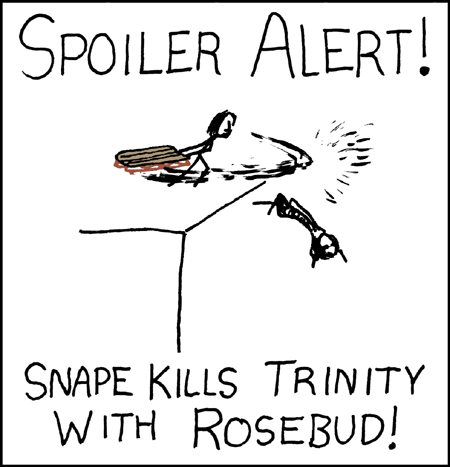
But have we gotten a little too fanatical about spoilers? I got hollered at not long ago after I revealed a detail of Philip Pullman's His Dark Materials trilogy. For a few minutes I felt horribly guilty, then my guilt shaded into annoyance. That series was published in the mid-1990s: if you wanted to be kept in the dark about all the plot details, why have you waited so long to read the dang books? How long do we have to keep book contents secret? Guess what: Cleopatra hugs an asp (I just spoiled the ending of Antony and Cleopatra). The South loses at Gettysburg (I just spoiled the ending of The Killer Angels). Rosebud is a sled (I just spoiled one of the biggest — and weirdest — reveals of all; although I will refrain from mentioning which story I'm referring to in case you've been living off the grid since 1941).


I do get that big twists can "ruined" by a premature reveal, but surely there's a statute of limitations on spoiler alerts. If they are old enough and famous enough, stories are pre-spoiled for us — do Adam and Eve live happily ever after in the Garden of Eden? Shhh! Don't tell me! And yet, knowing how it ends, we read the story anyway. There's even some evidence that knowing how it ends adds to a story: think of the literary device that puts the epilogue as prologue: you start with the shocker ending, and the whole point of reading the story is to find out how we got there.

In addition to getting people mad at you, spoiler fanaticism has another downside: it prevents us from discussing the stories we love. I finished Jojo Moyes' Me Before You recently, and I so wanted to discuss it with friends who'd also read it. But I couldn't, because to do so might have "spoiled" the book for those who haven't read it. The only way around this is to create rigid book-discussion groups, either online or off, where select people seal themselves off to discuss a book. But the formality of these private groups kills something you get from a spontaneous public discussion. On Facebook or at a social gathering, I'd like to be able to say something about Nick and Amy in Gone Girl, or talk about who died in the last episode of Game of Thrones. (You know someone's going to bite it.) But I can't risk it. People get seriously upset. I've seen less rancor in religious debates than when someone accidentally mentions — spoiler alert! — what happens to Wash in Serenity.

"I'm a leaf on the — whoops, wrong show!"

In short, I think spoiler alerts are considerate, especially when a story is new and the twist is huge. But I don't think it's reasonable to expect all aspects of a plot to be completely sealed off from you until you get your lazy behind around to reading or watching the thing. (She says, with the utmost affection.) If you don't know that Wesley and the Dread Pirate Roberts are the same person, don't be angry at the person who let this slip at a dinner party. Be mad at yourself for not watching The Princess Bride sooner.

How do you feel about spoilers? Are you in the "never ever" camp, or do they not bother you so much? Do you think spoiler sensitivity has gone too far—or not far enough?


via the comic "xkdc"


Sunday, December 16, 2012

So Long, Farewell, Auf Wiedershen, Goodbye:Violante Departs with One Last Word on Blogging


It is with a heavy heart that I bid goodbye to the Sisterhood, this blog and my anonymous audience. After two terrific years, the time has come to leave. Due to circumstances beyond my control, it will be impossible for me to continue contributing monthly posts.  So, I must cease being a blogger, which by no means stops me from being an avid follower, reader and commentator.

Looking back with affection, I realize that belonging to the Writing Sisterhood has been an über experience, one that has taught me plenty and not only about writing and writers. It has taught me about blogging and what to expect from it. I am tired of hearing that the Blog Age is over, that only video blogs have any hope in the age of Tumblr. Hey, I once heard Facebook would die with the advent of Twitter, and that blogs would kill forum life forever. Time has proved wrong all those prophecies.


Undoubtedly, there are more blogs than readers out there, but blogging is still a fairly respectable activity, as long as you abide by certain rules. First rule:  never blog about “everything.” The days of blogs that covered every subject under the sun are passé. A blog must always stick to a particular topic, but don´t make it too general or too specific.

My blog Latinas Del Ayer was meant to cover a myriad of issues concerning how women lived in Latin America in the first half of the Twentieth century.  The amalgam of subjects, ranging from fashion to entertainment, turned out to be too broad.  It confused the readers and I never got faithful devotees.

Around that same time, I began to compose another blog, this time I devoted the place to Fantasy Fiction.  Although the posts covered film, books and television series, I soon recognized that “thronies” and “fangbangers” were my audience. I began to pen weekly recaps of “Game of Thrones” and “True Blood.” Even after the seasons were over, I continued increasing my clientele by devoting 80% of my material to A Song of Ice and Fire matters. Since there are several” Game of Thrones” blogs around, I didn’t want to turn mine into a GOT site. My solution was to alternate the ASOIAF entries with posts on fictional vampires, witches and, that ever lasting favorite, Harry Potter.

As a blogger, your most important concern should always be your audience: who do you write for? What do they need? Thanks to Google search terms you may attract tons of visitors, but what matters is to entice them to become permanent guests. I absolutely agree that in order to gather a large following, the blogger has to visit and participate in similar blogs. It´s how I built a nice set of devotees in my first blog, but for some reason it didn’t work with my Fantasy Blog. Either some bloggers were not aware of the “reciprocal visiting card” rule or were not into creating a community.


There are many misconceptions and Murphy´s laws about how to blog properly, but one point that everyone agrees upon is that a blog is nothing without constant visitors. Apparently, there are three steps to achieve traffic and followers:  post often, post brief and post new.  Hogwash!

Sure, tons of people visit blogs every morning to watch the hottest video. In our audiovisual-oriented, semi-illiterate, attention-deficit afflicted culture, videos are fantastic. They demand less time, less intelligence and less attention to enjoy them. However, if a hundred blogs (plus YouTube) are showing the same video, who could want to visit them to watch the identical thing over and over again? It just doesn’t make sense.

This problem applies to written news as well. With so many places devoted to newscast activity, it´s a waste of time to wander from blog to blog reading similar accounts. Back in the early Twentieth-First Century, blogging revolutionized journalism, because blogs added editorial comments to every scoop. Soon users flocked to blogs just to share or challenge the blogger’s opinions. This is what made blogs so popular and so exceptional. Alas! That art seems to have lost its way in the days of up-to-the-minute, condensed, and frequently blogging.


Joining the race to get the “latest” bit in your blog seems like a futile exercise.  I am not an advocate of the “new” especially if your blog is, like mine, a place in search of “unique.” That is a term used in my last job to refer to regular customers who commented regularly on whatever you posted. Those people are rare, precious and difficult to fish. From experience and observation, I can assure you, they don’t care for “the latest.” They crave inventive opinions, a good blogging voice, and shared tastes rather than flashy and bizarre posts. They don´t mind reading a page or more when the content and writing are of quality.


When it comes to length, I have to declare myself guilty. I do tend to get carried away, but I also like to read meaty and comprehensive posts. Although I´m trying to condense my articles, I have come to the conclusion that half-a page posts, regardless of its subject matter, are useless.  An effective piece should take you a page and a half to express it, but unless the topic merits a longer exposition, keep it under the four-page limit.

Regular posts are also an issue. Although, the consensus among the Sisters is that we are extremely proud of our blog and its achievements, I think that if time had let us, we could have posted more often. However, work, family obligations, and the fact that some of us are joggling personal blogs as well as this one, prevented us from bringing more frequent contributions.

Nevertheless, beware of the word “frequent." Three juicy weekly posts are more than enough. Daily long entries will exhaust your creativity and drown readers with too much data, thus diminishing your chances of getting useful sensible comments and encouraging the desired debate.

My last advice has to do with “unique voice,” a rather abstract concept that keeps coming to my mind when I ran into a blog so welcoming that makes me want to tarry. I believe that each of this Divine Blog’s founding Sisters owns a personal voice (opinion, writing style, etc), and that is our greatest asset. But if you are running a one wo/man blog then you’ll have to find your own way of making it an outstanding place. 


Talented bloggers may enhance their place with their own visuals whether is artwork, personal photographs or home-made videos, and then there are those that are constantly coming up with contests and games.
What happens if you are not artistically gifted or lack the imagination to create contests?  Then you have to rely on subtler ways of making your blog unique. Look around at similar blogs.  What are they lacking? What it’s missing from them that could attract customers? What demographic group they are not targeting? Fliling a gap can make your blog stand out among others that address analogous subjects.


One last word before leaving this fabulous spot.  If I learned something from the company of my Sisters, it’s the importance of courtesy and hospitability in running a blog. I was terribly moved when a dear friend and former boss described the Sisterhood as “a cozy, warm place where ladies could drop for tea.” So I strongly advise those who read me to continue enjoying the welcoming atmosphere of this blog and to recreate it when building a space of your own. G-d bless you all!

Do you blog? Share your experience and tips on how to make a blog a special place.


Sunday, July 15, 2012

Kick-Ass Girls, Conniving Witches and Submissive Whores: Images of Feminine Power in Contemporary Fiction.


Recently, a friend of mine announced to me in an excited voice that finally literature had given up on stereotypical portrayals of women.   When I expressed surprise at her statement, she mentioned Stieg Larssen’s Lisbeth Salander as a mold-breaking protagonist who encompasses feminist values. I shrugged away her comments. I can hardly think of a tattooed hacker as a role model and the more I look around I find heroines in mainstream and genre novels still shaped according to old-fashioned masculine fantasies and girlish fears.

I know that, despite my protestations, many do see in Lisbeth Salander an ideal heroine, one that leases female and masculine readers alike.  After all, she is modern men’s fantasy girl. Thin, lean, flexible of body and covered with tattoos and piercings, she fulfills contemporary notions of feminine beauty. She is a computer wiz, fiercely independent, and she “kicks ass.” Moreover, at an age where most men seem to get excited at the sight of girls necking with each other, Lisbeth is bisexual. She doesn´t need men, she doesn’t want to be supported by men, she doesn´t demand protection or commitment. Even women could be attracted to her because she tramples on everything that makes us weak: romantic love, dependency, fear of physical or sexual violence and a legal system that is not always kind to the female sex.


If Lisbeth is the ideal contemporary heroine then her complete opposite should be Anastasia Steele, the flaky protagonist of the Shades of Grey trilogy. Since Shades could only be classified as erotica, it´s sad to know that, in 2012, the genre still uses clichés created by the Marquis de Sade in the 18th century. Like De Sade’s Justine, virginal Anastasia surrenders completely to a handsome rake who abuses her to his heart’s contentment.


 Anastasia agrees to become millionaire Christian Grey´s sexual slave only because he is sexy, good-looking and wealthy. Hey! After all isn’t that what women crave? Gorgeous dude, great in bed and a good provider? But those attributes don´t cloak the fact that Shades is a remake of the old rape fantasy. More than a female fantasy, Shades is the sum of all feminine fears.

In fantasy rape, the fantasists always enjoyed the act, and so does Anastasia. She derives pleasure from Christian´s abuse even when it evolves into sexual violence. Because, despite what its advocates claim, the multiple BSDM scenarios in the book could only be describe as violent. In a milder scene that takes place inside an elevator, Christian tugs Anastasia’s hair while kissing her roughly. She relishes it! I would be gouging the eyes of any creature that messes with my hair!


Many try to sell BDSM erotica as examples of “women empowerment.”  I can’t think how being spanked, mocked and tied-up constitutes “empowerment” especially since Anastasia not only enjoys her “master’s” attentions. She is also getting regular injections of cash that swells her bank account. Yes, the submissive whore stereotype is doing quite well in the bestsellers list.

What really blew my mind about 50 Shades of Grey were not its idiotic protagonists, but the fact that it was based on the author´s fan fiction...about Twilight! I can´t picture chivalrous Edward pulling a tampon off Bella’s vagina, but obviously E.L. James does, and so do the detractors of Stephanie Meyer's saga who claim that Bella is a “submissive” heroine. Odd, I must have read another story because she didn’t strike me as such. What I did notice is that Bella and Sookie Stackhouse of Charlene Harris’ vampire stories are damsels in distress, always in need of werewolf and blood-suckers paramours to come to their rescue. It gives the impression that paranormal romances are all about frail heroines. Does that apply to the Fantasy genre in general?


Unprecedented literary success has brought George R.R. Martin a nice bunch of critics, feminists among then. For a couple of  entries in my Fantasy Blog I found and read several articles discussing different aspects of Martin´s misogyny and the negative handling of feminine characters and female power in his Song of Ice and Fire. Some critics seem to resent the fact that Martin’s strong, independent women like Melisandre, the sexy conniving witch, and Cersei, the sexy conniving queen, are portrayed as evil.


Critics, and not only feminists, have the bad habit of imposing modern moral standards upon historical fiction or fantasy texts. Martin´s women, good and bad, are pretty strong for the barbaric patriarchal world they inhabit. And because it is Epic Fantasy, Martin even includes an ancient archetype, the kick-ass, cross-dressing, warrior maiden, Lisbeth Salander’s medieval equivalent. The saga is pitted with girls that dress like men and fight like men such as Arya Stark, Asha (Yara in the TV series) Greyjoy, Ygrette, the Wilding, and, my favorite, Brienne of Tarth.

Born a lady, Brienne’s plainness (and the fact that she is taller and stronger than the knights in her realm) makes her unlikely marriage material. So she trains to be a knight. When she falls in love with King Renly, she goes to his court to serve him as a squire- bodyguard, knowing he could never reciprocate her feelings (aside from being married, Renly is gay).) What´s interesting about Brienne is that she kills men, is very skillful with her sword, and is terribly strong, but she is far from a virago. For someone who dresses like a man, she is quite feminine. She is shy, sensitive, naïve and she loves troubadour’s songs as much as Sansa Stark (Westeros epitome of refined femininity) does.


Like Lisbeth Salander, she hurts men who hurt women, but unlike The Girl with the Dragon Tattoo, Brienne is not a stone wall: she cries, feels sorry for Jaime (with whom she is obviously falling in love) and appreciates the positive aspects of her sex as when she pledges her service to Catelyn claiming to admire Lady Stark's “woman’s courage.”


It is interesting that Martin shows women as both destroying and creating forces, as helpers as well as enemies of the men that love them. Curious, because modern literature insists in presenting women as connivers and bringers of sorrow.  In Ian McEwan’s Atonement, poor Robbie Turner is destroyed by two women, one he loves, one who loves him. Robbie has been aided in his studies by the Tallis Family, his mother´s employer. However, in the closely structured British class system, he is constantly reminded of his place, especially by Cecilia, the Tallis eldest daughter. On the other hand, he befriends little Bryony, Cecilia´s sister, a precocious would-be-writer who develops a crush on him.


After seeing half-naked Cecilia taking a dunk in the garden’s fountain, tumescent Robbie writes an embarrassing letter describing his feelings towards her. Bryony finds the letter and is shocked by Robbie’s sexually explicit language. She sublimates her jealousy into fear by making herself believe Robbie is a deranged pervert. After seeing him and her sister making love, Bryony is convinced he is dangerous, and when her cousin gets raped in the woods, Bryony accuses Robbie, who is sent to jail. Although Cecilia believes in his innocence and stands by him, there is a sense that her bewitching beauty caused Robbie’s downfall and that his life could have been much better if he had never met these dangerous sisters.


We can’t accuse Ian McEwan of being impartial to women when female authors play the same game. In 2001, the same year that Atonement came out, Philippa Gregory published The Other Boleyn Girl a fictionalized view of Henry the Eighth’s second marriage.  The plot follows Ann and Mary Boleyn’s rivalry for the love of King Henry who casts away loving Mary in order to marry her ambitious sister. For some reason, most novelists tend to be unfair to Ann Boleyn. Indeed she meddled in politics and religious affairs, but she was also a patron of the arts, and no more ambitious than most high-class ladies of her day. Her sister Mary had several lovers before getting into King Henry’s bed, and by the time Ann came to Court, her royal affair was over.


In the book, Ann and Mary are loving sisters despite their different characters. Anne is strong-minded and rebellious. As he mother puts it, she is used to get what she wants just by “stomping her little feet on the ground.” Sweet and obedient Mary is happy to be married to a not very bright young squire. Henry visits the Boleyn Manor and Thomas Boleyn pushes a very willing Ann into the king’s path. Although Henry is taken by her beauty, he resents Ann´s facetious willfulness and sets his eyes on demure Mary. When the men in her family (including her own husband) prod Mary into the royal bed, she has no option but to comply. Eventually she falls in love with the king, who enjoys her meekness, thus she becomes his submissive whore, but not for long. By the time Mary is bedridden with pregnancy, Ann is back.


With ruthless ambitious and cruel vindictiveness, Ann does everything in her power to lure Henry away from her sister. Se does not want just to be a mistress; she becomes queen by withholding her sexual favors from the king. Driven by lust, Henry divorces Catherine of Aragon, Mary is forgotten, but Ann never gets her husband´s love. Her willful ways, constant tantrums and inability to provide him with an heir, soon bore the King who has Ann put on trial. The many charges include sorcery since only under her conniving spells could the King have committed so many follies.


Ann loses her head for being a tempting witch while her sister fares better; Mary keeps her life and fades into oblivion. The novel seems to have two morals:  is better to be a submissive whore than a bewitching sorceress, and when it comes to men, women will trample upon their own sisters. After glancing over these images of “powerful “women, I rather stick with Lisbeth Salander.

Could you think of examples in recent literature of female protagonists that are good role models? What about your heroines? How do you make them strong yet appealing?

Malena (Formerly known as Violante)