Showing posts with label Interviews. Show all posts

Sunday, May 18, 2014

A Word with Diana Gabaldon and George R. R. Martin

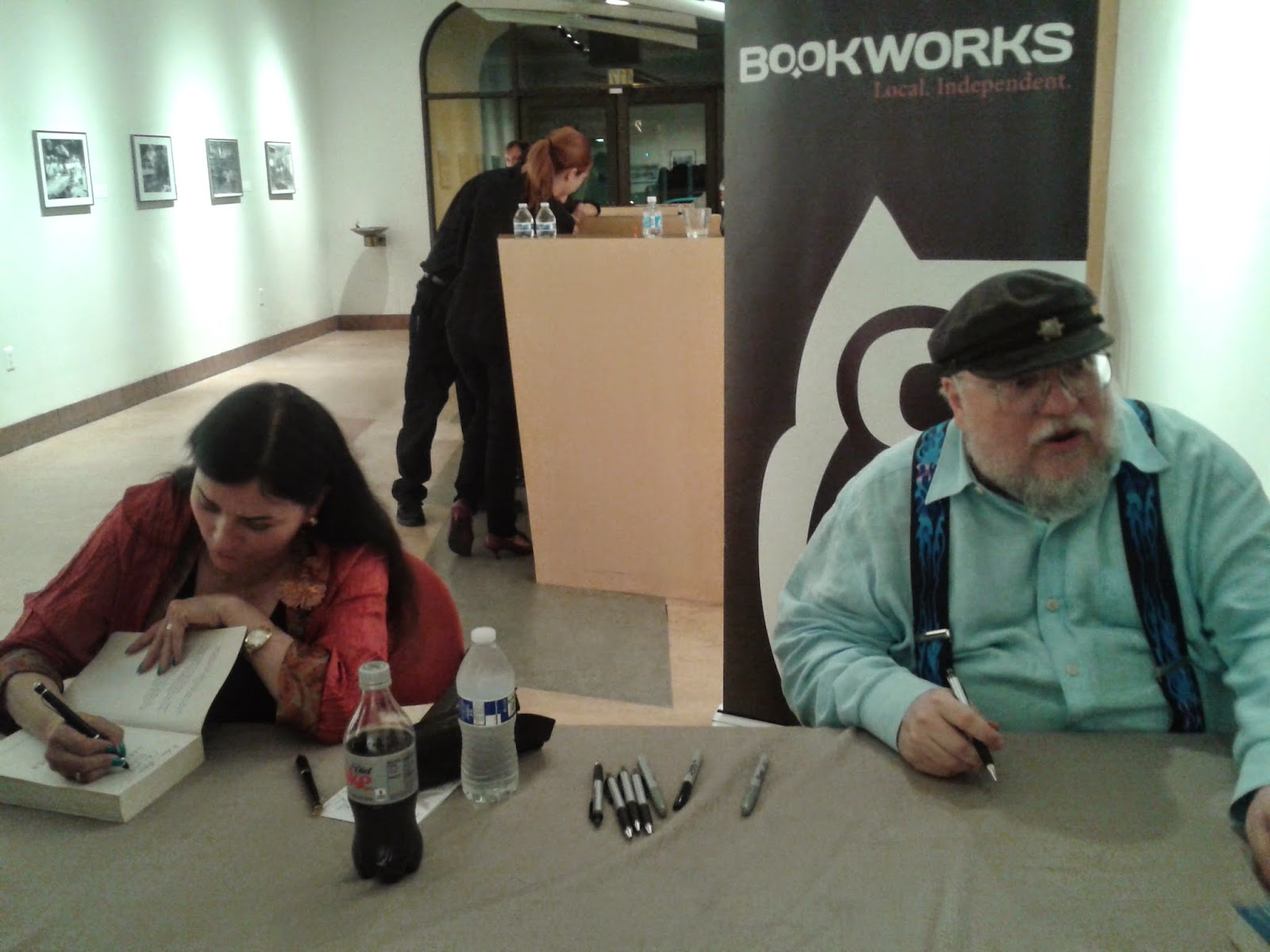
Last weekend, my writing sisters and I attended a fun event sponsored by our city library and a local bookstore. A Word with Writers consists of a candid conversation between two acclaimed authors who share experiences and anecdotes about their writing. The inaugural lecture featured none other than the beloved Diana Gabaldon, the author of the Outlander series, and George R. R. Martin, the brains behind the successful Game of Thrones. They both had a lot to say about what inspired their work and what their writings processes are like. Here are some of the evening’s highlights.


About their backgrounds and what inspired their books:

Gabaldon’s background is very interesting because she’s a scientist with degrees in zoology, marine biology and ecology. She blames her father for this copious amount of studying since when she was young, he had told her that she was a “poor judge of character” and would probably marry badly. To avoid a life or poverty, he recommended that she became a self-reliant professional. Gabaldon obediently got her PhD.

In her mid-thirties, Gabaldon decided to write a novel, more as practice than anything (she didn’t intend for anyone to read her work). Since she was so good at doing research and she liked history, she decided it would be a historical novel. Now the only question was where/when should she set it? The answer came to her while she was watching an episode of Dr. Who and spotted a man in a kilt. She was so taken by this man that she decided to write about a Scotsman. Being that a novel requires conflict (to her own admission, this was all she knew about novel-writing) she settled on the Scottish wars against England during the 1700s. Of course, she needed a woman to create some sexual tension with this beautiful man. Claire came to Gabaldon through an image of a woman in a cave full of men. She was English and very different from other 18th century women. When Claire opened her mouth, she recited her full name. There was nothing Gabaldon could do to tame her modern spirit. She fought with her throughout the novel, but eventually gave up and told her: “Go ahead and be modern, I’ll figure out why later.”  In that sense, she confesses, the time-traveling element in Outlander was an accident.

In contrast, Ser George had always been a writer and a reader. He was a Sci Fi, Fantasy and Horror fan—which used to be the same genre—and as a child, he wrote and sold horror stories to other kids. He eventually earned a master's degree in journalism. For many years, he worked in Hollywood as a TV writer in shows such as The Twilight Zone and The Beauty and the Beast, but there came a time where he wanted to work on his own stories, and so he turned to novel writing. When asked about his inspiration, he mentioned Tolkien as a big influence.

About their writing processes:

Martin offered an interesting analogy for writers. He said there are two kinds of novelists: gardeners and architects. An architect designs a blueprint, plans how he’s going to develop it and then does it. A gardener digs a hole in the ground, throws seeds and water, and hopes something will grow. Martin admits he’s a gardener. When he started A Song of Ice and Fire, he didn’t have a clear idea of where he was going with the story. All he had was the first scene and characters who kept telling him what they wanted. But characters can be treacherous, he says, and like a gardener he sometimes has to pull out weeds—which might explain why he kills so many of them!

Following the same analogy, Gabaldon also calls herself a gardener. However, her process is not linear, like Martin’s, but “organic.” She gets an image in her head and fleshes it out into a scene. Once she has several chunks, or scenes, she stitches them together into a narrative. She admits that when she started she didn’t know anything about writing novels (she had, however, written a 400-page dissertation). So she set two rules for herself: a) she wouldn’t stop, no matter what, and b) she would do the best she could.

Before she was done with the first Outlander book, she found an agent who was so taken with her story he signed her on right away and sold her book in four days. She didn’t originally plan to write so many sequels, she just knew that “there was more.” Her agent originally got her a three-book deal, but the novels kept coming.  Her writing is so accidental that her next series following the adventures of Lord John, a secondary character in the Outlander series, came about because she was invited to participate in an anthology of short stories. Since she didn’t want to interfere with Outlander’s main characters and plot, she thought of Lord John—who then took a life of his own.

Martin agreed with Gabaldon in that he didn’t plan to write such a long series either, but he was happy to do it since readers nowadays love to follow characters for 10-15 years. He says his entire series is one continuous story told in several books.


Diana Gabaldon and George R. R. Martin signing autographs

About their use of language:

Since Martin’s novels are set in a “quasi medieval world” he had to find a balance between modern syntax (so the audience wouldn’t be lost) and flavoring his text with archaic words to give the novel a proper context and avoid anachronisms. He called this the “common tongue of all fantasy novels.” He initially overused words like “mayhaps” or “forsooth,” but his editor objected. They reached a compromise by having the older characters use these terms and the younger ones employing a more modern language—as it tends to happen in real life.

Martin did not invent languages the way Tolkien did (he joked that Tolkien wrote The Lord of the Rings just so he could use his languages) but he made up five words of High Valyrian, and will make up a 6th if necessary. For the show, however, whole languages had to be invented since you can't just say, "She said in High Valyrian." Now when he writes a scene, he has to call HBO to ask how a character might say something in whatever language. The show hires people whose hobby is to invent languages with proper syntax and grammar to develop Dothraki and High Valyrian. As a funny anecdote, Martin mentioned that a fan once requested a High Valyrian dictionary.

Gabaldon mentioned that she has a few translators who help her with Gaelic, and she loves the sound of it.

About their TV shows:

Gabaldon announced that the Outlander series is now in production. The producer, who had previously worked in Battlestar Galactica, took two days to talk to her about the show. They decided that as a prologue, they would show a scene of Claire in a military hospital during WWII. Gabaldon had a blast inside the “Outlander world.” She admitted that at first she didn’t like the actor selected to play Jamie Fraser, but after seeing his audition she knew he would be absolutely perfect for the role (even though he accidentally said "OK" during a scene where Jamie was being pressured to marry Claire).

It took a lot longer to find Claire and poor Sam had to go through innumerable "chemistry tests.” Eventually, they found an actress who had the right chemistry with Sam and would play the perfect Claire. When someone asked Gabaldon if she would like to write for TV, she confessed she’s not a team player and likes to keep control of her writing.

Martin, on the other hand, mentioned that he writes one script per season and would love to write more, but he has yet to finish two 1500-page books. Yeah, you read correctly.

What’s interesting is that both shows will share actors. Apparently the BBC has churned out twenty or so actors, who participate in everything involving an English or Scottish accent. Every single one of them is in Game of Thrones, and, according to Martin, will appear in the Outlander series after they are killed off from GoT. (Ha!)

Anecdotes and questions:

Martin was asked which part of Westeros he'd choose to live in, if he could. He said Dorn. "It's warm, the women are warm and the food is spicy. It's New Mexico!"

Gabaldon mentioned that during an interview with a German reporter, tired to keep her tongue in check, she said she loved a man in a kilt because "you know he could have you up against a wall in 30 seconds."

When asked about their thoughts on self-publishing, neither one of them recommended it. Martin said writers are supposed to write, not publish or market books. He commented how sad it was to see writers desperately trying to sell their work in Bubonicon conferences and such, and how people often avoid them. Martin thinks that self-publishing is only a good idea for well-known authors whose names alone sell books.

They both acknowledged that it’s not easy to break into publishing, but the only thing a writer can do is keep writing.

In spite of the fans who wanted hints about how both series will end, neither Gabaldon nor Martin said a word. The only thing Gabaldon admitted to was having written the last scene ten years ago. “How I will get there is an entirely different question,” she said.


On a side note:
 
This has been a year of changes and exciting new opportunities for me. I would like to share some of them with you, my dear readers. First, I have a new agent for my generational saga (the first novel I wrote) the awesome Liza Fleissig of the Liza Royce Agency! Last but not least, my historical novel, The Black Letter, has made it to the Amazon Breakout Novel Contest Quarter Finals! If you’d like to take a look, you can find an excerpt here
 

Sunday, March 23, 2014

Interview with Agent Christa Heschke


Hey, writers! Looking for an agent to represent your YA/NA/Children's book? Agent Christa Heschke of McIntosh & Otis, Inc. is still open to new clients, and she has kindly agreed to answer my questions about her preferences and the current state of the publishing industry. Check out what she has to say and get those query letters ready!

Hi Christa, welcome to The Writing Sisterhood!


Q: Writers are always curious about what goes on behind agencies’ closed doors. Could you share with our readers what a day in the life of a literary agent is like?

A: Every day is very different, as we’re a full service agency, so we handle pretty much everything for our authors personally, such as contracts, foreign rights and other subsidiary rights (some agents have different people at their agency who do these types of things for them and don’t handle personally). Each day generally starts with me going through my emails, answering questions, checking in with editors on submissions, payments etc. then throughout the day I’ll have phone calls, meetings and lunches with editors, negotiate deals, work on contracts etc. Of course, all of these things don’t happen every day, so this is just to give you an idea of what may cross my desk.

Q: About how many submissions do you receive per week? What do you look for in a query letter? 

A: About 75 submissions a week, sometimes more. Well, first thing I look for in a query is that it’s a genre I am currently looking for. My current wish list is on my blog and on the M&O website under Agents.  Next, I look to see if it’s something that’s new or different. If you send me something that sounds like a knockoff I likely won’t read on. Make sure your letter is professional and not too conversational. I’ll also look to see if the project is a standalone or a series and if the author has written anything else or has a website so I can learn more.

Q: Will you be open to adult fiction in the near future? 

A: No. We have two great adult agents here. If I ever were to fall in love with an adult project I would co-agent with one of my colleagues. The adult world and children’s world are very different and working in children’s I’m not regularly meeting adult editors or expanding my contacts there.

Q: What is one of the most common problems you see in the manuscripts you receive?

A: I still see a fair amount of projects that are trying to chase trends. If you’re writing something only because you think it will sell a lot of copies because it’s similar to Twilight and Twilight sold a lot of copies you’re often hurting your own chances. Writing for trends can lack passion. When you have an idea for a novel and can’t get it out of your head, that’s passion. You’re not thinking of the endgame, just that you need to write it. Those are always the best books, if you ask me, and you can feel it when you read. Writing for trends can be formulaic and it’s often too late. Books take 18-24 months to publish on average and if there are already 10 books on mermaids and you’re only now writing one, many editors may have already had their fill of it.

The other problem I see a lot is a story that reads like a first draft and isn’t fully realized. Find critique partners or have a friend read your novel before sending it out. It’s best to send a project that has gone through revisions and is as good as you think it can be before sending to agents.

Q: Would you take on a client based on his/her potential even if the manuscript is not ready to be sold? 

A: Yes! I have never instantly sent out a manuscript after taking on a client. We always at least do a bit of tweaking. I wouldn’t take something on though that needed a lot of work. If I liked it and saw potential I’d likely ask for a revise and resubmit. It’s important to make sure an author is good at revision before taking them on.

Q: Why do you think YA fiction has become so popular in the last few years? There also seems to be a preference for fiction with supernatural/fantastic elements. Do you think these trends will continue for much longer? 

A: YA fiction is often hopeful. It’s about teens who are at the beginning of their lives. There’s so much promise. It’s about growth and becoming who you’re meant to be, first experiences and making mistakes. Anyone can relate to that even as adults. It’s just so accessible and often more fast paced than an adult novel. Depending on who you ask, the response will probably vary, but those are some of the main things. Paranormal and dystopian is on the way out; we’re seeing ends to series mostly in these genres now and I can’t think of too many editors or agents looking for it. In fact, many are specifically saying they aren’t considering it.  Not too many standalones or beginning of series these days.  I think everything is shifting back towards contemporary, but I also think people are trying to figure out what the next big thing will be. Magical realism is pretty highly sought after. There’s been some sci-fi, horror, thriller and light fantasy that has been doing well and editors and agents are still looking for those genres.

Q: Writers are often times frustrated with how difficult it is to get the attention of industry professionals. What do you think is the most effective method for a writer to get noticed: conferences, blogs, query letters, contests? 

A: That’s a hard question. Meeting an editor or agent at a conference certainly helps as we generally will put priority on those submissions.  Networking is always helpful. Join writing groups or book clubs with other writers. If any of the writers are published or become published they may recommend you to their agent. Referrals always get priority. Send your best work. It likely won’t be that first novel. Many writers have several novels under their belt before submitting to agents or editors. You keep getting better with practice. Make sure the book you submit is polished and as good as it can be. Have friends and critique partners give you opinions. Sending an agent every project you have isn’t going to get you noticed. Most agents frown on it unless they specifically ask to see more work.  Send the project you think is the best fit for that agent. An online presence is nice to see but it doesn’t sway me either way unless it’s particularly negative towards editors/agents/the industry. Try to keep your online presence professional and positive.   Contests are good too. I’ve found some of my clients that way.  It’s hard work to get noticed and you really have to dedicate yourself to it and not let yourself be troubled too much by rejection. It’s all about finding that right person to champion your work and it may take some time to find them.

Q: How do you feel about writers posting excerpts of their unpublished novels and/or creating websites for them? 

A: I think short excerpts are fine.  It can help get you some readers/fans who will buy your book once you are published.  I don’t think an entire website dedicated to an unpublished book is necessary. I’d stick to an author site or blog and you can talk about your work there. But, be wary as there are people out there who steal ideas so I’d say less is more.

Q: Do you think e-books present a threat to traditional books or they can happily co-exist? 

A: They can happily co-exist. I think there was some worry about it, when they first started becoming popular, but I hope that there will always be those book lovers who enjoy holding a real book. It’s such a different experience.

Q: Finally, what are your top three authors of all time? What are your top three books?

A: That is so hard to answer! I have a lot of authors and books I really enjoy. I always was a big RL Stine fan (Fear Street specifically), I loved Corduroy as a kid and The Teeny Tiny Woman (it’s an early reader). My parents said that I would act it out while I was reading it.  The Hobbit is another favorite. I also am a big Bruce Coville and Garth Nix fan.  Oh and can’t forget Jane Austen!

Thank you, Christa, for those very insightful answers!

For more information about Christa and what she's looking for, check out her blog and her agency's website.

Sunday, February 23, 2014

Interview with Author Delilah Dawson (and Book Giveaway!)

Here at the The Writing Sisterhood we're always happy to welcome other writers and share their successes with our wonderful readers. Prolific author Delilah Dawson has just released her latest novel, Wicked After Midnight and has agreed to answer some questions about her work and her publishing experience. The best part is that Delilah is giving away 3 copies of her e-novella THE DAMSEL AND THE DAGGERMAN! All you have to do is leave a comment below, fill out the quick form and you'll automatically enter the giveway. The contest ends on Saturday, March 1. Good luck everybody! UPDATE: Winners have been chosen. Please scroll down to see if you're one of our winners!


Hi Delilah, welcome to The Writing Sisterhood!

Thanks so much for having me!

Q: Please tell us about your new book. What is it about?

A: Wicked After Midnight is the final book in the Blud trilogy and can be summed up as steampunk vampire Moulin Rouge. The series takes place in a fantasy world where most of the animals and many of the people drink blood, where pets are clockworks and fashion is dominated by thick corsets, high collars, and gloves. Demi Ward is a blood drinker and circus contortionist from our world who sets out to become a star in the cabarets of Paris. It's a dark, twisty, glittery, sexy adventure.

Q: Could you share what your publication process has been like?

A: I didn't grow up knowing I wanted to be a writer—I assumed that writers were called to their destiny, like doctors or nuns. Then, in 2009, when my second child was almost a year old, I was living on three hours of sleep a night and basically broke my poor brain. All the signals that told me I couldn't write a book disappeared, and I knocked out my first draft in a couple of months. After exhaustive online research and edits, I queried that book, a quirky women's fiction, receiving over 50 rejections and some kind agently feedback that the writing was solid but the story was fatally flawed. I scrapped that book and wrote a middle grade. After over 30 rejections, I received offers of representation from two amazing agents. It was a difficult and painful decision, but I chose the one who handled lots of different genres, since I knew my next book was fantasy for adult audiences. My agent didn't sell the middle grade, but we worked on the fantasy, turned it into a romance, and sold it to Pocket at auction in a three-book deal. That book was Wicked as They Come. Since then, I've sold three e-novellas, a Big Six anthology story, a commissioned comics e-novella, three YA books, and several short stories and comics. I love being an author and finally feel like I'm doing what I was meant to do. More books are always in the works!

Q: Everything supernatural/fantastic seems to be more popular than ever. Why do you think that is? 

A: What I want most in a book is an escape. I don't want to think about mortgages and cancer and PTA dues. I want to be transported away from my worries and straight to a magical place full of possibility and adventure. I like the fast pace and creative worldbuilding of fantasy, and supernatural elements tap into the accepted cultural shorthand to make strange creatures seem familiar. Almost all of my books are built on fantasy, so I hope the trend continues.

Q: Could you explain what exactly is “steampunk”?

A: Steampunk has as many definitions as it does admirers. Some people describe it as Victorian science fiction or like the Wild Wild West movie but... good. Even if people can't describe it, they usually know it when they see it: corsets, top hats, and technology based on gears. The steampunk in my books arose naturally from the worldbuilding. Since all the prey animals, including horses, are vicious predators, the people must travel using trains, dirigibles, submarines, and horseless carriages and keep clockwork animals as pets. The best steampunk, in my opinion, go deeper than just the aesthetics of the Victorian world with cogs glued on and helps to inform the society, mores, fashion, and everyday life throughout the story.

Q: YA has recently become a crossover genre, with more and more adults reading it. That's put pressure on YA authors to write for two distinct audiences in one book. Do you feel that pressure?

A: Yes, but I don't see it as a negative. I like the immediacy, feelings, and excitement of YA books, along with a bit of snark and humor. And I like writing romance with themes of feminism, independence, and falling for men who balance passion with intelligence. Therefore, getting your YA peanut butter in my Romance chocolate is not a bad thing—it's a great thing. I did need some coaching regarding YA dialog, as my brain is definitely stuck in the 90s crossed with now. But I think people who like the Blud series will find the same dark whimsy and adventure with a touch of horror when they read my YA books.

Q: What inspires your stories?

A: Every story is different. Wicked as They Come was inspired by Buffy the Vampire Slayer and the album Like Vines by the Hush Sound. Wicked as She Wants was inspired by a reimagining of Princess Anastasia as the most dangerous woman around. Wicked After Midnight was inspired by my love for Baz Luhrman's Moulin Rouge. And Servants of the Storm, my August YA debut, was inspired by a combination of a trip to Savannah, a girl's picture from a fashion magazine, a viewing of The Tempest, and an afternoon in the basement during a tornado. My agent says I'm like a gun, that if you point me in a direction and shoot, I'll find a target.

Q: If you had to define your work in one word, what would it be?

A: WHIMSYDARK

Q: Who are your three favorite authors?

A: They used to be strangers whose books I like, but now that lots of my friends are authors, this question is far more challenging! If you're looking very simply at the books I wait for all year and read in a big rush the second they're out, it would be Cassandra Clare, Tiffany Reisz, and Diana Gabaldon. If you want a list of the authors who are my favorite people, we're going to need a bigger boat. ;)

Q: What advice would you give writers trying to get published? Did you ever feel like giving up?

A: My best advice is just a reminder that it's not over until you stop writing. Writing is not like a video game where you get a certain number of guys before GAME OVER, where you have to run a specific course. There are infinite paths, infinite ways to write, infinite times you can query a new book, and tons of ways to level up your skill set. I'm sure I had moments, right after form rejections from “dream agents” or rejections on full manuscripts, when I felt wronged and furious and done, but nothing keeps me going like hope. I would get a rejection and immediately send out a new arrow, knowing that one day, I would hit the target. And, yeah, I still have doubts and down days and times during writing when I feel like an untalented phony who will never succeed. But I keep going anyway, and the great days far, far outnumber the bad.

Q: Do you have plans for your next novel yet? 

A: Good gravy, yes! Servants of the Storm debuts in August, and I can't wait to unleash it on the world. I'm working on two first drafts, one a dark and twisty women's fiction and the other a YA Weird West adventure. I have a geeky YA contemporary marinating before its first revision, and we're in talks to shape the sequel of my 2015 YA. And I have an anthology story due in March. I've never been so busy, and I've never been so happy.

Thanks Delilah!


a Rafflecopter giveaway

Sunday, December 2, 2012

Interview with my Agent Rachael Dugas

So thrilled to present this interview with my wonderful agent Rachael Dugas of Talcott Notch Literary Services. Rachael has been an agent for about a year and a half and has already made three deals (yay, Rachael!) I sat her down for a virtual cup of coffee (wish it could have been real) and picked her brain with questions about the publishing industry and what she looks for in a novel. Enjoy!


Rachael, welcome to the Diving Secrets of the Writing Sisterhood!

Q: What genres do you love the most? What genres/themes you do NOT represent?

A: My pet genres are definitely YA, middle grade, and women’s fiction. These are some of my favorite genres as a reader, so I’m not really surprised they seem to be where I’ve gravitated as an agent. The next level down (genres I also love, but not with QUITE the same fervor) would be romance, historical fiction, and commercial adult fiction that has something really unique to make it stand out. In terms of non-fiction, I have a serious interest in cookbooks and performing arts-related material.

I do try to keep an open mind and consider everything that passes through my inbox, but I am really not terribly interested in sci-fi, fantasy, horror, crime, inspirational fiction, or non-fiction books in the business, health, financial arenas. We also do not work with picture books at our agency. Fortunately, between fellow Talcott Notch agents Gina Panettieri, Paula Munier, and Sara D’Emic and myself, we represent just about everything else!

Q: What type of Women’s Fiction (or any of its subgenres) appeals to you the most?

A: I absolutely adore any sort of quirky women’s fiction. I love a WF novel with a flawed, yet loveable, protagonist with a proclivity for getting herself into zany situations with very little effort. I like books centered around strong women with big personalities and opinions. That being said, they do need to be relatively believable characters that manage to be fresh and interesting, but still realistic. I do also love a sensitive, charming, and attractive love interest that compliments the heroine and brings out the best in her. I have also noticed I gravitate towards slightly sarcastic narrators/tones, though this is not necessarily a requirement. I have always loved reading Meg Cabot’s women’s fiction and have developed a recent love for Jill Mansell and her amazingly fun and quirky characters, so that should definitely give you a feel for the kinds of women’s fiction I adore.

Q: I recently read that Women’s Fiction is becoming harder to sell. Do you agree with this statement? Why or why not?

A: That’s really interesting. As an agent just entering the field with in the last two years, the areas I’ve had the most success with so far are YA and romance, and I think that says a lot about what people, women especially, are reading right now. Romance sales have soared as e-readers have become ubiquitous, since readers no longer need to feel embarrassed about toting around the typically salacious covers. (Though what girl doesn’t enjoy seeing a good shirtless cowboy or highlander every now and then?) Though women’s fiction covers tend to be a lot tamer, if women are buying romance frequently, recommendations generated by sites like Amazon and proximity to romance titles on bookstore shelves should certainly point avid romance readers in the women’s fiction direction. Plus, there’s certainly a lot of crossover between the women’s fiction and romance—and if the readers are buying it, the publishers will continue to provide it. I also recently heard that the emerging genre “new adult” has been dubbed the new “chick lit”, so I think there’s a lot of speculation and potential misinformation floating around as people try to figure out the future of publishing and the “next big thing”. Whether or not it will come to fruition remains to be seen.

Q: Why do you think YA fiction has become so popular in the last few years? Do you think this trend will continue for much longer?

A: I think YA really started doing so amazingly well once grown-ups realized it was ok for them to read books for teens! With the mega-success of series like Harry Potter, Twilight, and The Hunger Games, I think that reading teen literature well into your adult years is no longer taboo. This has also been compounded by the fact that you don’t have to walk into the teen paranormal romance section of Barnes & Noble if you are self-conscious, but can order YA novels online or download them to your e-reader. The audience has really become much broader.

That’s not to say we can dismiss the intended audience as a factor for the success of the genre, of course! Teens, unlike younger children, have the means to buy books for themselves and experience much less parental intervention in regards to their reading material. Teens who love read devour books, seek them out themselves, and are willing to pay for them in a way that adults aren’t always. Also, teens eat, sleep, and breathe social media. If they like a book, they will tell their friends about it, whether it’s through tweets, Facebook, Goodreads, or old-fashioned word-of-mouth—and, as everybody knows, that’s not only the cheapest kind of publicity a book can get, but also the best!

Q: What are your top three authors of all time? What are your top three books?

A: Oh, gosh, you know there’s no way in heck I could ever answer this, right? That’s like asking me to pick which of my pets I love best! I will say that there are certain books that have always stayed with me in a meaningful way, even as my tastes have changed over time, and the top three on that list are The Bell Jar, Little Women, and the Harry Potter series. These are books I can (and have) read a million times over and find something new to appreciate in their dog-eared pages each time.

Q: What do you think is the ideal number of clients for an agent?

A: I think that’s really too personal a preference to make a blanket generalization about. (Though it’s an excellent question!) A list that is too vast will become unmanageable, but a tiny one isn’t great either. Some agents may set a literal number, but I know all of us here at Talcott Notch keep it pretty flexible. When you find an amazing book and you just know that you need to have it, you’re not going to pass it by because you don’t have room for it. Conversely, you wouldn’t take a mediocre book just to meet a magic quota. It’s definitely a quality game versus a quantity one.

Q: Please tell us about your editorial internship at Sourcebooks, Inc. What did you do there and how do you think this experience prepared you to become a literary agent? 

A: My editorial internship with Sourcebooks was wonderful. I worked in one of their smaller offices, where I assisted with their romance, women’s fiction, and Jane Austen-related titles, so I had a really hands-on and personal experience. I had the opportunity to write cover copy, to work with the systems they used to prepare manuscripts for production, and to research the market and competitive titles, just to name some of my more typical tasks. I really learned a lot about both the specific market and the industry in general. For a brand-new graduate with a love of books, an English degree, and almost no clue about what the publishing industry was like, it was the best thing that could have happened to me.

I found all the skills I acquired translated really well to agenting. Publishing is really a hands-on business. You can prepare your knowledge and your base skills (talking about books, market awareness, etc.) in school, but it’s that actual field experience that really counts. I would advise any college students who think they may want to go into publishing to start looking for internships now. It’s what will really make a difference when you get out in the real world and start applying for jobs.

Q: What are the most common problems you see in the manuscripts you receive?

A: If there’s one general problem with the manuscripts I read, it’s simply that I am not 100% convinced that they will have the ability to stand out in a severely crowded marketplace. If you get as far as a request for a full from an agent, you have probably written something that a) demonstrates a fairly accomplished level of writing prowess and b) is rooted in a concept that seems interesting, unique, and marketable. The problem is that many—if not most—manuscripts fail to marry the two, and that the combination is really the magic formula that makes me snatch up the phone and make an offer. It’s the most heartbreaking thing, as an agent, to pick up a manuscript that had an amazing start and find that it just doesn’t deliver in the remaining pages, but it happens more often than not. Also, sometimes a writer might achieve this elusive ideal, and I can see it from an objective standpoint, but I just don’t have that ardent desire to work with the particular novel—it’s just missing something for me. As we discuss all the time around here, a rejection doesn’t necessarily mean your novel isn’t well-executed or saleable—it just might mean that we don’t see it working for us or for our agency.

Q: Writers are often times frustrated with how difficult it is to get the attention of industry professionals. What do you think is the most effective method for a writer to get noticed: conferences, blogs, query letters, contests?

A: Unfortunately, I think so much of getting noticed is really just luck of the draw. I would say any chance to meet an editor/agent face-to-face will improve your odds slightly over more impersonal querying, but it’s certainly not a guarantee. If you only knew how many people we meet at conferences, pitch events, etc., you’d understand! I can tell you a surefire way to improve your chances when querying, though: know your market and always be specific. You’d be surprised how many queries I receive with a subject line of “Query”… and that’s it. While we strive to read every e-mail that comes through our inboxes, the sheer volume works against us and sometimes we have to pick and choose which e-mails to open and which to wait on. When I have several hundred e-mails in my inbox and I am picking through to find interesting-looking submissions, an e-mail titled “query” is not going to draw my attention. If you list your title, genre, and word count in the subject line, however, I can get a pretty good snap idea of what I’m about to read. It really helps! My other biggest piece of advice is to be honest and don’t try to paint yourself or your novel as something they’re not. Lies always come out in the end.

Q: How important do you think blogs are for fiction writers?

A: I think they are great! Readers love a place to connect with authors and to go beyond the pages of the books they love, teens especially. I think all fiction writers should create that space where their fans can get to know them, and I think it never hurts to start building it as early as possible.

Q: A lot of writers are nervous about the impending merger between Random House and Penguin. Do you think that if this happens, books will become harder to sell?

A: Books are already hard to sell. I don’t necessarily think a merger like this will make them any harder. It seems like the ramifications of this union will most strongly impact the upper corporate workings of these companies. Though, in an industry where much of the power is already centralized, it is totally understandable that writers, agents, and independent publishers are a little nervous.

Q: Do you think e-books present a threat to traditional books or they can happily co-exist?

A: I think people who love books—that is, the literal, physical act of holding a book in your hand, smelling the binding, and turning the pages—will always buy books. I am one of these strange, obsessive creatures myself and I refuse to switch over to an e-reader, both on principle and because, after crashing so many computers over the years, I have a slight distrust of technology’s ability to retain my most beloved data. Until we find ourselves in some dystopian-esc world where we’ve killed too many trees and paper is an uber-precious commodity, I feel reasonably certain that book people will continue to feed their hunger for the printed word by buying printed books.

Additionally, I don’t so much view them as two separate commodities as two different ways to format the same content. In a world where self-publishing is so accessible, e-books can get a bit of a bad rap, but many, many e-books are the electronic version of existent, printed books. They still went through the acquisition, development, and editorial process that their paper counterparts experienced. To me, it’s just like buying an mp3 versus a CD—it’s just a format choice.

Thank you, Rachael, for these informative answers!

Side note to all my fellow NiNoWriMos: Congratulations to all winners and non-winners! This was my second time participating, but my first time reaching the goal (50,029 words!) and I just wanted to say that I really enjoyed the sense of camaraderie and support provided by the writing community. Best luck to all of you with your new projects and keep on writing!


Monday, February 20, 2012

Writing Romance: An Interview (And a Giveaway!)


Like many English majors, I was brainwashed in college against reading any genre fiction. Growing up as a reader has involved letting go of that arbitrary prejudice and learning to enjoy a variety of genres: in the last year alone I've read a fantasy, a mystery, several YAs, and a thriller. Excellent writing exists across genres, and the tagline “literary” is no guarantee of artistic merit, much less reading enjoyment. This week, I’m delighted to introduce our readers to Gabi Stevens, author of the Time of Transition series, classified as “paranormal romance” and described by one Amazon reviewer as “a mix between contemporary romance and Harry Potter.” (Ms. Stevens has also kindly offered a book giveaway: see end for details.)

Q: When you tell people you write romance novels, what kind of reaction do you get?

A: Here are some of the actual quotes I’ve received and the answers I wish I could say in parentheses:
“When are you going to write a real book?” (As opposed to the fake one you’re holding right now?)
“When are you going to write something serious?” (You mean the ones that leave you feeling like you need Prozac?)
“How can you write such trash?” (I’m sorry you have such an opinion on novels celebrating love. How sad you’ve never experienced it.)

Here are some of the more positive ones:
“Oh, I love trashy novels.” (Then you won’t like mine because it isn’t trash.)
“Did your husband pose for the cover?” (Sure, because a middle-aged engineer is just who readers want to see.)
“Is it based on real life?” (Yes, just like Agatha Christie’s many murders and Stephen King’s encounters with preternatural beings and events. What part of fiction don’t you understand?)

I have to say that those reactions come from non-romance readers. People who read and enjoy romance are excited to meet an author. I’ve never had anything but a truly wonderful experience with readers. And it’s a large community. Romance comprises the largest segment of the fiction market. With sales exceeding 1.3 billion dollars in 2010, romance beats the next largest segment (religious/inspirational) by nearly 600 hundred million dollars.

The word is getting out however. There are now academic conferences on the romance novel, books on romance (Beyond Heaving Bosoms by Sarah Wendell and Candy Tan), articles and web sites.These examples are only a small sampling of information on Romance. Romance Writers of America (RWA) is a national organization with over 10,000 members with local chapters across the US and online.

Q: For a genre that has such strong and enthusiastic support, romance seems awfully misunderstood. What would you say is the most common misperception about this genre?

A: I’d like to address three misperceptions actually. The first is that writing romance is easy. Nathaniel Hawthorne said, “Easy reading is damn hard writing.” Authors who have never attempted it seem to think that they can pop out a romance novel in a weekend. Sorry, folks. We study our craft. We worry about characterization, plot, theme (I’m giving a talk on theme this summer at the RWA national conference in Anaheim in July), story arc, turning points, wordsmithing, conflict, etc. What one discovers if one studies the market, editors, and agents is that romance authors, especially the members of RWA are better prepared than other authors. They understand the business and the craft side of writing. Be prepared to learn a lot before you write romance.

The second is that the books are formula. And here it is: a romance is the story of two individuals in a central love story with a satisfying ending. Okay, genre romance tends to have the HEA—happily ever after, and that’s what people object to: that all the books are the same. What non-romance readers don’t realize is that the novels aren’t about whether the two characters get together; they’re about how the two characters get together. Within the genre are such varied subgenres as historical, which has its own subgenres such as regency, British, Scottish, western, medieval, etc; contemporary; romantic suspense; paranormal, including vampires, werewolves, ghosts, time travel, sci fi, and my own, fantasy; inspirational; category; and single title. There are light romances and dark ones, humorous and serious, short and long. One last thing about formula: I defy you to name a genre that isn’t formulaic. When was the last time you read a mystery where the detective ends the book by saying, “Oh well, I couldn’t solve it. Better luck next time”? A better word for formula is reader expectation. All genres, including literary fiction, have reader expectations, and if those expectations aren’t fulfilled, the book fails.

The third misperception is that romance novels are all about the sex. Porn for women. In my last book, As You Wish, the story is told in 306 pages. Of those, ten pages describe sex. That’s approximately three percent of the novel. And the rest is describing the characters’ clothing. Just kidding. There is an actual story. (I know. You’re shocked.) Depending on what type of book you pick up, the level of sensuality and the amount of sex will vary from having events occur behind closed doors to explicit erotic romances. And besides, what’s wrong with sex?

Q: As a big fan of Diana Gabaldon’s (quite sexy and wildly popular) Outlander series,  I wholeheartedly agree! Next question: In researching sci-fi and fantasy, I discovered a number of rules, such as “each magical ability must come at a cost.” Each genre has such properties and peculiarities: what can you tell us about the romance genre?

A: If you are writing for the romance market, the book must have a couple and a happy ending. A book can be romantic but not be a romance (think Nicholas Sparks or Danielle Steele), or have a happy ending and not be a romance. Otherwise the parameters are wide open. I would contend that the best romance novels hold their own against the best novels in any genre. Yes, there are bad ones, but, really, every genre has bad ones. Great romance novels are sublime, just as any great novels are. Books one considers great comes down to taste (after grammar, sentence structure, etc.). We all have different tastes, which is as is should be. I would hate to have only one type of book to read. If you want to learn more about the genre, do check out rwanational.org. And if you’re planning on writing a romance novel, love them. It’ll show up in your writing if you don’t.

Q: When one of my manuscripts developed a strong romantic subplot, I went to the library and checked out a few books on writing romance. I think this is one thing that sets romance apart from the other genres: non-romance writers can turn to this genre for ideas on their own plots, because so many novels have a romantic element. This can't really be said for westerns, sci-fi, fantasy, or horror.

A: The point you bring up is why I find the critics’ and (snobby) readers’ reaction to romance so baffling. Love is such a central and deeply ingrained human emotion. So many, many stories focus on love of all kinds. So many great books have strong romantic subplots—look at Stephen King’s latest book, 11/22/63. Suzanne Brockmann gave a keynote speech that I was privileged to hear. She left us in tears. In the speech she said, when the towers were falling on 9/11, people didn’t call their banks, or their businesses. They called their loved ones to say that they love them. JK Rowling’s great villain (Voldemort for those of you living under rocks) is defeated because he cannot understand love.

Q: The process of deciding which genre to write in is rather mysterious to me. I am still genre-hopping, myself, trying to find the best fit. I've toyed with YA, fantasy, historical fiction, and that vague category known as "women's fiction." Paranormal romance is such a specific subcategory: what led you there? Is it because that's what you enjoy reading, or was it something else? 

A: I loved reading since I was tiny, and romances specifically since I was 16 (I can still distinctly recall the first romance I read. My mother gave it to me—Johanna Lindsey’s Captive Bride. The second one I read was Kathleen Woddiwiss’s The Flame and the Flower. Woddiwiss’s book is widely acknowledged as the birth of the modern romance novel and changed women’s fiction forever). I also have a degree—two actually—in literature. I’ve always preferred genre fiction or 19th century fiction, and, well, one can’t write 19th century fiction in the 21st century, can one? Paranormal romance is a logical choice for me because I’ve studied the Grimm fairytales extensively, and many of the books I loved as a kid were paranormal—The Chronicles of Narnia, The Lord of the Rings, The Borrowers, The Phantom Tollbooth, the E. Nesbit and Edward Eager books, etc. (Just stop me now.) I’ve always loved mysteries as well, and went through a long period of reading horror, and still love science fiction. But romance remains my favorite and I have written historical romance as well under a different name.


The greatest thing about being unpublished is that you can genre-hop. You have the freedom to write whatever you wish. Once you sell a book, the publisher will want to see similar books from you. That doesn’t mean that you can’t someday write in other genres—many authors do—but bottom line is that writing is a business once you’re published (and should be before as well) and some of that freedom disappears.

Q: One thing my writer friends sometimes say is that they won't, or can't, consider themselves Real Writers™ until they get published. When did you first self-identify as a writer?

A: I finished my first manuscript after five years of picking it up and putting it down. It was a hobby, nothing more. I was still so far from being published, but having finished a manuscript was such a thrill, I immediately started on a second. Only after finishing my third did I really consider that writing was something I could see myself doing as a career. At that point I started a fourth manuscript, actively sought an agent, and joined writers’ groups.

While getting published is certainly one of a series of steps with different goals, I believe you must identify yourself as a writer before that event. Why? Because if you aren’t taking yourself seriously, taking your craft seriously, making goals for yourself, then you won’t get to the step of publication. Even before I was published, my kids knew that when I was writing, I was working. My husband respected my need to spend money I hadn’t earned from writing on writing. Because I was a writer. After publication, you’re just a published writer.

Q: What was the process of getting your first novel published? For example, was it the first novel you'd actually written, or did you have abandoned projects? How many queries did you send out before you got a bite, and how did you decide which agents to contact?

A: The first novel I sold was in fact my first manuscript, but it’s not that simple. I went back to my first manuscript and rewrote it after my fourth manuscript. And revised it more times than you can count. So really, it no longer resembled my first manuscript by the time I sold. I definitely have unsold manuscripts (three complete, four partials). They aren’t abandoned—due to changes in editors, the market, different stages in my career, they remain unsold or unfinished, but definitely not abandoned.

Once you’ve decided what type of novels you write, the agent search can begin. There are all sorts of databases to explore—on line and off. Make sure to do research. You don’t want to send a children’s book to someone who doesn’t represent that genre or fiction to a non-fiction agent. Look at the acknowledgments and dedications of books you love. Very often the authors will mention their agents. And join a writers’ group. Talk to other writers and find out their agent stories.

As for the queries themselves. . .I always laugh when an article appears about a best selling book and the writer drags out the number of times the author was rejected. Kathryn Stockett, author of The Help, was rejected sixty times and people are shocked by that number. I’ll tell you right here, that number is common and higher numbers are just as common. The opportunities for rejection abound. In one of my outings in this business, I was rejected closer to eighty times. What I give Ms. Stockett credit for is perseverance. My first agent gave me the following words of wisdom: There are three elements in a successful writing career—luck, talent, and perseverance. Of the three you need only two, but one of them must be perseverance.

Q: Regarding famous rejections, like Kathyrn Stockett’s and JK Rowling’s: I, too, have marveled that so many agents could turn down such obviously well-written manuscripts. Is there really such a glut of fabulous fiction out there that agents can afford to be so choosy? Then someone pointed out that these manuscripts may not have been nearly so polished when the authors first began pitching them. Perhaps the rejections came with feedback that helped the authors slowly revamp their stories into the current bestseller incarnations. What are your thoughts on that?

A: Frankly, editors and agents don’t have the time to give much feedback these days. Your manuscript has to be almost publishable when it comes across their desk because they don’t have the time to teach you. There are exceptions of course, but really you have to know the craft before you think of submitting. Learn, learn, learn. Write, write, write. This doesn’t mean that my agent or my editors haven’t helped me, but I do know the craft.

A large number of competent manuscripts cross editors’ and agents’ desk these days, and I can’t think of a worse adjective than “competent.” They want a manuscript that sings. And a manuscript that sings to one editor won’t to another. So much is subjective.  So editors and agents choose what they like. I’ve heard enough editors and agents say exactly those words—they choose what they like—that I absolutely believe it. I also believe most of the stuff that hits their desks is terrible and not ready for publication. Not to sound mean or superior, but a lot of writers have an unrealistic opinion of their abilities. That doesn’t mean they can’t learn; it just means they aren’t ready.


Gabi Stevens writes paranormal romances. Her next book, Wishful Thinking, is the third book in a series featuring fairy godmothers and will be released April 24, 2012. The first two books, The Wish List and As You Wish are available now. Gabi would love to share her books with new readers. One lucky winner will receive a copy of The Wish List  and another will receive As You Wish Just leave a comment here and a way to contact you. Winners will be chosen March 1.

You can find Gabi at www.GabiStevens.com, www.GabiStevens.blogspot.com, or on Facebook or Twitter.

Monday, August 1, 2011

Interview with Western Author Melody Groves

The Divine Secrets of the Writing Sisterhood would like to welcome Western author and SouthWest Writers' president Melody Groves!


New Mexico native Melody Groves has a deep love for anything cowboy and Old West. As a member of New Mexico Gunfighters, she “shoots” sheriffs and outlaws every other Sunday in Albuquerque’s Old Town.
           
Winner of two first-place writing awards, Groves is President of SouthWest Writers and publicity chairman for Western Writers of America. She writes for American Cowboy, True West and New Mexico magazines. Her non-fiction book, Ropes, Reins, and Rawhide: All About Rodeo, is a guide to understanding the sport. Additionally, Hoist a Cold One! Historic Bars of the Southwest, a look at the history and beauty of 26 front and back bars, launched in mid-July.

She is also author of the Colton Family Saga series, Border Ambush, Sonoran Rage, and Arizona War. Recently, her essay about living in New Mexico was published in Voices of New Mexico.

As an author, what drew you to not only become a writer, but specifically the genre of Westerns?
 I’ve always been a writer—I think it’s a passion that comes from within. And specifically the genre of Westerns, it also comes from within. I wrote them kind of in a closet for years until realizing that they’re a valuable, viable part of literature. Since I grew up in southern New Mexico and spent time on horseback and visiting old ghost towns, Westerns are sort of in my blood, so to speak. I feel a definite connection with the past.


Border Ambush
by Melody Groves
When people think of Western novels, they tend to think of writers such as Louis L’Amour and Zane Grey. Do you think their work still properly represents the types of Westerns being published today? Are Western novels as popular today as when authors such as L’Amour and Grey were being published?
L’Amour and Grey’s Westerns are similar and yet different from today’s. All of the Westerns speak to redefining oneself and also the landscape is usually a character. Westerns today aren’t quite as popular as say, in the 1950s, but we’re seeing an increase in readership and sales. I think it’s because people want a good story and are looking for something with moral characters. People would buy them if bookstores would promote them. There’s definitely a need and a market for Westerns.


Why do bookstores shy away from promoting Westerns? Is there something specific about the genre that keeps them from doing so?
It's a nasty spiral. Bookstores don't carry a wide range of Westerns because people don't request them. People don't request them because they don't know about them. I've attended many Western events where we sell a wide range of Westerns, and people are always so very grateful. They say they can't get them anywhere else. And I don't think it's necessarily the genre itself, it's the sales that guide the book sellers. WWA is doing what we can to change people's reading habits. It's frustrating, to say the least.


What was your experience like on the road to getting published?
My experience to getting published was up and down, pretty much like everybody else’s. Once I decided that I really, truly wanted to get published, then I attended workshops, conferences, classes and talked to everybody I could. A ton of rejections later, I got an article published in a magazine, and the rest as they say…is history.


Your novels are published through La Frontera Publishing, a smaller press. Can you give some insight as to what it’s like to work with a smaller press as opposed to having your work published through one of the “Big Six”?
A small press has tons of advantages and disadvantages. The publisher knows you and you know him/her. It’s usually easier to get him on the phone than a larger publisher. They’ll also keep your book in print longer than the Big Six. The down side is: they’re small, which means even more of the marketing burden is on you and if they have a personal crisis (I know one small publisher who had pneumonia and then hip surgery, so was out for almost a year), the work pretty much stops.

A larger press has a staff to handle everything that needs to be done to get a book published. It’s a bit more impersonal, but their books could have a wider distribution range. The down side: if your book doesn’t perform well, it’s taken off the shelf in a matter of months.


Would you recommend a smaller publishing house, or does it depend on the genre and what a writer hopes to accomplish with his/her work?
My recommendation as to whether to go large or small—just go. There’s nothing wrong with small publishers, I like them a lot. The important thing is that if your book is on the shelf, somebody will pick it up and buy it. If your small publisher isn’t doing his job, then try to find another who will. Genre really doesn’t matter.
Ropes, Reins and Rawhide
by Melody Groves


You’ve also written a non-fiction book entitled Ropes, Reins, and Rawhide: All About Rodeo, plus you have another non-fiction book that was recently published about historic bars of the Southwest. Is it more challenging to write non-fiction as opposed to fiction or vice versa? 
Non-fiction or fiction—which is more challenging? Both. Writing is hard work, whether it’s made up or real. In both areas, you’ve got to be accurate with your facts, whether it’s the date of a certain battle or what kind of matches they use.


What type of advice would you give to an aspiring writer of a non-fiction work?
Write about something you love. You’re going to spend thousands of hours with the topic and if you don’t have passion about it, you’re going to end up hating it and probably not doing your best work. Also, pick a topic that will appeal to a wide audience. That’s your best chance of getting published.


What I mean by that is instead of writing about say, hummingbird nests of Albuquerque, make the topic something like “Small birds of the Southwest.” That way, people in Phoenix may buy it, too. After my rodeo book came out, I decided to write a book on Ranch Rodeo. What I discovered was that very few people knew the difference and even fewer knew what one was. I didn’t want to spend my time promoting a book to people who needed to be educated first. So, I abandoned the idea, even though I had a publisher for it!


I’m seeing a wide audience for my bar book, Hoist a Cold One! Historic Bars of the Southwest, which just came out in June. Everyone knows what a bar is and they’re even more interested when I tell them that it’s not about the building, but about the wooden bar itself.
Melody Groves' newest release!
If you could pick out one scene in your writing that proved to be the most challenging, what would it be and what made it so difficult to write?
One of the first scenes I ever wrote in a Western was the most challenging.--a cattle stampede! Why did I think it would be easy? Not only did I have a thousand steers running in various directions, thunder, lightning, rain, dust and cowboys yelling all had to be described. Needing to bring in all the senses: smell, sight, sound, taste, seeing…it was organized chaos. I got through it and then realized I’d forgotten wind. Any time I have a barroom fight or some such, those are tough because there are so many moving parts.

You are the current president of SouthWest Writers, an all-genres writing group in Albuquerque, New Mexico. As the president, what kinds of challenges do you face when it comes to managing a fairly large writing group?
As president of SouthWest Writers, the biggest challenge is providing speakers, classes, workshops and conferences that address the various levels of writing skills our members have. Unlike Western Writers of America where in order to join you must be published in the Western genre, SouthWest Writers accepts anyone who is even vaguely interested in writing. Our members range from those who just like to be around writers, to those who’ve won national awards. Trying to please everybody is tough.

Conferences are a large part of any aspiring writers journey to getting published. In the last year, SWW has not held a writers conference. Can you give a little insight as to what goes into organizing a conference and what happens if for some reason the conference has to be cancelled?  Do you have any alternate suggestions if an aspiring writer is unable to attend a conference due to any number of reasons (i.e. financially unable, time conflict, conference doesn’t offer what writer is looking for, etc.)?
Conferences are extremely important, so in developing one, we look for wide appeal but a specialized topic that many genres can learn something from. To organize one, we need about five dedicated people to select topic, place, date, speakers, etc. The best is to start at least a year out. We’re organizing a February 2012 conference on screen and script writing, which at first blush sounds like it’s a limiting topic. But from my own personal experience, I know that two classes on screenwriting I took drastically improved my dialogue and understanding of structure in my fiction. This conference will offer something for everyone.

This year we had a perfect storm for not being able to put together a conference or two for SouthWest Writers. In a span of five months, I had two conference coordinators quit, even though the conferences were in the works. The executive board and I sat down and did some hard, cold number crunching. We decided that no matter what, we’d lose money and we didn’t have enough time to put on the quality of conference we wanted. Canceling it was one of the hardest decisions I’ve had to make.

There is no good substitute for conferences, but the next best thing would be to read on line about the various writing topics. With today’s online blogs and websites, writers can pick up a lot of helpful tips. But my recommendation: save your pennies and locate a conference that you’re interested in and go!
 
According to your website, http://www.melodygroves.com, you make several appearances throughout the year for book signings and conventions such as Western Writers of America. When it comes to publicity and marketing your work, how important are these scheduled events to your career?
Publicity and marketing—hugely important. Scheduled events such as signings and presentations have several benefits. First, you meet people who are unfamiliar with your work. Now, they know your name. Second, you become more and more comfortable speaking about your work and talking to strangers. Third, you get to meet some amazing people.

When I attend Western Writers of America conventions, not only do I get to renew my friendship with writers across the US, but meet editors and agents who become not only friends but critical elements in my career. I look at it this way: I can write all I want to, but if I want someone to read it, I need to get out in public. Thankfully, I’m no longer shy.

On your website you also list that you are a gunfighter re-enactor. You play “Mad Mel” and you “know what it feels like to shoot a sheriff.” This sounds like it would be so much fun. Does doing something like this allow for you to feel, in some small way, what the characters in your book would be going through? How important is re-enacting when it comes to your writing? 
 Believe it or not, my Old West gunfighting re-enacting is vital to my writing. While it’s a ton of fun, and we do use blanks, I learn something new every show that I can put in my writing. I’ve stood toe to toe with sheriffs and outlaws, shooting at them, they shooting at me. And while the bullets aren’t real, the adrenaline is. It’s scary to stand facing someone with a gun.

And I know what it feels like to hit the ground after being “shot.” It hurts, unless it’s on grass.

A couple of years ago, my group was in Tombstone playing at the OK Corral. I was Morgan Earp, so I was lined up on one side with my “brothers” and Doc. On the other side stood the McLowry’s and Clanton boys. Two things happened that I’ve used in my writing. Doc’s shotgun had a hair trigger—it went off before the cue was given. We all started shooting, ducking, dying earlier than we’d rehearsed. Secondly, there was so much dust from our boots and smoke from our guns that I couldn’t see across the corral. I knew they were there, but I couldn’t see my target. That was the way it really happened. Spontaneous and smokey.   


If you could give two words of advice to any writer out there trying to break into the publishing world, what would those two words be? 
Keep Writing. Pure and simple. You won’t get any better or published by not writing.

My mantra, especially when I’m discouraged: “Never Give Up. Never surrender.”  Thank you “Galaxy Quest” movie. 


And thank you, Melody Groves, for your wonderful insight into the world of Western writing!

Feel free to visit her website at http://www.melodygroves.com.