Last weekend, my writing sisters and I attended a fun event sponsored by our city library and a local bookstore. A Word with Writers consists of a candid conversation between two acclaimed authors who share experiences and anecdotes about their writing. The inaugural lecture featured none other than the beloved Diana Gabaldon, the author of the Outlander series, and George R. R. Martin, the brains behind the successful Game of Thrones. They both had a lot to say about what inspired their work and what their writings processes are like. Here are some of the evening’s highlights.

About their backgrounds and what inspired their books:
In her mid-thirties, Gabaldon decided to write a novel, more as practice than anything (she didn’t intend for anyone to read her work). Since she was so good at doing research and she liked history, she decided it would be a historical novel. Now the only question was where/when should she set it? The answer came to her while she was watching an episode of Dr. Who and spotted a man in a kilt. She was so taken by this man that she decided to write about a Scotsman. Being that a novel requires conflict (to her own admission, this was all she knew about novel-writing) she settled on the Scottish wars against England during the 1700s. Of course, she needed a woman to create some sexual tension with this beautiful man. Claire came to Gabaldon through an image of a woman in a cave full of men. She was English and very different from other 18th century women. When Claire opened her mouth, she recited her full name. There was nothing Gabaldon could do to tame her modern spirit. She fought with her throughout the novel, but eventually gave up and told her: “Go ahead and be modern, I’ll figure out why later.” In that sense, she confesses, the time-traveling element in Outlander was an accident.
In contrast, Ser George had always been a writer and a reader. He was a Sci Fi, Fantasy and Horror fan—which used to be the same genre—and as a child, he wrote and sold horror stories to other kids. He eventually earned a master's degree in journalism. For many years, he worked in Hollywood as a TV writer in shows such as The Twilight Zone and The Beauty and the Beast, but there came a time where he wanted to work on his own stories, and so he turned to novel writing. When asked about his inspiration, he mentioned Tolkien as a big influence.
About their writing processes:
About their use of language:
Martin did not invent languages the way Tolkien did (he joked that Tolkien wrote The Lord of the Rings just so he could use his languages) but he made up five words of High Valyrian, and will make up a 6th if necessary. For the show, however, whole languages had to be invented since you can't just say, "She said in High Valyrian." Now when he writes a scene, he has to call HBO to ask how a character might say something in whatever language. The show hires people whose hobby is to invent languages with proper syntax and grammar to develop Dothraki and High Valyrian. As a funny anecdote, Martin mentioned that a fan once requested a High Valyrian dictionary.
Gabaldon mentioned that she has a few translators who help her with Gaelic, and she loves the sound of it.
About their TV shows:
It took a lot longer to find Claire and poor Sam had to go through innumerable "chemistry tests.” Eventually, they found an actress who had the right chemistry with Sam and would play the perfect Claire. When someone asked Gabaldon if she would like to write for TV, she confessed she’s not a team player and likes to keep control of her writing.
What’s interesting is that both shows will share actors. Apparently the BBC has churned out twenty or so actors, who participate in everything involving an English or Scottish accent. Every single one of them is in Game of Thrones, and, according to Martin, will appear in the Outlander series after they are killed off from GoT. (Ha!)
Anecdotes and questions:
Martin was asked which part of Westeros he'd choose to live in, if he could. He said Dorn. "It's warm, the women are warm and the food is spicy. It's New Mexico!"
Gabaldon mentioned that during an interview with a German reporter, tired to keep her tongue in check, she said she loved a man in a kilt because "you know he could have you up against a wall in 30 seconds."
When asked about their thoughts on self-publishing, neither one of them recommended it. Martin said writers are supposed to write, not publish or market books. He commented how sad it was to see writers desperately trying to sell their work in Bubonicon conferences and such, and how people often avoid them. Martin thinks that self-publishing is only a good idea for well-known authors whose names alone sell books.
They both acknowledged that it’s not easy to break into publishing, but the only thing a writer can do is keep writing.
In spite of the fans who wanted hints about how both series will end, neither Gabaldon nor Martin said a word. The only thing Gabaldon admitted to was having written the last scene ten years ago. “How I will get there is an entirely different question,” she said.


About their backgrounds and what inspired their books:
Gabaldon’s background is very interesting because she’s a scientist with degrees in zoology, marine biology and ecology. She blames her father for this copious amount of studying since when she was young, he had told her that she was a “poor judge of character” and would probably marry badly. To avoid a life or poverty, he recommended that she became a self-reliant professional. Gabaldon obediently got her PhD.
In her mid-thirties, Gabaldon decided to write a novel, more as practice than anything (she didn’t intend for anyone to read her work). Since she was so good at doing research and she liked history, she decided it would be a historical novel. Now the only question was where/when should she set it? The answer came to her while she was watching an episode of Dr. Who and spotted a man in a kilt. She was so taken by this man that she decided to write about a Scotsman. Being that a novel requires conflict (to her own admission, this was all she knew about novel-writing) she settled on the Scottish wars against England during the 1700s. Of course, she needed a woman to create some sexual tension with this beautiful man. Claire came to Gabaldon through an image of a woman in a cave full of men. She was English and very different from other 18th century women. When Claire opened her mouth, she recited her full name. There was nothing Gabaldon could do to tame her modern spirit. She fought with her throughout the novel, but eventually gave up and told her: “Go ahead and be modern, I’ll figure out why later.” In that sense, she confesses, the time-traveling element in Outlander was an accident.
In contrast, Ser George had always been a writer and a reader. He was a Sci Fi, Fantasy and Horror fan—which used to be the same genre—and as a child, he wrote and sold horror stories to other kids. He eventually earned a master's degree in journalism. For many years, he worked in Hollywood as a TV writer in shows such as The Twilight Zone and The Beauty and the Beast, but there came a time where he wanted to work on his own stories, and so he turned to novel writing. When asked about his inspiration, he mentioned Tolkien as a big influence.
About their writing processes:
Martin offered an interesting analogy for writers. He said there are two kinds of novelists: gardeners and architects. An architect designs a blueprint, plans how he’s going to develop it and then does it. A gardener digs a hole in the ground, throws seeds and water, and hopes something will grow. Martin admits he’s a gardener. When he started A Song of Ice and Fire, he didn’t have a clear idea of where he was going with the story. All he had was the first scene and characters who kept telling him what they wanted. But characters can be treacherous, he says, and like a gardener he sometimes has to pull out weeds—which might explain why he kills so many of them!
Following the same analogy, Gabaldon also calls herself a gardener. However, her process is not linear, like Martin’s, but “organic.” She gets an image in her head and fleshes it out into a scene. Once she has several chunks, or scenes, she stitches them together into a narrative. She admits that when she started she didn’t know anything about writing novels (she had, however, written a 400-page dissertation). So she set two rules for herself: a) she wouldn’t stop, no matter what, and b) she would do the best she could.
Before she was done with the first Outlander book, she found an agent who was so taken with her story he signed her on right away and sold her book in four days. She didn’t originally plan to write so many sequels, she just knew that “there was more.” Her agent originally got her a three-book deal, but the novels kept coming. Her writing is so accidental that her next series following the adventures of Lord John, a secondary character in the Outlander series, came about because she was invited to participate in an anthology of short stories. Since she didn’t want to interfere with Outlander’s main characters and plot, she thought of Lord John—who then took a life of his own.
Martin agreed with Gabaldon in that he didn’t plan to write such a long series either, but he was happy to do it since readers nowadays love to follow characters for 10-15 years. He says his entire series is one continuous story told in several books.
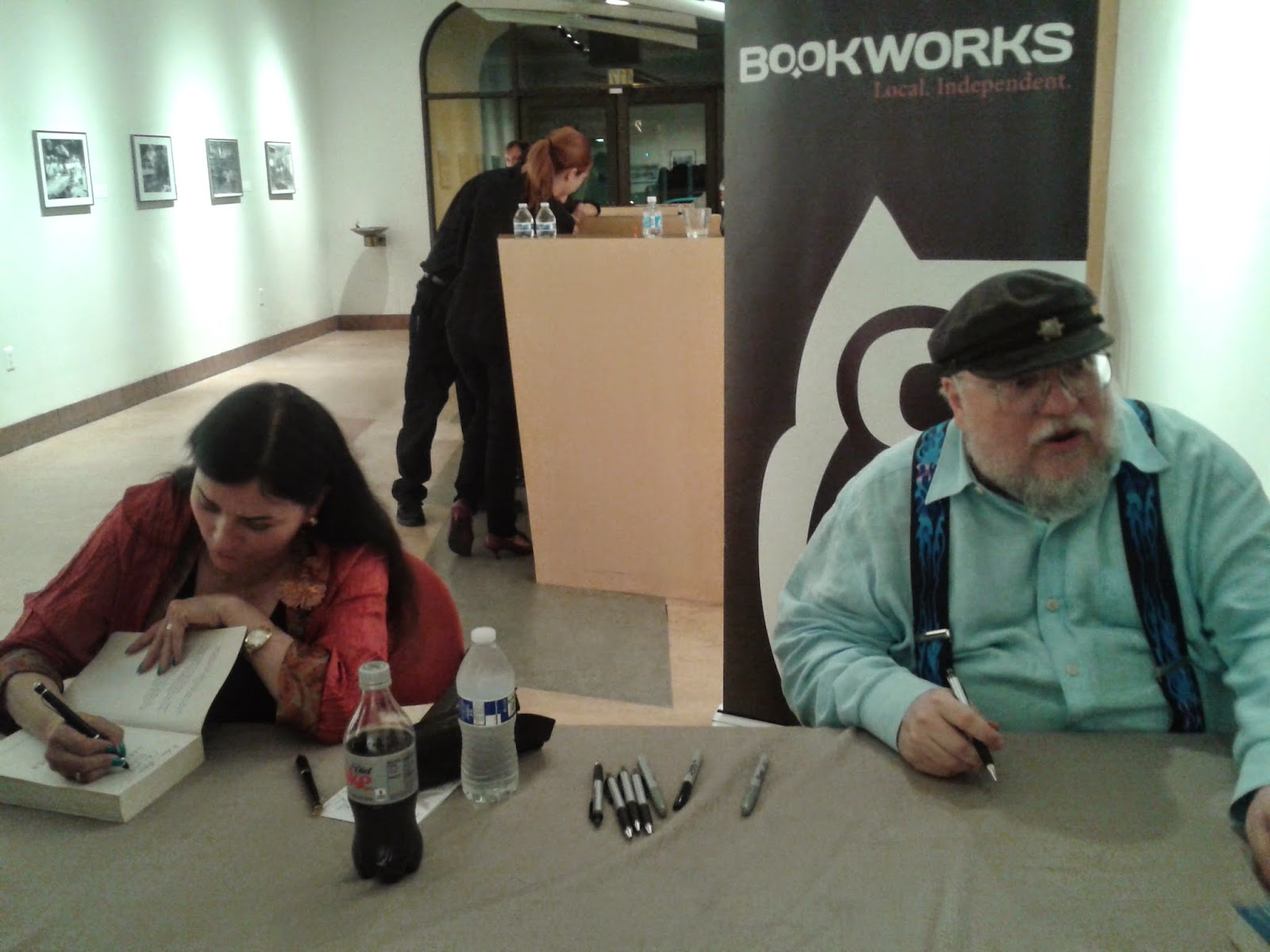 |
| Diana Gabaldon and George R. R. Martin signing autographs |
About their use of language:
Since Martin’s novels are set in a “quasi medieval world” he had to find a balance between modern syntax (so the audience wouldn’t be lost) and flavoring his text with archaic words to give the novel a proper context and avoid anachronisms. He called this the “common tongue of all fantasy novels.” He initially overused words like “mayhaps” or “forsooth,” but his editor objected. They reached a compromise by having the older characters use these terms and the younger ones employing a more modern language—as it tends to happen in real life.
Martin did not invent languages the way Tolkien did (he joked that Tolkien wrote The Lord of the Rings just so he could use his languages) but he made up five words of High Valyrian, and will make up a 6th if necessary. For the show, however, whole languages had to be invented since you can't just say, "She said in High Valyrian." Now when he writes a scene, he has to call HBO to ask how a character might say something in whatever language. The show hires people whose hobby is to invent languages with proper syntax and grammar to develop Dothraki and High Valyrian. As a funny anecdote, Martin mentioned that a fan once requested a High Valyrian dictionary.
Gabaldon mentioned that she has a few translators who help her with Gaelic, and she loves the sound of it.
About their TV shows:
Gabaldon announced that the Outlander series is now in production. The producer, who had previously worked in Battlestar Galactica, took two days to talk to her about the show. They decided that as a prologue, they would show a scene of Claire in a military hospital during WWII. Gabaldon had a blast inside the “Outlander world.” She admitted that at first she didn’t like the actor selected to play Jamie Fraser, but after seeing his audition she knew he would be absolutely perfect for the role (even though he accidentally said "OK" during a scene where Jamie was being pressured to marry Claire).
It took a lot longer to find Claire and poor Sam had to go through innumerable "chemistry tests.” Eventually, they found an actress who had the right chemistry with Sam and would play the perfect Claire. When someone asked Gabaldon if she would like to write for TV, she confessed she’s not a team player and likes to keep control of her writing.
Martin, on the other hand, mentioned that he writes one script per season and would love to write more, but he has yet to finish two 1500-page books. Yeah, you read correctly.
What’s interesting is that both shows will share actors. Apparently the BBC has churned out twenty or so actors, who participate in everything involving an English or Scottish accent. Every single one of them is in Game of Thrones, and, according to Martin, will appear in the Outlander series after they are killed off from GoT. (Ha!)
Anecdotes and questions:
Martin was asked which part of Westeros he'd choose to live in, if he could. He said Dorn. "It's warm, the women are warm and the food is spicy. It's New Mexico!"
Gabaldon mentioned that during an interview with a German reporter, tired to keep her tongue in check, she said she loved a man in a kilt because "you know he could have you up against a wall in 30 seconds."
When asked about their thoughts on self-publishing, neither one of them recommended it. Martin said writers are supposed to write, not publish or market books. He commented how sad it was to see writers desperately trying to sell their work in Bubonicon conferences and such, and how people often avoid them. Martin thinks that self-publishing is only a good idea for well-known authors whose names alone sell books.
They both acknowledged that it’s not easy to break into publishing, but the only thing a writer can do is keep writing.
In spite of the fans who wanted hints about how both series will end, neither Gabaldon nor Martin said a word. The only thing Gabaldon admitted to was having written the last scene ten years ago. “How I will get there is an entirely different question,” she said.
On a side note:
This has been a year of changes and exciting new opportunities for me. I would like to share some of them with you, my dear readers. First, I have a new agent for my generational saga (the first novel I wrote) the awesome Liza Fleissig of the Liza Royce Agency! Last but not least, my historical novel, The Black Letter, has made it to the Amazon Breakout Novel Contest Quarter Finals! If you’d like to take a look, you can find an excerpt here.


