Showing posts with label George R. R. Martin. Show all posts

Sunday, May 18, 2014

A Word with Diana Gabaldon and George R. R. Martin

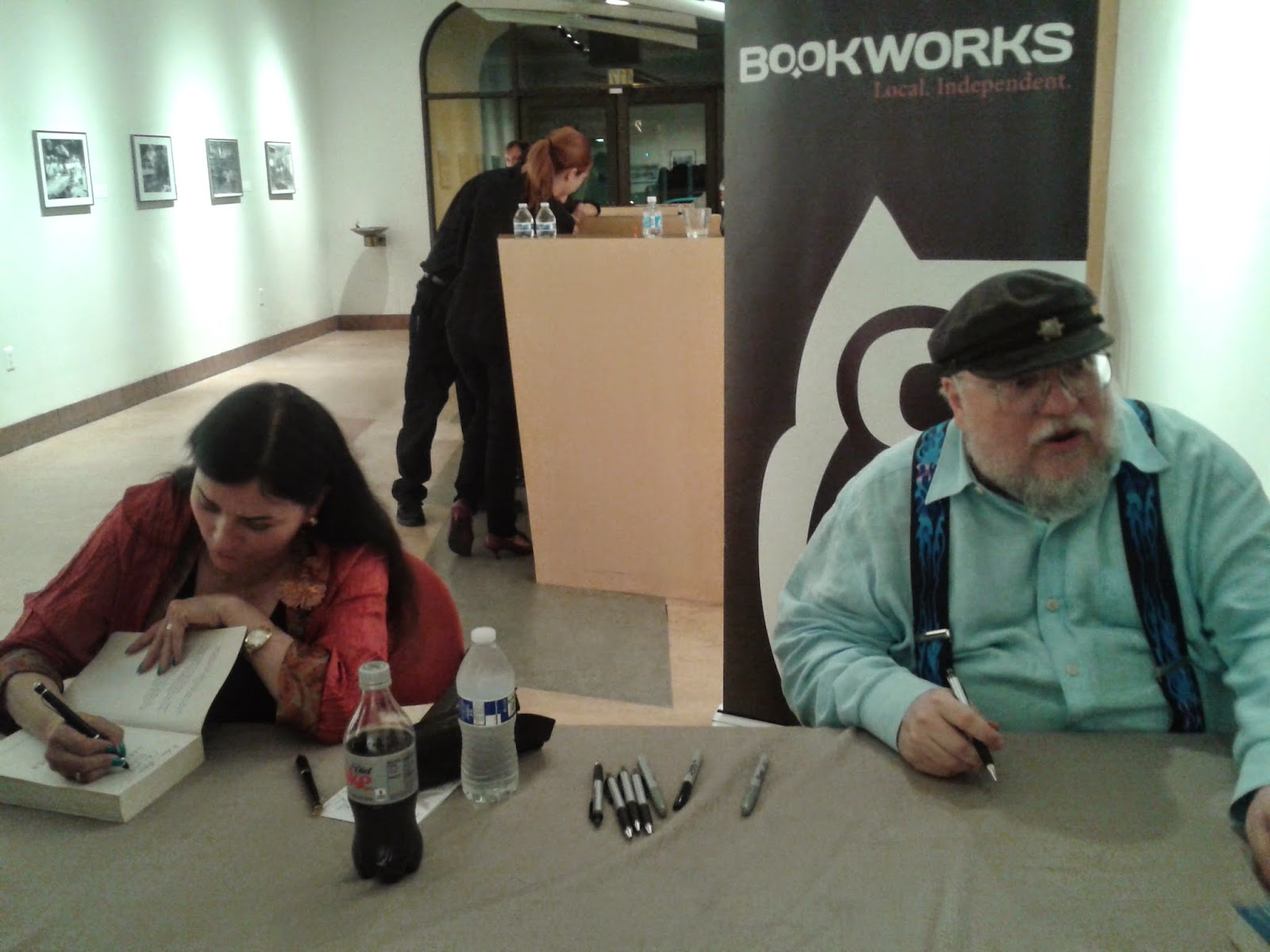
Last weekend, my writing sisters and I attended a fun event sponsored by our city library and a local bookstore. A Word with Writers consists of a candid conversation between two acclaimed authors who share experiences and anecdotes about their writing. The inaugural lecture featured none other than the beloved Diana Gabaldon, the author of the Outlander series, and George R. R. Martin, the brains behind the successful Game of Thrones. They both had a lot to say about what inspired their work and what their writings processes are like. Here are some of the evening’s highlights.


About their backgrounds and what inspired their books:

Gabaldon’s background is very interesting because she’s a scientist with degrees in zoology, marine biology and ecology. She blames her father for this copious amount of studying since when she was young, he had told her that she was a “poor judge of character” and would probably marry badly. To avoid a life or poverty, he recommended that she became a self-reliant professional. Gabaldon obediently got her PhD.

In her mid-thirties, Gabaldon decided to write a novel, more as practice than anything (she didn’t intend for anyone to read her work). Since she was so good at doing research and she liked history, she decided it would be a historical novel. Now the only question was where/when should she set it? The answer came to her while she was watching an episode of Dr. Who and spotted a man in a kilt. She was so taken by this man that she decided to write about a Scotsman. Being that a novel requires conflict (to her own admission, this was all she knew about novel-writing) she settled on the Scottish wars against England during the 1700s. Of course, she needed a woman to create some sexual tension with this beautiful man. Claire came to Gabaldon through an image of a woman in a cave full of men. She was English and very different from other 18th century women. When Claire opened her mouth, she recited her full name. There was nothing Gabaldon could do to tame her modern spirit. She fought with her throughout the novel, but eventually gave up and told her: “Go ahead and be modern, I’ll figure out why later.”  In that sense, she confesses, the time-traveling element in Outlander was an accident.

In contrast, Ser George had always been a writer and a reader. He was a Sci Fi, Fantasy and Horror fan—which used to be the same genre—and as a child, he wrote and sold horror stories to other kids. He eventually earned a master's degree in journalism. For many years, he worked in Hollywood as a TV writer in shows such as The Twilight Zone and The Beauty and the Beast, but there came a time where he wanted to work on his own stories, and so he turned to novel writing. When asked about his inspiration, he mentioned Tolkien as a big influence.

About their writing processes:

Martin offered an interesting analogy for writers. He said there are two kinds of novelists: gardeners and architects. An architect designs a blueprint, plans how he’s going to develop it and then does it. A gardener digs a hole in the ground, throws seeds and water, and hopes something will grow. Martin admits he’s a gardener. When he started A Song of Ice and Fire, he didn’t have a clear idea of where he was going with the story. All he had was the first scene and characters who kept telling him what they wanted. But characters can be treacherous, he says, and like a gardener he sometimes has to pull out weeds—which might explain why he kills so many of them!

Following the same analogy, Gabaldon also calls herself a gardener. However, her process is not linear, like Martin’s, but “organic.” She gets an image in her head and fleshes it out into a scene. Once she has several chunks, or scenes, she stitches them together into a narrative. She admits that when she started she didn’t know anything about writing novels (she had, however, written a 400-page dissertation). So she set two rules for herself: a) she wouldn’t stop, no matter what, and b) she would do the best she could.

Before she was done with the first Outlander book, she found an agent who was so taken with her story he signed her on right away and sold her book in four days. She didn’t originally plan to write so many sequels, she just knew that “there was more.” Her agent originally got her a three-book deal, but the novels kept coming.  Her writing is so accidental that her next series following the adventures of Lord John, a secondary character in the Outlander series, came about because she was invited to participate in an anthology of short stories. Since she didn’t want to interfere with Outlander’s main characters and plot, she thought of Lord John—who then took a life of his own.

Martin agreed with Gabaldon in that he didn’t plan to write such a long series either, but he was happy to do it since readers nowadays love to follow characters for 10-15 years. He says his entire series is one continuous story told in several books.


Diana Gabaldon and George R. R. Martin signing autographs

About their use of language:

Since Martin’s novels are set in a “quasi medieval world” he had to find a balance between modern syntax (so the audience wouldn’t be lost) and flavoring his text with archaic words to give the novel a proper context and avoid anachronisms. He called this the “common tongue of all fantasy novels.” He initially overused words like “mayhaps” or “forsooth,” but his editor objected. They reached a compromise by having the older characters use these terms and the younger ones employing a more modern language—as it tends to happen in real life.

Martin did not invent languages the way Tolkien did (he joked that Tolkien wrote The Lord of the Rings just so he could use his languages) but he made up five words of High Valyrian, and will make up a 6th if necessary. For the show, however, whole languages had to be invented since you can't just say, "She said in High Valyrian." Now when he writes a scene, he has to call HBO to ask how a character might say something in whatever language. The show hires people whose hobby is to invent languages with proper syntax and grammar to develop Dothraki and High Valyrian. As a funny anecdote, Martin mentioned that a fan once requested a High Valyrian dictionary.

Gabaldon mentioned that she has a few translators who help her with Gaelic, and she loves the sound of it.

About their TV shows:

Gabaldon announced that the Outlander series is now in production. The producer, who had previously worked in Battlestar Galactica, took two days to talk to her about the show. They decided that as a prologue, they would show a scene of Claire in a military hospital during WWII. Gabaldon had a blast inside the “Outlander world.” She admitted that at first she didn’t like the actor selected to play Jamie Fraser, but after seeing his audition she knew he would be absolutely perfect for the role (even though he accidentally said "OK" during a scene where Jamie was being pressured to marry Claire).

It took a lot longer to find Claire and poor Sam had to go through innumerable "chemistry tests.” Eventually, they found an actress who had the right chemistry with Sam and would play the perfect Claire. When someone asked Gabaldon if she would like to write for TV, she confessed she’s not a team player and likes to keep control of her writing.

Martin, on the other hand, mentioned that he writes one script per season and would love to write more, but he has yet to finish two 1500-page books. Yeah, you read correctly.

What’s interesting is that both shows will share actors. Apparently the BBC has churned out twenty or so actors, who participate in everything involving an English or Scottish accent. Every single one of them is in Game of Thrones, and, according to Martin, will appear in the Outlander series after they are killed off from GoT. (Ha!)

Anecdotes and questions:

Martin was asked which part of Westeros he'd choose to live in, if he could. He said Dorn. "It's warm, the women are warm and the food is spicy. It's New Mexico!"

Gabaldon mentioned that during an interview with a German reporter, tired to keep her tongue in check, she said she loved a man in a kilt because "you know he could have you up against a wall in 30 seconds."

When asked about their thoughts on self-publishing, neither one of them recommended it. Martin said writers are supposed to write, not publish or market books. He commented how sad it was to see writers desperately trying to sell their work in Bubonicon conferences and such, and how people often avoid them. Martin thinks that self-publishing is only a good idea for well-known authors whose names alone sell books.

They both acknowledged that it’s not easy to break into publishing, but the only thing a writer can do is keep writing.

In spite of the fans who wanted hints about how both series will end, neither Gabaldon nor Martin said a word. The only thing Gabaldon admitted to was having written the last scene ten years ago. “How I will get there is an entirely different question,” she said.


On a side note:
 
This has been a year of changes and exciting new opportunities for me. I would like to share some of them with you, my dear readers. First, I have a new agent for my generational saga (the first novel I wrote) the awesome Liza Fleissig of the Liza Royce Agency! Last but not least, my historical novel, The Black Letter, has made it to the Amazon Breakout Novel Contest Quarter Finals! If you’d like to take a look, you can find an excerpt here
 

Sunday, November 11, 2012

Storytelling vs. Fiction Writing


After a lifelong affair with storytelling, becoming a professional storyteller was one of the highlights of my librarian career. At the time, I naively thought that being good at my craft (as I was told I was) meant I could put my stories on paper and instantly become a novelist. Think again! There is a huge difference between writing and storytelling. As the cliché goes, writers are made, storytellers are born. But like Yours Truly, you may be a fantastic tale-spinner and yet lack all the skills that makes a good novelist.

Family lore asserts that I was involved in storytelling way before I learn how to read. I used to memorize fairytales and then create my own version which I would retell to family, servants, pets and whatever captive audience I could get hold off. It was a form of oral fanfiction. As I grew old, my storytelling experiences went underground, until I found myself in Library School.

There I learned that storytelling was a crucial skill for good Children’s Librarians.  There I heard about the great Augusta Braxton Baker and other pioneer storytellers/librarians. I also got to meet and watch real storytellers performing their magic.  One of the landmarks of those wonderful years was a chance to do library programs in which I polished my old art and went through marvelous experiences that plied me with anecdotes to dine on for decades.

Augusta Braxton Baker


Technique vs. Drama
Encouraged by my storytelling success, I decided that I had the skills to become a true novelist. This crass mistake derived from my confusion between the terms “storytelling” and “story writing.” The first is all about voice, words, atmosphere, vigorous action, drama and wonder. The second is all about method, prose, rules and in-depth characterization. 


Popular commercial writers like to think of themselves as “storytellers,” consequently they rely more on dynamic action and dramatic mood than on literary technique. Their lack of fine writing skills is what their foes will bring up when attacking their work. On the other hand, think of Henry James’s novels, very little happens in them, but you can’t deny his masterful prose or his powerful characters.

The majority of fairy tales were originally found within storytellers repertoires. But when early folklorists shuffled those narratives from the oral realm to a written page, the tales underwent drastic modifications. Early versions of well known tales contained disturbing elements such as Sleeping Beauty being raped by the prince or Rapunzel having twins out of wedlock (something they forgot in the Disneysque version called “Tangled”.) Language had to be cleaned up and the whole text had to undergo a refining process. Each story found that transcription to paper meant to be bound by literary technique and conventions.

No twins for this Rapunzel!


Rules vs. Spontaneity
Storytelling is linked to an old traditional activity known as oral narrative. It goes back to cavemen telling tales around the camp fire. Most cultures will have some form of traditional storyteller, from the Irish “seancaid” to the Jewish “maggid.” In the past, storytellers have been seen as shamans, healers, keepers of tradition, even as intermediaries between the sacred and the profane. Such is the strength that comes from spinning a tale.


Telling a story, even to an adult audience, is a dynamic-spontaneous activity. You can’t go back to polish a draft or edit mistakes. What comes from your mouth is what your audience gets. It’s like acting in a play, if you goof you get booed. If you forget your character name, or skip a major moment, your audience will know and will let you know. And worse than being pelted with tomatoes, like actors of old did, is to lose your listeners’ attention. It is the equivalent of losing their respect.

You have to prepare in advance for predictable disasters. So you said “Princess Alice” instead of “Princess Alexandra”? Then you quickly explain that Alice is Alexandra’s evil twin who, in fact, is working wit Dark Forces to take over her sister’s throne. I know it sounds far-fetched, but believe me, it does work. I have tried it. Did I say the storyteller is an actor? A stand up comedian might be a better description.


Is your audience yawning and staring at the clock? Wake them up with some unexpected plot twist. In Romana, the Jewish-Italian version of Snow White, the heroine does not find shelter with benevolent dwarves; she ends up at the lair of seven ruthless thieves! I often imagine this twist must have come about as a desperate storyteller attempted to get his audience’s attention back with a “Hey, guess what? Romana has just been caught by the most dangerous gang in the entire Italian peninsula. Yes, seven hardened criminals, and there she is, hanging from a tree branch, wondering if she should climb down and take her chances with these strapping lusty outlaws.”

Darth Vader and Son


You may think this only works in front of a live audience, but surprise twists are useful in all forms of storytelling, especially in book or film series that have dragged too long and are reaching the point where the reader’s patience is wearing thin. Who would have imagined that Darth Vader would turn out to be Luke Skywalker’s father? It was the most unforeseen moment of the Star War Saga and left us waiting breathlessly for “The Return of the Jedi.”  Stephanie Meyer was aware that half her fandom wouldn’t be happier with Bella choosing to be Vampire Bride instead of the Wolf Man’s Wife. Her solution was to turn Jacob into Bella’s future son-in-law and leave her readers pondering about the possible incoming “Reneesme’s Adventures in Lycanthropy.”

Followers of George R.R. Martin’s Song of Ice and Fire were a bit confused after Clash of Kings, the second book of the series. Not only was it more slow-paced than the previous  Game of Thrones, but Martin’s surprising killing of the apparent protagonist had left his devotees treading on thin ice. The only thing they were certain was that the one great villain of the story was Ser Jaime Lannister. How else could one describe a man who had backstabbed his king, impregnated his much-married Queen (who also was his twin sister), ambushed good Ned Stark in the street, and threw children off ramparts?

Well, in Storm of Swords, the third book in the saga, Martin did the unthinkable: he presented Jaime as a victim. By turning him into a POV character, the author granted him a chance to tell his side of past events, baffling those who thought him a monster. That changed the viewer’s perception of the character forever, transformed the Kingslayer into a sort of heroic figure, and made Storm of Swords the most read, discussed and loved book of the entire saga.

Ser Jaime Lannister from Kingslayer to tragic hero


Archetypes vs. Well-Developed Characters
But storytelling is not totally devoid of pitfalls, one of them is lack of time and space to develop multifaceted characters. Thus, storytelling has to rely on archetypes: The Charming Prince, Cinderella, talking animals, and others that just by mentioning their name have the spectators imagining looks and personalities. When telling a tale in front of a live audience you don’t have the time to give a complete biography or a full physical description therefore you to have to simplify. One of my tales started like this, “Miguelito was a very poor mouse. So poor was he that his pants lacked pockets because he lacked loose change.” Obviously, if I was writing the tale I would submit to the “show not tell” clause, and never mention the word “poor.” In storytelling you just have to.


When Isabel Allende published The House of the Spirits, critics pounced on her accusing my countrywoman of creating a bad copy of Gabriel Garcia Marquez’s One Hundred Years of Solitude. Indeed, her book owed plenty to Garcia Marquez’s masterpiece, but Allende imbued enough political ideology and her own family lore into the novel to establish a distance. Moreover, she had one advantage over the Colombian author, she had well-developed characters.

This may sound like anathema. Don Gabo is a literary giant, nobody surpasses him in telling stories, describing imaginary worlds, and creating a family tree spotted with intrigue and domestic drama, but his larger-than-life characters are iconic images, never flesh and blood personages. Look at his fictional women. We know that his many Renatas, Remedios and Amarantas fall in and out of love, get pregnant by the wrong man and die in childbirth, but do we know what they think? What they like to do in their spare time?

Garcia Marquez is a terrific storyteller and as such he relies on characters that are a combination of mythical figures and anecdotes. He could stand in front of a crowded theater and verbally convey his novel because it belongs to an oral storytelling tradition. Unlike him, Isabel Allende’s characters are too complex and experience too much interior drama to be put into five words. There is no way to explain briefly about mystical Clara, forced by fate to marry a man that belonged to her dead sister. And how would you verbally express the horror, pain, and humiliation of Alba as she goes through physical torture?

Meryl Streep as Clara in "The House of the Spirits"


If I had to take one book with me to a desert island, I would pick The Holy Bible. Aside from its spiritual content, it’s the best storytelling I have ever laid eyes upon. Within its covers you find everything: political trickery, supernatural events, domestic squabbles, war epics, romance and lust. We love biblical stories and their protagonists have become household names, but do we see them as real-life characters? Do we get to know their point of view? We know King David liked women and played the harp, but what was his favorite food? We know Sarah hated her husband’s concubine Hagar, but do we know if Hagar hated her back? Do we know if Hagar was happy with Abraham?

Every March, Orthodox Jews are subject to one great story hour. The reading of Megillat Esther (The Book of Esther) is the highlight of the Purim Holiday. The synagogue becomes a big storytelling room. All gather to hear the rag-to-riches story of Esther, a nice Jewish girl who is taken away from her home, and after winning a harem beauty contest, becomes Queen of Persia. I love to hear how even after marrying the most powerful man in the land, Esther is still subject to palace intrigues, has to hide her Jewish identity, and strives to save her people from evil Haman.


The story ends in a colossal triumph after Esther manages to save Persia, the Jews and herself through cunning and courage. It’s Cinderella meets Joan of Arc, but do we know Esther? Do we know how she felt about her king-husband?  Is she home-sick? Where did she learn to play bedroom politics and how she went about it? Knowing the answer to all those questions would make The Book of Esther a terrific novel, but it would probably take two days to read it in the temple. Even the most pious audience would be snoring before the reading was over.

Continuity vs.  "The End" word
Whenever we think of the term “storyteller,” the name “Sherezade” comes to mind. Wrapped in her veils, the protagonist-narrator of the Arabian Nights is the teller of stories par excellence. She alone performed the prowess of spending a hundred-thousand-and one nights weaving stories to charm a king out of his psychotic misogyny. What is so compelling about her feat is the impression that Sherezade spends every hour of her existence at her craft, that her entire life is linked to the continuous act of fable-spinning. It’s only by the end of the book, after it’s disclosed that she has delivered two sons for the Sultan, that we realize that a lot more went on  in that bedchamber than just telling tales.

María Montez as Sherezade


Sherezade exemplifies one of the greatest joys of storytelling, its continuity. Unlike novel writing that is bound to arrive to the word “The End,” a tale could go on forever. A storyteller could call it a day just to retake the narrative thread the following day, or night like Sherezade did. A novelist can give up on his craft, never write another book, a great novel may never have a sequel, but storytelling is endless. You have cycles of tales connected to one single protagonist like Anansi, the Spider or Stupid Jack. That is what written series and storytelling have in common, the infinite possibilities.

Agnes Newton Keith was an American bestselling writer that wound up experiencing stranger than fiction events. In 1942, she and her small son were taken into captivity by the Japanese. For the next three years, she lived in a civilian prisoner camp, away from her husband and enduring privations, malnutrition, slave work, plus physical torture and a rape attempt. Throughout her captivity, her utmost preoccupation was the survival and well-being of George, her little boy. One way she found to keep up George’s morale was an evening storytelling session that centered on the exploits of a super hero known as Big Game Hunter “Keith of Borneo” (later joined by “Jack, the Giant-Killer”.)

Birthday card , Agnes Newton Keith sent to her husband while still in captivity


One night she realized that other children in her compound had gathered around her mosquito net to hear her story. At first, Mrs. Keith wanted to yell that this was only for George, but finally she gave in. Her daily story session became a source of pleasure and comfort for the youngsters in captivity and a way to maintain her narrative skills. She stretched Keith’s adventures as far as credibility could allow, sent him on trips around the world, personalized the stories and in every way proved the power of storytelling and the capacity for a tale to continue ad infinitum.

The Interactive Storyteller vs. The Writer in the Ivory Tower
Mrs. Keith’s anecdote illustrates another advantage that storytelling has over story writing: you get to know your audience. When we write our first bit of fiction, we write it mostly for ourselves. We are the target audience and we grow attached to that piece because we like it. Then we expose it to the criticism of family and friends. We start modifying our text to suit the audience’s needs, a process that expands as we move from acquaintances to agents and publishers. We are always running into new more demanding readers, while in the horizon looms the threat of the “real public,” a terrifying but foreign group.

In storytelling you have no such problems. Even if you may be awed at the prospect of meeting listeners for the first time, you’d have plenty of data on them. You will know their sexes, occupations and ages. Novelists have three abstract age groups to choose their target audience from: children, young adult or adults. In storytelling, age groups tend to be more specific.


My first story session brochures explicitly said “toddlers and pre-schoolers” and my audience were Latinos. My second storyteller job was with elementary school children and it was done in English. Even when dealing with adults, knowing in advance that you will be addressing senior citizens, middle-aged housewives, or teenage boarding school students helps you prepare tales, props and mood.

When your book hits the market you don’t know who will be buying or reading it. Whether it comes from New York Times reviewers or by readers complaining on the Amazon boards, reactions to or interpretations of a novel may shock its author. The storyteller gets to face the reaction immediately and has a chance to discuss the interpretation or even change it, because storytelling is always an interactive activity. So interactive that in some cultures the listeners actually interrupt the session with questions and even offer suggestions to improve the storytelling.


There is tremendous power in storytelling for narrator and public alike. When my mother saw the snapshots of my first story hour she was more impressed by the children’s expressions than by her daughter’s antics. “Look at their little gaping mouths!” she said. I know what it’s like to captivate an audience as well as I know what it feels to be enthralled by a fine storytelling session, or by a book that fulfills my emotional needs or by a television show that grips my attention while bringing comfort to my exhausted mind.

Modern authors tend to forget and forsake the pleasure of interacting. They cherish (sometimes with good reason) the distance that separates them from audience. A true storyteller would never sacrifice his chance to know the feedback of listeners/readers and would find a way to recognize and meet their needs.

Can you think of a novelist, or scriptwriter who combines the quality of fine fiction writing with strong storytelling skills?

Sunday, October 14, 2012

Plagiarism or a New Genre? Defining Fanfiction


The arrival of Internet has revolutionized the concept of fandom, and a manifestation of this revolution is the fan-generated literature known as “fanfiction.” Beyond homage or admiration, these written spinoffs of television, film and literary franchises could be cataloged as samples of personal prose and a good practice for more serious fictional writing. Nevertheless, well-known authors resent amateurs meddling with their work and view fanfiction as mere plagiarism.

The definition of “fanfiction” applies to a story inspired by an original work that either modifies or expands the actual text. Such yarns are non-profitable, exclusively on-line published (most of the contemporary fanfiction in English is gathered at Faniction.net) and targets devotees of the inspiring piece. These transmedia texts are triggered off by several subjects: anime, films, TV series and books, especially sagas like Twilight, Harry Potter and George R.R. Martin´s A Song of Ice and Fire.


Fanfiction springs from four emotions:

Love: A loving fan would wish to enhance a favorite tale by using its universe and characters.

Deprivation:  After the word “The End” is reached, a feeling of hunger gnaws the fan’s vitals. The only way to appease it is to continue the story, to expand the boundaries and create sequels.

Impatience: It arises while waiting for another season of a TV show to roll by or by the incessant counting of months and years before a new book comes to the market (George R.R. Martin, hear our clamor!) What best way to beat that impatience than writing our own versions?

Frustration:  Many readers experiment with fanfiction to appease exasperation with an author who pairs off the heroine to the wrong partner, kills a favorite character or drags the plot into an undesired direction. Most aficionados understand those moods. How many of us want to push Martin to write faster, are angry that Bella didn’t choose Jacob, or, like me, feel that the doctors in “Grey´s Anatomy” never make the right amorous decision?


 Fanfiction is basically prose, although I have heard of poetry fics and fan song fiction. There is a form of fanfiction that is expressed in video structure, and you may find several samples in YouTube. FF or “fanfic” (as it is known) appears usually in the shape of short stories, but there is also the drabble, telling a tale in less than a hundred words. On the other hand, some fan-authors actually write full novels that are posted in a serialized fashion.

Fanfics are usually set in their canon universe, but some are located in alternative spaces. I have seen Game of Thrones characters turned into contemporary high school students. Crossover fanfiction is when characters mingle with other fictional individuals outside of their canon universe. An example would be people from “Glee” attending Hogwart, or the “Ron Solo” fics. Yes, that is indeed Ron Weasley ambling about the “Star Wars” cosmos. I have found some interesting crossover romances among YouTube videos and I leave you this one that pairs Jaime Lannister with Lucrezia Borgia (from “The Borgia” series.)


In terms of genre, fanfiction’s favorite category is Romance.  Love fanfic provides an extensive canvas upon which devotees can splash all the intensity of their lusty or platonic fantasies. There are romantic fics for every taste, from “fluff” or “feel-good” happy-ending stories, to “kink” (in Spanish we use the Japanese term "lemon") used to define erotic tales with extensive sexual content.  There is heterosexual fanfic as well as one targeting gay audiences. The latter is known as “Slash,” or “Femslash” if geared towards lesbians.  To continue the possibilities, now we have “twincest”, which was obviously prompted by the nefarious Lannister Twins’ escapades, but I found several fics that involved George and Fred Weasley!

A glance through the almost infinite variety of romantic merging proves the readers’ need for love stories in places where such emotions are not present. It also expresses the vastness of fan’s imagination when it comes to the engineering of these liaisons. Hermione Granger and Harry Potter sounds like a match made in heaven, but Hermione and Severus Snape CatelynStark and Jon Snow?  Jaime Lannister and Ned Stark? Jacob Black and Edward Cullen?

I love fanfiction, but I am not longer interested in writing it.  Way before the term existed, I was already scribbling it. It was a great method to rewrite poor and unsatisfactory endings. In my stories, Julien Sorel survived the guillotine; it was Brian of Bois Gilbert (not dull indecisive Ivanhoe) who rescued Rebecca from the stake; and Scarlett and Ashley flew together to Mexico leaving Melly behind to look after her rival’s brood and to comfort Rhett (in more than one way.) Curiously, years later I discovered the existence of a manga that had Rebecca and her Templar nemesis in love and together. Curiouser still, at a high-school workshop I had my students rewriting GWTW´s last chapter. Five of them had Melanie living happily ever after...as Mrs. Rhett Butler!

Were Melanie and Rhett meant for each other?


One of the most rewarding aspects of fanfiction is learning than others feel just like you do, that they also envision perfect couples that no author cares to create.  It gives you a sense that you are not a freak because you want Sansa Stark to fall in love with Sandor Clegane, or because you wish Sirius Black to resurrect, and that you are not alone in giving the Hermione-Ron combination a jaundiced eye.

Around the turn of the century, I had my first ran into official fanfiction. It happened at a website devoted to “Big Valley,” a 60’s television western. I never thought “Big Valley” had such a large following, especially thirty years after its cancellation. But there it was, an Internet page with some juicy fanfiction as bonus.

Big Valley’s major hook were its protagonists, The Barkley Brothers played by Richard Long, Peter Breck and Lee Majors (in his pre-Farrah days). Most BV’s followers had a thing for Jared Barkley (R. Long) or his half-brother Heath (Majors). It surprised me to discover, through the said fanfiction, that grumpy Nick (P. Breck) also had a major fandom. For decades, I had thought I was the only soul on the planet to have a crush on him. This showed me that fan interaction is the phenomenon´s major attractive. Fanfiction brings together likeminded people, even if their taste in common is just a mundane fantasy.
Peter Breck as Nick Barkley


Inventive and daring as the internet version may be, fanfiction is not a new art form. Back in the early XVII century, readers demanding a follow-up to the adventures of Don Quixote saw their dreams come true when Spanish bookstores presented the desire book. The only problem is that this Quixote was a fanfic written by Alonso de Avellaneda. Since Miguel de Cervantes had no way to sue Avellaneda (Golden Age Spain was not a litigious society), he had no other choice but to write a sequel to the quests of his mad knight.

 In our own times, we find novels that could be defined as fanfiction. Examples are parody novels such as Seth Grahame-Sennett’ Pride and Prejudice and Zombies or Alice Randal’s Wind Done Told, a retelling of Gone with the Wind seen from the point of view of Scarlett´s mulatto half-sister. Parallel novels like Geraldine Brooks’ March (reviewing the experiences of the father of Little Women in the Civil War) and Jean Rhyss’ Wide Sargasso Sea (the story of Jane Eyre’s “Madwoman of the Attic”) also qualify as fanfic.
Even sequel novels that have not been written by the author of the source material are nothing but glorified plagiarism (aka “fanfiction.”) Just think of P.D.James Death Comes to Pemberley, (sequel to Pride and Prejudice) Susan Hill’s Mrs. De Winter (sequel to Rebecca) and Alexandra Ripley´s infamous Scarlett.  But nobody would accuse those respectable writers of being anti-original. Why not? Is it because their skills place them above a bunch of dilettantes?


The level of writing skills in fanfiction varies from author to author. There are some whose style is definitely amateurish, whereas others show much literary promise. A couple of years ago, my countrywoman Francisca Sola wrote a fanfiction novel called El Ocaso de los Altos Elfos (The Twilight of the High Elves.) It was her response to a major disappointment with Harry Potter and the Order of Phoenix. El Ocaso was so booming that it was translated to English and Italian, and was not bought by Random House only because of copyright conflicts with J. K. Rowling. Since then, Francisca has became a novelist in her own right, having published two books and being one of the few Chilean authors to dabble in paranormal fiction.

Francisca Solar, a fanfiction success story

 Francisca Solar is not the only success story in the fanfiction universe. E.L. James has achieved fame and fortune thanks to the rewriting of her Twilight erotic fanfic. For those who still don´t know it, the fic had its rebirth in the market as the notorious 50 Shades of Grey. Naomi Novick, creator of the Temeraire series, has confessed to have written fanfiction in the past. But despite these precedents, the new genre is still reviled and even fought by established authors who rail against the bootlegging of their works.

The United States Supreme Court has been emphatic about it, as long as fanfiction is described as such and as long as the authors do not profit from it, fan-generated literature is perfectly legal. The Guardian may define fanfiction as “crass” and “celebrity-obsessed,” but many critics and reviewers (such as Teresa Nielsen Haydn, editor of Tor Books) are embracing it as a new subgenre. Yet writers are still raising their voices against the trend.

While Stephanie Meyer encourages fanfiction based on her characters, Anne Rice has formally demanded that stories centered on her work be removed from Fanfiction.Net.  She wrote an open letter to her readers denouncing fanfic:  “I do not allow fan fiction,” she wrote. “The characters are copyrighted. It upsets me terribly to even think about fan fiction with my characters. It is absolutely essential that you respect my wishes."  Some fanfic authors, who did not abide with Ms. Rice´s wishes, claim to have been victims of further harassment from her part.


George R.R. Martin does not reach those extremes, but perceives fanfiction as an infraction of his copyrights. He resents the distortion of his literary universe and believes that plagiarizing his work is a bad exercise for novice writers.  J.K Rowling is much more tolerant, she claims to be flattered by the Harry Potter inspired stories, but draws the line at excessive sexual content.

How do you feel about this issue?  Have you ever been inclined to write about characters that were not your own? Or do you see it as a useless exercise of your writing skills? Do you feel that derivative tales are never up to the original’s excellence or are you one of fanfiction’s secret “junkies”?


Sunday, July 15, 2012

Kick-Ass Girls, Conniving Witches and Submissive Whores: Images of Feminine Power in Contemporary Fiction.


Recently, a friend of mine announced to me in an excited voice that finally literature had given up on stereotypical portrayals of women.   When I expressed surprise at her statement, she mentioned Stieg Larssen’s Lisbeth Salander as a mold-breaking protagonist who encompasses feminist values. I shrugged away her comments. I can hardly think of a tattooed hacker as a role model and the more I look around I find heroines in mainstream and genre novels still shaped according to old-fashioned masculine fantasies and girlish fears.

I know that, despite my protestations, many do see in Lisbeth Salander an ideal heroine, one that leases female and masculine readers alike.  After all, she is modern men’s fantasy girl. Thin, lean, flexible of body and covered with tattoos and piercings, she fulfills contemporary notions of feminine beauty. She is a computer wiz, fiercely independent, and she “kicks ass.” Moreover, at an age where most men seem to get excited at the sight of girls necking with each other, Lisbeth is bisexual. She doesn´t need men, she doesn’t want to be supported by men, she doesn´t demand protection or commitment. Even women could be attracted to her because she tramples on everything that makes us weak: romantic love, dependency, fear of physical or sexual violence and a legal system that is not always kind to the female sex.


If Lisbeth is the ideal contemporary heroine then her complete opposite should be Anastasia Steele, the flaky protagonist of the Shades of Grey trilogy. Since Shades could only be classified as erotica, it´s sad to know that, in 2012, the genre still uses clichés created by the Marquis de Sade in the 18th century. Like De Sade’s Justine, virginal Anastasia surrenders completely to a handsome rake who abuses her to his heart’s contentment.


 Anastasia agrees to become millionaire Christian Grey´s sexual slave only because he is sexy, good-looking and wealthy. Hey! After all isn’t that what women crave? Gorgeous dude, great in bed and a good provider? But those attributes don´t cloak the fact that Shades is a remake of the old rape fantasy. More than a female fantasy, Shades is the sum of all feminine fears.

In fantasy rape, the fantasists always enjoyed the act, and so does Anastasia. She derives pleasure from Christian´s abuse even when it evolves into sexual violence. Because, despite what its advocates claim, the multiple BSDM scenarios in the book could only be describe as violent. In a milder scene that takes place inside an elevator, Christian tugs Anastasia’s hair while kissing her roughly. She relishes it! I would be gouging the eyes of any creature that messes with my hair!


Many try to sell BDSM erotica as examples of “women empowerment.”  I can’t think how being spanked, mocked and tied-up constitutes “empowerment” especially since Anastasia not only enjoys her “master’s” attentions. She is also getting regular injections of cash that swells her bank account. Yes, the submissive whore stereotype is doing quite well in the bestsellers list.

What really blew my mind about 50 Shades of Grey were not its idiotic protagonists, but the fact that it was based on the author´s fan fiction...about Twilight! I can´t picture chivalrous Edward pulling a tampon off Bella’s vagina, but obviously E.L. James does, and so do the detractors of Stephanie Meyer's saga who claim that Bella is a “submissive” heroine. Odd, I must have read another story because she didn’t strike me as such. What I did notice is that Bella and Sookie Stackhouse of Charlene Harris’ vampire stories are damsels in distress, always in need of werewolf and blood-suckers paramours to come to their rescue. It gives the impression that paranormal romances are all about frail heroines. Does that apply to the Fantasy genre in general?


Unprecedented literary success has brought George R.R. Martin a nice bunch of critics, feminists among then. For a couple of  entries in my Fantasy Blog I found and read several articles discussing different aspects of Martin´s misogyny and the negative handling of feminine characters and female power in his Song of Ice and Fire. Some critics seem to resent the fact that Martin’s strong, independent women like Melisandre, the sexy conniving witch, and Cersei, the sexy conniving queen, are portrayed as evil.


Critics, and not only feminists, have the bad habit of imposing modern moral standards upon historical fiction or fantasy texts. Martin´s women, good and bad, are pretty strong for the barbaric patriarchal world they inhabit. And because it is Epic Fantasy, Martin even includes an ancient archetype, the kick-ass, cross-dressing, warrior maiden, Lisbeth Salander’s medieval equivalent. The saga is pitted with girls that dress like men and fight like men such as Arya Stark, Asha (Yara in the TV series) Greyjoy, Ygrette, the Wilding, and, my favorite, Brienne of Tarth.

Born a lady, Brienne’s plainness (and the fact that she is taller and stronger than the knights in her realm) makes her unlikely marriage material. So she trains to be a knight. When she falls in love with King Renly, she goes to his court to serve him as a squire- bodyguard, knowing he could never reciprocate her feelings (aside from being married, Renly is gay).) What´s interesting about Brienne is that she kills men, is very skillful with her sword, and is terribly strong, but she is far from a virago. For someone who dresses like a man, she is quite feminine. She is shy, sensitive, naïve and she loves troubadour’s songs as much as Sansa Stark (Westeros epitome of refined femininity) does.


Like Lisbeth Salander, she hurts men who hurt women, but unlike The Girl with the Dragon Tattoo, Brienne is not a stone wall: she cries, feels sorry for Jaime (with whom she is obviously falling in love) and appreciates the positive aspects of her sex as when she pledges her service to Catelyn claiming to admire Lady Stark's “woman’s courage.”


It is interesting that Martin shows women as both destroying and creating forces, as helpers as well as enemies of the men that love them. Curious, because modern literature insists in presenting women as connivers and bringers of sorrow.  In Ian McEwan’s Atonement, poor Robbie Turner is destroyed by two women, one he loves, one who loves him. Robbie has been aided in his studies by the Tallis Family, his mother´s employer. However, in the closely structured British class system, he is constantly reminded of his place, especially by Cecilia, the Tallis eldest daughter. On the other hand, he befriends little Bryony, Cecilia´s sister, a precocious would-be-writer who develops a crush on him.


After seeing half-naked Cecilia taking a dunk in the garden’s fountain, tumescent Robbie writes an embarrassing letter describing his feelings towards her. Bryony finds the letter and is shocked by Robbie’s sexually explicit language. She sublimates her jealousy into fear by making herself believe Robbie is a deranged pervert. After seeing him and her sister making love, Bryony is convinced he is dangerous, and when her cousin gets raped in the woods, Bryony accuses Robbie, who is sent to jail. Although Cecilia believes in his innocence and stands by him, there is a sense that her bewitching beauty caused Robbie’s downfall and that his life could have been much better if he had never met these dangerous sisters.


We can’t accuse Ian McEwan of being impartial to women when female authors play the same game. In 2001, the same year that Atonement came out, Philippa Gregory published The Other Boleyn Girl a fictionalized view of Henry the Eighth’s second marriage.  The plot follows Ann and Mary Boleyn’s rivalry for the love of King Henry who casts away loving Mary in order to marry her ambitious sister. For some reason, most novelists tend to be unfair to Ann Boleyn. Indeed she meddled in politics and religious affairs, but she was also a patron of the arts, and no more ambitious than most high-class ladies of her day. Her sister Mary had several lovers before getting into King Henry’s bed, and by the time Ann came to Court, her royal affair was over.


In the book, Ann and Mary are loving sisters despite their different characters. Anne is strong-minded and rebellious. As he mother puts it, she is used to get what she wants just by “stomping her little feet on the ground.” Sweet and obedient Mary is happy to be married to a not very bright young squire. Henry visits the Boleyn Manor and Thomas Boleyn pushes a very willing Ann into the king’s path. Although Henry is taken by her beauty, he resents Ann´s facetious willfulness and sets his eyes on demure Mary. When the men in her family (including her own husband) prod Mary into the royal bed, she has no option but to comply. Eventually she falls in love with the king, who enjoys her meekness, thus she becomes his submissive whore, but not for long. By the time Mary is bedridden with pregnancy, Ann is back.


With ruthless ambitious and cruel vindictiveness, Ann does everything in her power to lure Henry away from her sister. Se does not want just to be a mistress; she becomes queen by withholding her sexual favors from the king. Driven by lust, Henry divorces Catherine of Aragon, Mary is forgotten, but Ann never gets her husband´s love. Her willful ways, constant tantrums and inability to provide him with an heir, soon bore the King who has Ann put on trial. The many charges include sorcery since only under her conniving spells could the King have committed so many follies.


Ann loses her head for being a tempting witch while her sister fares better; Mary keeps her life and fades into oblivion. The novel seems to have two morals:  is better to be a submissive whore than a bewitching sorceress, and when it comes to men, women will trample upon their own sisters. After glancing over these images of “powerful “women, I rather stick with Lisbeth Salander.

Could you think of examples in recent literature of female protagonists that are good role models? What about your heroines? How do you make them strong yet appealing?

Malena (Formerly known as Violante)