Showing posts with label Cephalopod Coffeehouse. Show all posts

Friday, June 27, 2014

Cephalopod Coffeehouse: Outlander

Welcome to this month's round of the Cephalopod Coffeehouse hosted by the illustrious Armchair Squid! Pull up a chair and pour yourself a mug of coffee or tea!

This month I chose Diana Gabaldon's very first novel Outlander. This wasn't really a random choice. A little over a month ago I attended a event put on by the local library called "A Word With Writers." The featured speakers were Diana Gabaldon and George R.R. Martin. If you'd like to read about the event, visit Sister Lorena's post here.

Once upon a time I had tried to read Gabaldon's novel, but never finished. I knew why. I'd found it incredibly boring. But, after hearing her speak about her work, I thought I'd give Outlander a second chance. I dug around my bookshelf until I found my copy. The front cover was just as dated as I remembered and certainly didn't make me think that the lovely, delicate Claire was much of a beauty.


The cover of my copy. If you open the front
flap you'll find an equally unflattering
picture of Jamie with a late-80s
hairdo.

I flipped my book open to where I'd left off all those years ago, which was less than a quarter of the way through the novel. I even had an old, faded receipt I was using as a bookmark. It's from World's of Fun in Kansas City and says I purchased the amusement park ticket for $28.54 on July 3, 2000. So, yeah, it's been a while since I last cracked this book open.

What did I glean from reading Outlander this time around?

First off, although still boring for most of the story, I managed to get through almost the entire novel. I have to admit that I still have about 100 pages to go, but I've skimmed to the end and have a general idea of what happens. If you don't know how long Outlander is, it clocks in at 850 pages.

Next, I realized that Gabaldon has a certain beauty to the way she writes. I love how she describes Claire's surroundings in the novel. Or even some things that we take for granted. Like giving birth. Near the end, when Jenny, Claire's sister-in-law describes to Claire, who has never had a child, what birthing a baby feels like it becomes such an intimate moment filled with descriptions I never even thought about when I was pregnant. With scenes like that, Gabaldon has a magical touch to the way she writes.

Going back to the boring bit, I was disappointed to find that I felt like I never really got to know the main character, Claire. So many things that would be questions in anyone's head if they fell through time and into a strange world they knew nothing about are not raised. It's as if Claire knew exactly what to expect as soon as she fell through those rocks. No toilets? Not a problem. No bathing? Not a problem. Expected to wear suffocating clothing? Not a problem. Questionable sanitary practices in the 1700s? Not a problem. There were times when I wanted to shake Claire and ask, "Now, tell me how you really feel about the absence or lack of..." How do you go from having toilet paper to none at all and not feel just a bit nervous about the prospect? Claire never seems to mind not having modern-day amenities. And if the argument is because Frank, her modern-day husband, and all his historical research prepared her for something like this, I don't buy it. Simply put, she had no interest in what Frank did. That was apparent in the beginning of the novel. So, because I felt like I didn't really know Claire, all the strings of lovely descriptions, sex, and bits of adventure seemed to drag in many places.

On that note, the novel didn't pick up for me until around page 500 and the witch trial. Now, that I liked, and the next 200 pages were exciting. I didn't know what would happen to Claire. Would she be drowned just to find out if she was a witch? Would her knight in shining armor (a.k.a. Jamie) show up at the last minute? What I was hoping and waiting for throughout the entire novel was whether Claire would end up back at the ring of stones. If you've not read the novel, I won't spoil it for you. Her final decision between choosing Frank or Jamie was the right one, I believe.

Finally, there are some final tidbits that stopped me while reading. Claire spots Geillis's inoculation scar, but, again, she doesn't think one thing about it, and only on a side note brings it up to Jamie. What? I think my mind would be racing with all kinds of questions. Claire, from the modern world of 1945 knows an awful lot of older vocabulary from the 1700s. Somewhere I heard that Gabaldon wrote the time travel aspect because she couldn't get Claire to curb her modern-day tongue. Um, no. As soon as she's back in the 1700s, Claire seems to know all the lingo. I actually wanted more of her worldly tongue in the novel, and just felt disappointed it wasn't there. There's also an awful lot of spanking or talk of spanking going on throughout the novel. Just a head's up.

In the end, if you're debating about whether to read Outlander or not, then keep a few things in mind: 1) Gabaldon is truly a lovely writer, 2) 850 pages was way too long for something that could have used some extra editing, 3) Claire almost seamlessly fits into the 1700s, and 4) after all that, you may or may not be inclined to read the next novel in the series. I have no desire to read the next novel at the moment. But, who knows? Maybe I'll change my mind in, say, fourteen years!

Check out other reviews on the Cephalopod Coffeehouse bloghop:


Friday, May 30, 2014

Cephalopod Coffeehouse: Rebecca

I got bogged down with some difficult books this month, which slowed my reading considerably. I reviewed my actual favorite book on my personal blog, so I'm kind of covering the leftovers here. BUT! That's not to say I didn't like any of them. In fact, my second-favorite novel of the month was Daphne du Maurier's Rebecca, and I liked it quite a lot.

But first, real quick, what slowed me down: I waded through Long Man, a new novel that's receiving rave reviews but which just never quite grabbed me. Possibly I needed the audiobook companion ... more and more, I find it difficult to get into books unless I have a couple solid hours with a good audiobook version. On the flipside, I listened to an audiobook lecture titled Philosophy of Mind that was not exactly boring, but was technical and difficult. I thought I was reasonably good at philosophy, in a layperson way, but no. I found a lot of the content so abstract and almost mathematical as to be nearly impenetrable. And because it was only aural, I kept losing my concentration. Lesson learned: have an audio and visual copy of most anything before jumping in. (Yay for libraries.)

On to Rebecca. Although I got a degree in English literature, I'd never read du Maurier before. Last year Rebecca kept coming up in book review after book review. It seemed every new novel was an homage in some way to this 20th-century classic. So, because a book about a haunting kept haunting me, I figured I ought to give it a whirl.

My first surprise was that it was a 20th-century novel. I was thinking... ghosts and English estates and brooding lords-of-the-manor, gotta be 1820 or so. That would be because the novel draws heavily on the Bronte sisters. However, it's actually fairly modern, more Great Gatsby than Wuthering Heights. Rebecca was published in 1938, the same year this photo was taken:


That is my grandmother. Isn't she lovely? She was 21 at the time, approximately the same age as the nameless narrator who tells the story of Rebecca. The narrator is a stand-in for du Maurier herself, who wrote the novel as an exploration of her own jealousy—her husband had a previous paramour that du Maurier suspected he was still a little in love with. (My grandmother, as far as I know, never had this issue.) Rebecca is not really a ghost story, I discovered—or at least not the story of an actual ghost. There is nothing supernatural here, in spite of the gothic setting and tone. The titular Rebecca does indeed haunt the narrator, but she does it by simply having existed and lived a huge life that the narrator, her opposite, constantly bangs into. Where the narrator is small, self-effacing, plain, uptight, moral, and a bit weedy, Rebecca was tall, extravagant, beautiful, luscious, and wicked.

Of course, the real center of the story is the truly evil Mrs. Danvers. The housekeeper steals every scene she is in. I couldn't help thinking of Frau Blücher from Young Frankenstein whenever she was described ... which made me giggle a little, which in turn took some of the creeping horror away from those scenes. That didn't stop me from gasping at one of the truly over-the-top scenes in the middle of the book, which was as delicious as it was theatrical. (For those who've read it: the bit where the narrator and Danvers are looking out the window over the paving stones.)

Stay close to zee candles. Zee stairway can be ... treacherous
Once I got into this book, I was turning pages pretty feverishly. But it took a while. The narrator is a wimp, and wimpiness doesn't sit too well with modern readers, myself included. I had to keep reminding myself that novels aren't (always) prescriptive, and protagonists are not and shouldn't always be expected to be heroes. Protagonists should be allowed the full range of human experience, and cowardly, sniveling people have stories to tell too. We may not like being inside such a person's head, but if the story is plausible and well-written, with interesting characters, it's worth sitting with a problematic protagonist. It was for me.

Want to read other Cephalopod Coffeehouse reviews, and/or participate in future ones? Visit our host, the Armchair Squid. 

Friday, April 25, 2014

The Cephalopod Coffeehouse: Waiting to be Heard


By now, you’ve probably heard of Amanda Knox. You may even have an opinion about her case and whether or not you think she was involved in the murder of her roommate, Meredith Kercher. My interest in the case started when Amanda was acquitted a couple of years ago, but it grew with recent developments (in January, her appeal was reversed). In addition to the popularity of the case, I became interested in her memoir as a source of research for my third novel since it also deals with an exchange student who gets into trouble abroad.

After all that has been said about Amanda on news shows, magazines, the internet and even a made-for-TV movie, Amanda finally gives us her version of the story. In a prose that is easy to follow and insightful, we meet Amanda a few months before she moves to Perugia, Italy. We get to know her parents, her siblings and her sometimes quirky and adventurous nature in her native Seattle, where she has planned in some detail her year of studies in Italy—a lifelong dream of hers.

Amanda is not very different from other people her age who travel abroad. I also traveled to Europe in my early twenties and Amanda seemed as ordinary as any other girl I met during my trip. I won’t go into too much detail about her story since: a) it’s all over the internet and b) if I tell you too much, you won’t want to read it (and if you’re interested in her story, I believe it’s worth reading. Especially because we’re so used to making quick judgments based on what the media tells us.)  I’ll just say that Amanda goes into great detail about those first months in Italy, the people she associated with, her relationship with her roommates, the boys she met, etc. She doesn’t portray herself as a saint as she admits to having smoked pot and engaged in sexual activity with two or three guys. This, she says, were mistakes the media and the prosecution exploited during her first trial.

Amanda claims her relationship with Meredith was good. According to her, they were confidents and friends who explored the city together and shared similar experiences (both were English speakers trying to find their way through a new culture and a new language). Then she describes the moment she met Raffaele—her then boyfriend and partner in this ordeal—their short-lived but intense relationship, the day Meredith died, the police interrogations, her two trials and her life in prison. She brings insight into a few things that are not explored much on the internet or news shows:
  • What, according to Amanda, happened during the interrogation where she accused her boss of killing Meredith (and later admitted to lying about it). She offers a theory as to why she lied that night.
  • During her appeal, there was an important testimony from a man who’d been imprisoned with Meredith’s convicted killer (Rudy Guede, who’s DNA was all over Meredith’s room). This man said Guede confessed to having raped and stabbed Meredith in conjunction with “a friend” (who wasn’t Raffaele or Amanda, which is what the prosecution alleges). In fact, Guede was supposedly having a moral dilemma as to what to say during their appeal. (Guede had a separate trial and conviction from Amanda and Raffaele.) This story made more sense to me than the prosecution’s theories of a “sexual game gone bad” or a “Halloween Eve sacrifice.”
  • Explanations as to why there were traces of Amanda and Raffaele’s DNA in a couple of items that the prosecution assigned as proof of their culpability.
  • Insights on the people in Amanda’s life in prison and outside. I was especially touched by three people in her life: a Catholic priest who befriended Amanda—an agnostic—during her hardest times in prison (Don Saulo); one of her best friends from Seattle who moved to Perugia to be near Amanda after she was sentenced to 26 years in prison (Madison) and Laura, an American inmate who grew up in Ecuador and became sort of a foster mom or older sister to her. Amanda’s family is also commendable as they never abandoned Amanda and during her four-year-ordeal always made sure someone was in Italy on visiting days. Her stepfather went as far as to move to Perugia for some time. Amanda’s story, as sad as it is, also serves as a testimony that goodness is sometimes found in the most unexpected places.
After reading Amanda’s memoir, I conclude that yes, she made MANY mistakes, primarily not taking the police interrogations seriously—she didn’t wait for a lawyer to be present and she never called the American embassy before answering questions in a language that she didn’t speak well. Her lying during one of her confessions, I admit, is hard to understand and made me wonder if she was covering up for something else (heavy drug use?) however, I do not believe she was involved in Meredith’s attack. It just doesn’t make sense. Our civilization has become SO reliant on technology that sometimes we drop common sense out the window. The prosecution claims that a girl like Amanda—with no prior convictions and a model student who came from a good family—is guilty of murdering (savagely) and raping her friend (when she doesn’t even have the *right* equipment, if you know what I mean). What we do know is that there is no motive. The prosecution claimed Amanda and Meredith argued over the bathroom’s cleanliness, but only a psychopath would kill over this, right? Not to mention the fact that there is no evidence of her presence in Meredith’s room. The prosecution claimed Amanda and Raffaele wiped their own DNA in the room but left Guede’s, as though it was possible to see DNA! Plus, there was no proven relationship between Guede and Amanda or Raffaele (Raffaele said he’d never met the man and Amanda said she saw Guede once or twice with her downstairs neighbors but couldn’t even remember his name.) 

I truly believe that Amanda’s problems stemmed from her immaturity and naivety at the time of her trip. Not only was she cavalier about who she spent time with (including working at a bar with people she barely knew) smoking pot on a regular basis and having sex with guys she’d just met. Unfortunately, this is not uncommon in people her age. When I moved to the US to go to college, I had the fortune of having a couple of family members here to guide me through the process of moving to a different country and start a new life as an adult. Also, my parents came with me and helped me settle in the dorms. When Amanda arrived to Italy, she had nowhere to live and found her new roommates on a bulletin board. I know, LOTS of college kids do this, but this doesn’t mean it isn’t dangerous. ESPECIALLY in a different country where you barely speak the language and you don’t know the “rules of the land.”

By the end of the book, however, you see Amanda as a different woman. Not sure this has to do with the fact that Amanda is a writer (currently studying Creative Writing in Seattle) and she knows that in every journey, the hero must show change and growth, or that she truly matured with all the hardship she went through, but her transformation was evident to me.

Have you been following this case or read her memoir? Do you believe in her innocence? What do you think will happen now that her appeal got reversed? Do you think the US will extradite her to Italy? Do you think it’s fair that she was tried twice for the same crime?

Check out these coffeehouse reviews!

1.The Armchair Squid2.My Creatively Random Life
3.Wishbone Soup Cures Everything4.Valerie Nunez and the Flying Platypi
5.Huntress6.Servitor Ludi
7.MOCK8.StrangePegs -- Mrs. Frisby and the Rats of NIMH
9.Words Incorporated10.Agatha Friggin' Christie
11.Ed&Reub12.The Writing Sisterhood
13.Read, Write, Repeat14.V's Reads
15.The Cephalopod Coffeehouse: April 2014 16.Debi O'Neille, writing against the wind

Friday, March 28, 2014

The Cephalopod Coffeehouse: The Girl Who Played with Fire

"Salander heard a sound and saw a movement out of the corner of her eye just as she was putting the key in the door of the Honda. He was approaching at an angle behind her, and she spun around two seconds before he reached her." (The Girl Who Played with Fire, Page 193)
Welcome everyone to this month's round of the Cephalopod Coffeehouse. Make sure to make the rounds and see what everyone has been reading over the past month.

A couple of weeks ago I finished up the second book in Stieg Larsson's Millennium series, The Girl Who Played with Fire. I was going to review the third book in the series, The Girl Who Kicked the Hornet's Nest, over at The Random Book Review, but I haven't quite finished it. It's kind of been a busy week for me but, hey, I'm still reading!

This is the part where I make the assumption that everyone under the sun has heard of Stieg Larsson and his Swedish Millennium series, but considering that not everyone enjoys the same genres, I won't make that assumption. When reading Larsson's background, it's really not surprising he chose topics such as misogyny, sex trafficking, and corrupt political systems to use in his books. Here's a little bit about Larsson's background according to this website:
Stieg Larsson (1954-2004) was a Swedish writer and journalist. Prior to his sudden death of a heart attack in November 2004 he finished three detective novels in his trilogy "The Millennium-series" which were published posthumously...Altogether his trilogy has sold more than 20 million copies in 41 countries, and he was the second bestselling author in the world in 2008. Before his career as a writer, Stieg Larsson was mostly known for his struggle against racism and right-wing extremism.
He liked extreme storylines, to say the least. There is supposedly a fourth book hidden inside Larsson's computer, but much controversy surrounds who should own the rights to Larsson's estate: his father and brother or his life partner Eva Gabrielsson. Feel free to visit the website I listed if you're interested in checking out the controversy.

Stieg Larsson

About the book:

Mikael Blomkvist, crusading publisher of the magazine Millennium, has decided to run a story that will expose an extensive sex trafficking operation. On the eve of its publication, two people are brutally murdered, and the fingerprints found on the murder weapon belong to his friend, the troubled genius hacker Lisbeth Salander. Blomkvist, convinced of Salander's innocence, plunges into an investigation. Meanwhile, Slander herself is drawn into a murderous game of cat and mouse, which forces her to face her dark past.

If you've read the first book in the trilogy, The Girl with the Dragon Tattoo, then you know that The Girl Who Played with Fire picks up roughly a year or so after the first novel. After Salander and Blomkvist's harrowing ordeal in the previous book, Salander has skipped the country with her loot and has spent time abroad. We find her in Grenada at the beginning of the story, doing what she does best: saving a young woman from certain death at the hands of her husband. This element is important because as the story unfolds we see that Salander's past, which is riddled with abuse, will come back and rear its ugly head.

Where in The Girl in the Dragon Tattoo Salander and Blomkvist spend a large portion of the book together, in the sequel, they only come in close contact with one another at the end of the book. I struggled with that a little bit, because I was expecting more one on one work between the two of them. The third book is shaping up to be much of the same, but I've yet to finish it (I have about a third of the book left), so I don't know if there will be any resolution to their relationship. I'm hoping so (but please don't tell me how it ends)!

Overall, I enjoy the hacking capabilities of Salander. I'm very fascinated with every nuance of the hacking world Larsson creates. I have no idea if what he's saying is true about how hacking works, but at least it makes for an interesting read. I do struggle with Larsson's portrayal of women in his books. None of them seem like the type of woman a man would want to settle down with and raise a family. Berger, Blomkvist's longtime love interest, is tough as nails in the publishing world. She knows what she wants, goes and gets it, and stops for a little hanky-panky if the need arises. Which seems to be quite a bit with her and it usually borders on kinky. For whatever reason, Larsson feels the need to divulge all the ends and outs of the female characters' sex lives, but he doesn't go too much into the mens' unless they're the ones doing the sex trafficking. Salander is a very damaged individual and more of who she is comes out in the second novel. When Blomkvist learns the truth about her rape, I feel it's disappointing how he rationalizes his physical relationship with Salander. She had come to him not long after her rape, so that meant it was okay. Sorry, but that's just sad. What the girl really needs is someone willing to listen to her, but Larsson builds her into an individual full of mistrust and the need for isolation that all I ever feel for her is pity.

The hard-looking Lisbeth Salander from the Swedish films.

If you've not read the book, know this:  the story feels dated. Larsson drops so many brand names, especially with computer technology, that it loses some of that here-and-now feel. Grant it, the book does deliberately state that it's 2004, but time can be tricky when it comes to contemporary thrillers. Readers are constantly wanting to feel the technology and brands of today. Palm pilots may have been cool in 2004, but I don't know anyone still using them now. The book also tends to become a tedious read. There are some pretty long passages of information dumps and over explanation of the basic facts that at times the storyline gets swallowed up. As a whole, though, Larsson weaves a great story concerning Salander's background. Which, is why I had to read the third book.

Have you read any of Stieg Larsson's books? If so, what's your opinion?

Make sure to check out the rest of the Cephalopod Coffeehouse reviews:

Friday, February 28, 2014

Cephalopod Coffeehouse Review: Wave

Welcome to the Cephalopod Coffeehouse review, a cozy gathering of book lovers. Each month we gather to share our reviews of the best book we read in the last month. It's also a blog-hop, so thanks for hopping by!

"I am in the unthinkable situation most
people can't bear to contemplate."
I read two really excellent books this month, so I'm sharing one here and one (A Constellation of Vital Phenomena, by Anthony Marra) on my personal blog, Words Incorporated.

Wave is a grief memoir, a genre exemplified by Joan Didion, Isabel Allende, and CS Lewis. I dunno—I think Sonali Deraniyagala might trump them all. Not that this is a competition anyone wants to win. She lost her entire family (two sons, a husband, and both parents) in 2004's horrific tsunami. Hundreds of thousands of people died that day, but here, we are focusing on this family, this particular loss. It is a stunning book.

The story crashes in on you immediately, locating you with the family the morning of the devastation, just as the sea was coming in but before anyone realized what was wrong. I read this first chapter in one gasping go, my heart pounding, unable to look away or think about anything else till it was done. You don't really want to diminish such an experience by calling it a "hook," but by god, I was hooked. From there, the pace slows a bit as the author walks you through the aftermath, but it never really lets up. Strangely, I didn't want to put it down for a second.

I would say "I can't imagine what it must be like to lose your entire family," but that's what this book does. Makes you imagine it. I also have a husband, two kids, and two parents, without any of whom I'd be unmoored, but ... the kids! To lose your babies in an instant like that. Grief isn't something you can recount easily, it doesn't fit in the frame. It's like those blue whales she observes from the boat ... too big to fathom. You can only get bits at a time. If ever you needed a reminder to be grateful for what you've got, for every mundane second of what you've got, Sonali will remind you.

There's a little gift buried in this memoir that doesn't get mentioned in reviews: the glimpse at a life that is both so similar to and so very different from my own. Sonali is Sri Lankan, upper middle class, and married an Englishman. She raised her family biculturally, across continents. That alone was interesting to me. The physical descriptions of Sri Lanka—the sea, the jungle, routine hoards of cranky elephants—were colorful and fascinating. I felt like I was getting a cultural education right along with the Job-like horror story. It almost seems in poor taste to mention it, like you're not supposed to notice how interesting her family is. Or was. 

Steve, Vik, and Malli
And that's part of what makes this book work: you get caught up in how interesting they are. Malli in his tutu, Vik's fascination with eagles, Steve cooking dinner. She fleshes them out slowly; you get to know them after they are firmly established as dead, and it becomes ever-more difficult to believe they could possible BE dead. How could such real people be dead? They had futures, each of them, and you find yourself rooting for them impossibly, hoping somehow it'll all turn out all right in the end.

I was struck by the "army of friends and family" who kept Sonali from killing herself that first year. In the US, our ties to our nuclear family are often strong, but our ties to our extended family and community can be remarkably weak, relative to other cultures. I don't think I have "an army" of people who could watch over me 24/7 for months on end. In my culture, if I were in that position, I'd be committed to an institution. That's what we do. In George Packer's The Unwinding, which I reviewed here last month, I noticed how alone Americans are, relatively speaking; the only person who could rely on extended family to help her out during financial crisis was an Indian immigrant.

Sonali Deraniyagala
Some reviewers have complained that the book is too sad to be borne. I didn't feel that way: I struggled much more with Leaving the Sea, a book of short stories I finished right before I started this one. I don't know how that fiction could be bleaker than this reality, but there is an intimation right from the start that Sonali is going to be OK somehow. Maybe simply because she is there, writing this memoir—she couldn't do that if she wasn't a little bit OK. Some people survive but never do come back to life after tragedies; they remain shells for the rest of their days. This writer (and how is she not a professional writer? Her writing is amazing) seems like she has a shot at being all right. That resilience is what makes the book bearable.

Note: Much of this review is shared from my review over at Goodreads. Feel free to join me there.

Thursday, January 30, 2014

The Cephalopod Coffeehouse: The Infatuations


Ever since I started writing in English, I’ve been reading mostly American and British authors. Not only as a tool to become more proficient in the language, but also to understand what’s selling in English-speaking markets and how their stories are told. Once in a while, though, I’ll dig into world literature and look at what’s selling outside the US, mostly in Latin America and Spain.

This month I ran across a Spanish author called Javier Marías, who is apparently making waves across the Atlantic. From what I understand, there’s even Nobel Prize talk. His latest work, The Infatuations (in Spanish, Los Enamoramientos) is a literary novel (but honestly, what Spanish/Latin American author doesn’t write literary?) with elements of crime, obsession and love—or more specifically, elements of “falling in love,” which is not the same thing, according to the author. As Alfaguara (the Spanish publisher of this novel) indicates on its website, this is "a book about the state of being in love, which seems to justify everything."


The plot is simple: María Dolz is a book editor who’s been watching a couple at a café every morning for years (whom she affectionately calls “The Perfect Couple”) until one day, they stop coming. By chance, she learns that the Perfect Husband (Miguel) had been stabbed to death. When María sees the Perfect Wife again at the café, she approaches her for the first time and offers her condolences. The now-widow invites her to her home for a chat and opens her heart to María (known to them as “The Prudent Young Woman”). At the widow’s house, María meets a family friend (Javier) and from the prudent, distant observer she once was, María becomes entangled in the lives of these strangers until their fate lies in her hands.

Oddly, in this novel—which may seem so intriguing and juicy—the plot is not the most important thing. As the author himself tells us through one of his characters (in reference to another novel):

“What happened is the least of it. It’s a novel, and once you’ve finished a novel, what happened in it is of little importance and soon forgotten. What matter are the possibilities and ideas that the novel’s imaginary plot communicates to us and infuses us with, a plot that we recall far more vividly than real events and to which we pay far more attention.”

The author’s philosophy comes through in his work since, for example, we know very little about his protagonist. We come to know how María thinks and feels, but little to nothing about her past, her family or even her age. We’re stuck in this one anecdote of her life, this brief season where we learn the bare minimum about her (where she works and some of the people she associates with) in order to understand her choices and actions. This is a novel where the human condition (our fear of death, our unfulfilled desires, the things we do for love, the process of grieving after losing someone) becomes the focus of the story.

I found the novel to be both refreshing and frustrating. While the prose is engaging and identifiable (as I mentioned earlier, the author analyzes in great deal feelings and experiences most of us have had) he repeats his discourse in a way that the plot becomes sometimes static. I did enjoy his reflections and repeated motifs (he uses the same examples to illustrate his views on injustice and grief) but at the same time, I wanted the action to move along, I wanted to see the characters interact in different ways—as opposed to being told what they did and simply witnessing their philosophical conversations in almost every scene, which leads me to my other objection: the characters sounded (mostly) the same in their views of life (sort of cynical) and they all engage in super long monologues.

Despite my grievances, the novel is also refreshing and here’s why: the story doesn’t follow “the hero’s journey” or any predictable pattern (even though the reader is definitely intrigued to know what will happen and what did in fact happen to Miguel). It’s more of a “slice of life” type of story with no perceivable change in the protagonist or any of the other characters (aside from the end of a natural grieving process). I loved this because I am so tired of books and films that follow a formula as though it was a manual of instructions to install a dishwasher. It seems contradictory, doesn’t it? The same things that made it refreshing (the differences from the traditional storytelling model) also presented a source of frustration for me. In the end, though, the novel touches on much deeper issues than who killed Miguel and why or what will happen with the protagonist’s love life. It talks about how our perspective and memory may affect the truth (or what we perceive as such), it talks about how humans adjust to the loss of a loved one to the point where if that person were to come back, he or she may no longer have a place in our lives, and it talks about justice and impunity. In summary, it’s one of those novels that will leave you pondering for days and perhaps make you examine your own philosophies and fears.

Spanish edition of The Infatuations. Which cover do you like better?
Have you read this novel? If so, what did you think? Do you agree with the author in his assessment that ideas are more important than events in fiction? 

Check out these Cephalopod Coffeehouse reviews!

1.The Armchair Squid2.What's up, MOCK?!
3.Words Incorporated4.Scouring Monk
5.Huntress6.A Creative Exercise
7.Libby Heily8.Trisha @ WORD STUFF
9.Wishbone Soup Cures Everything10.mainewords
11.Julie Flanders12.Hungry Enough To Eat Six
13.Yolanda Renee14.M.J. Fifield
15.StrangePegs -- Turn Coat16.The Writing Sisterhood
17.Ed and Reub18.StrangePegs -- Vader's Offspring

Friday, November 29, 2013

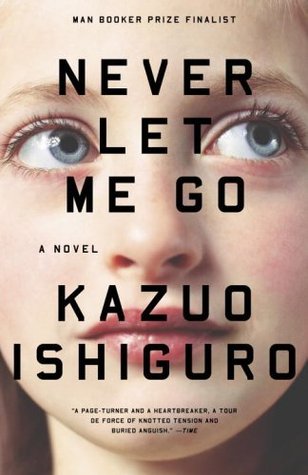
Cephalopod Coffeehouse Review: Never Let Me Go

As the Cephalopod Coffeehouse review for November approached, I began weighing and comparing the various books I read this month. As I am writing two Cephalopod reviews, I think will save my actual favorite for my personal blog. For the Writing Sisterhood I'm going to cheat a little and present the weirdest book of the month for me: Never Let Me Go, the strange, semi-dystopian novel by Kazuo Ishiguro.


First, it's a book written by a Japanese-Brit, which is a little unusual. Ishiguro moved from Japan to the UK when he was five years old, and if this book is any indication, he thoroughly identifies as an Englishman. Ishiguro is best known for his novel The Remains of the Day, about a lovelorn butler, whom most of you are probably picturing as Anthony Hopkins. As with that novel, Never Let Me Go was turned into a major motion picture. I haven't seen it yet: I'm hoping the film fixes the problems I had with the novel.

Before I progress, there's no way to talk about this book without spoiling it, as mystery and slow-reveal are the driving force behind it. So if you haven't read it yet, you may not want to continue past these next few caveats: first, it's not really as sci-fi book, so ignore that description. It's not even dystopian, not in the sense you're used to. I am reviewing it as a highly-praised polemic that ultimately misses the mark; if you still want to read it, go do that. If you expect you never will, you can keep reading this review.

I read this book in less than 24 hours, so clearly I found it gripping. The setting is an modern-day English boarding school, called Hailsham, populated by "special students," which will put many people in mind of Harry Potter. But what makes these students special is left deliberately unclear, both to themselves and to the reader, for much of the book. The reader learns about what's happening roughly at the same time as the main characters, but unlike the reader, the main characters don't seem to care. And this is one serious flaw of the book: the characters don't care about their own fate.

We've gotten used to dystopian novels—especially where teens are involved—as "rage against the machine" stories where the young 'uns fight back, form a rebellion. And most dystopian novels nowadays are written expressly for a teen audience, but there is a respectable subset of dystopian novels that are written for adults, and in these, the system usually wins: the opposition is crushed or assimilated. Fahrenheit 451, 1984, Minority Report, and Brave New World are examples. Never Let Me Go seems to want to be this sort of book, although the nemesis is less speculative and more realistic than in classic dystopian works. In any event, the system appears to win in the end of Never Let Me Go. But unlike most dystopian novels, nobody even fights back in this one. As I came up to the end of the book, I began to wonder if passivity had actually been bred into the students. Humans, the real kind, have a survival instinct. Are these characters truly human? Did Ishiguro mean to be so ambiguous about that?

What drove the book forward was the unanswered question of what Hailsham is about; you don't know what's going on and you keep thinking the next page might give you the answer. So you keep turning pages. I was glued to the sofa for five hours straight. But once the majority of the questions were answered by the Hailsham's administrators (about 80% if the way through), the forward momentum was really lost for me, and I kind of plodded through the rest of it. And here it is (true spoiler alert here): Society is breeding clones for the purposes of organ transplants. The clones are informed of their purpose and know that the organ donations will result in their death; they seem all right with this. The purpose of Hailsham is not just to rear clone children, but actually to form a little rebellion: the administrators want to prove that clones aren't just vessels, but living breathing feeling human beings. Hailsham is a sort of arts school, and the art that the students produce is supposed to be a sort of Turing test: only real humans, not machines, can make art. The students dutifully churn out art, but the rebellion is quashed when something totally unrelated to the rest of the story happens offscreen, and so the school is shut down.

And so the reader is left with a big "meh." If society doesn't mind, and the clones themselves don't mind, what's the point of a rebellion? If the rebellion ends because of actions completely outside the plotline, what was the storytelling purpose of it? In the end, when the main characters "complete" (i.e., die from having given up all their vital organs) I had a hard time caring. Society didn't care about them, their protectors didn't care about them, and they don't even care about themselves. So why should the reader care? The point of the novel was not the people, but the morality tale. Morality is always a weak pillar on which to hang a story, and Ishiguro doesn't even seem clear on what his moral message is. I have to give it a certain number of stars for holding my attention, but I was left fairly unsatisfied. The whole question raised is whether these test-tube clones, raised only for their organs, are really human. The purpose of the art gallery and the whole Hailsham project was to prove the students had souls, had feelings. But do they? They seem like normal enough children and teens, but when they are asked to walk into the slaughterhouse, they don't hesitate. There's no attempt to escape. There's the barest nod to the idea that at least claiming to fall in love with another student can defer the slaughter for a few years, and the two protagonists make a halfhearted stab at this, but it's not at all convincing.

I have to say, for a book that I didn't especially love, Never Let Me Go has stayed on my mind for days and days since I've finished. Mostly I'm trying to reconcile how it was I was so gripped by the narrative and yet left so terribly unsatisfied. I felt like the novel was a long-winded way of saying, "Hey y'all, don't do cloning, OK?" Or maybe it was the more generic "Science Is Dangerous!" morality tale that much sci-fi (ironically) seems to be. If you're going to write a polemic, you'd better be very clear on your moral message and all your characterization and plot had better be in service to that message. Otherwise, please for the love of God, save us hours of feverish page-turning and just write an essay.

Did you read the novel? Have you read anything else by Ishiguro, and what do you think of his style? Are there novels with a moral message you feel work better than others, and how do they pull it off?

Be sure to check out these other Cephalopod Reviews:


1.The Armchair Squid2.Scouring Monk
3.mainewords4.Huntress
5.DeniseCCovey6.A Creative Exercise
7.Trisha @ WORD STUFF8.Katie O'Sullivan ~ Read, Write, Repeat
9.V's Reads10.Bird's Nest
11.Hungry Enough To Eat Six!12.The Random Book Review
13.Words Incorporated14.Defending the Pen

Friday, October 25, 2013

The Cephalopod Coffeehouse: Gone Girl


In a world where everything dark is in and chick lit is out, Gone Girl fits right in. This is one of those books that grabs you by the collar, shakes you up a bit and won’t let go until you raise your head 489 pages later and utter a “what the hell just happened?” to whoever might be standing (or sleeping) next to you. The odd thing is within the constraint of its genre (film noir, mystery) it offers some interesting insights about marriage and gender expectations.

The story is told by two narrators: husband Nick and wife Amy. Nick wakes up on his fifth anniversary with bitter thoughts about his wife. Due to their mutual layoffs, Amy—a once-successful-New Yorker with famous writer parents and a book series inspired by her (Amazing Amy)—has been dragged out of her milieu and transplanted in a small mid-western town to assume the role of perfect housewife. Amy, apparently, is not happy about the move and doesn't seem as Amazing as Nick once thought. The encounter between the two of them this particular morning promises to be explosive, but instead of a collision between these two forces, we’re taken to another scene—a few hours later—in the bar Nick now co-owns with his twin sister. After a disturbing phone call, Nick returns home to find that his wife is missing and the house has been broken into. The police comes in and questions Nick, but there is no trace of Amy.

The next chapter goes into one of Amy’s diary entries—five years prior—when she first met Nick and gives us an insight of what those earlier days were like.

In alternating chapters between the two narrators in two different timelines, we get a sense of who they are. Well, at least we think we do. Pretty soon, Amy’s disappearance turns into a media frenzy. Nick keeps saying the wrong things, gets caught in a few lies and can’t explain what he did the day of Amy’s disappearance between breakfast time and the bar. Even worse, he can't figure out the clues his wife left him on their anniversary's Treasure Hunt. Before he knows it, he becomes the number one suspect in her disappearance.

So far, it seems like a pretty standard Lifetime movie, right?

Wrong.

This novel is so cleverly written that halfway through the book it takes a twist that challenges everything you thought and believed. That, and the fact that Flynn’s style is so engaging and unique (particularly when it comes to Amy’s voice). Someone called it a nice blend between literary and commercial. I have to agree with this assessment. While the plot moves quickly, there are reflections about gender relationships and marriage that I believe many readers may feel identified with. Having said this, there were situations that seemed too convenient for one of the characters, plus I wasn’t fully satisfied with the ending—though I would say that it was original and unexpected.

Despite its qualities (voice, character complexity, interesting plot) this novel is not for everybody. Like the cover suggests, the book is somewhat sinister, the characters extremely flawed and not very likable, and some may even consider it contrived. But there is something about the premise—that famous hook—that makes you keep reading until the big question is answered. I recommend this book to those readers who love suspense, plot twists and murky characters.

If you've read this book, care to share your thoughts with me?


Check out these other reviews:

1.The Armchair Squid2.Subliminal Coffee
3.The Beveled Edge4.Blue Sky Gazing
5.Hungry Enough To Eat Six!6.Servitor Ludi
7.V's Reads8.Julie Flanders
9.Trisha @ WORD STUFF10.Rebecca @ The Dusty Cellar
11.Scouring Monk12.The Writing Sisterhood
13.The Random Book Review14.Wikes! Hikes on the Long Trail
15.Ed & Reub16.M.J. Fifield
17.StrangePegs -- Fortunately, the Milk18.StrangePegs -- "My Killbot Buddy"
19.Katie O'Sullivan20.Gladiator's Pen
21.Em Dashes and Ice Cream22.StrangePegs -- Fahrenheit 451
23.Words Incorporated24.http://sallys-scribbles.blogspot.co.uk
25.Spirit Called26.Denise Covey

Friday, September 27, 2013

Cephalopod Coffeehouse: London Boulevard by Ken Bruen

"After I showered, I cracked a brewski and got dressed. Kept it casual. Sweatshirt and jeans. My nose was still aching, but I could live with it. Gant was hovering on the outskirts of my mind. The mental threads one makes are tenuous and treacherous. I dredged up a line. 
It's not about hatred, it's about absolute devastation." (London Boulevard, Page 164)
Welcome back everyone to September's round of the Cephalopod Coffeehouse. If you're here for the first time, the Sisterhood is glad to have you along, and feel free to visit any of the other reviews in the links below.

My choice this week is a novel I received as a freebie from my local writers' group. They have a raffle at the end of each meeting and give away about twenty books. By the time my number was called, the pickings were pretty slim, so I ended up with Ken Bruen's crime thriller London Boulevard. If you hop over to The Random Book Review you'll see I chose a denser, more literary novel with The Story of Edgar Sawtelle, so it's good that I ended up with Bruen's book to review here. You'll see why in a second.

To lay a little groundwork, I'll start with the blurb on the front flap. If you don't like to know a little backstory right up front, then you can skip over this part.
When Mitchell is released from prison after serving three years for a vicious attack he doesn't even remember, Billy Norton is there to pick him up. But Norton works for Tommy Logan, a ruthless loan shark lowlife with plans Mitchell wants nothing to do with. Attempting to stay out of Logan's way, he finds work at the Holland Park mansion of faded movie actress Lillian Palmer, where he has to deal with her mysterious butler, Jordan. It isn't long before Mitchell's violent past catches up with him and people start getting hurt. When his disturbed sister Briony is threatened, Mitchell is forced to act.
Hmm...where to start. After reading the blurb again, I don't even remember who Tommy Logan is from the story (and I just finished this book a few days ago). The man Mitchell has a "hard-on" for (as it's put in the book) is a man by the name of Gant. This isn't good if I'm already getting lost when it comes to the characters in the story.

Overall, I'd say I had two annoying issues with this book. Grant it, the book is fast-paced, definitely filled with crime, sex, and bad guys (and now I'm wondering why there weren't really any good guys...), and gives you a sucker punch with how ruthless the main character seems to be. And that's problem number one for me. In the beginning of the story, Mitchell is released from a three year stint in prison for aggravated assault. The first person to say he'll become a repeat offender is the warden, and right away I wanted to root for him, thinking that he'll beat the odds.

Nope.

Mitchell leaves prison and commits about twenty other crimes (maybe even more, but I lost count) before the story comes to an end. One right away in the first chapter when he breaks a window washer's arm. I figured there had to be some redeeming quality to this character. Maybe he's not into drugs? No. Okay, maybe he's not into illegal firearms? Wrong again. How about not using those illegal firearms to plug a kid in the knees with four bullets? Again, no. Let's see...he's not a womanizer? Considering the fact that he proposes to one woman while he's still going at it with another on the side, I'd have to disagree on this one as well. There was absolutely nothing I liked about Mitchell's character and that was extremely disappointing for me. I stopped rooting for him about a third of the way through the novel, knowing he was on a downward spiral. But here's the thing: He finds out he didn't commit the crime that sent him to prison in the first place, and yet he still continues to live like some sadistic criminal. I just didn't get it.

The second issue I had with this book was the overall storyline and ending. Some critics have said that it's a stolen plot from Sunset Boulevard, but I don't know that story very well, so I can't agree or disagree. Just an FYI, the story stops abruptly. There are loose threads dangling there at the end, but heck if I know if they ever get resolved! The storyline is thin, with not much more than pointless crimes taking place. I guess that's where the struggle with understanding Mitchell's character came into play. He is always looking for trouble and that is what develops as the storyline. Not the kind of path I would take with my writing, but hey, I don't write crime either.

To put it bluntly, I don't think Ken Bruen is "one of the great crime writers of our time" as the front flap proclaims. At best, this is a half-baked story that just stops when it could probably be getting better. I've read better and I'm sure you have too. This book's a no-brainer to read and is quick to get through. The only upside to that is that I still had to finish my other novel for this week's reviews and so I had plenty of time after finishing London Boulevard.

On a final note, some musers on Amazon believe that Bruen only wrote this so it would be turned into a film. That wouldn't surprise me, considering the fact that it came out a couple of years ago on the big screen.

Um...just so you know, if Mitchell
didn't want to be a criminal, then
maybe he shouldn't knowingly
do half the stupid things he does.

Make sure to check out the other reviews in the Cephalopod Coffeehouse this month:


Friday, August 30, 2013

Cephalopod Coffeehouse Review: The Killer Angels

Welcome to August's Cephalopod Coffeehouse, a cozy gathering of book lovers who meet to discuss their thoughts on the best books they read the past month. My selection* for this month is The Killer Angels, by Michael Shaara. Published in 1974, it's considered the classic novel of the Civil War — look, it says so right on the cover!

Winner of the 1975 Pulitzer Prize
I picked this book up reluctantly, after having finished most of the rest of my self-assigned reading for 2013. I know next to nothing about the Civil War and haven't ever been terribly interested. But wow. What an incredible book. Shaara wisely focuses rather than trying to evoke the entire scope of that war: he narrows in on one battle (Gettysburg) and two primary characters, General James Longstreet on the Confederate side and Colonel Joshua Lawrence Chamberlain of the Union side. Other military leaders get to take the narrative helm from time to time, but these two men take center stage.

The melancholic Longstreet
Shaara's prose may be a little sentimental at times, but his characterization of those two officers is exceptional. Chamberlain in particular is so finely drawn that his character was revived from obscurity: virtually nobody had remembered his heroism at Little Round Top until this novel was published.

Robert E. Lee, however, does not come across well here. What image I had of him was of a tragic hero: wonderful leader, terrible cause. But by the time Gettysburg came around, Lee had been undone by success: he thought he couldn't lose, so he stopped strategizing. As my son said, while watching the Ken Burns documentary on the war, "Oh! I know what happened to him! Hubris." Lee's men loved him, but he was no tactician in Gettysburg and Pickett's charge led thousands to needless deaths. I mean, "needless" even in the context of war. In contrast, Longstreet seems both brilliant and practical, though he didn't inspire the same sort of love. I felt depressed after each Longstreet section, though — he was always hurtling into doom, and he knew it. He was gloomy anyway, due to the death of three of his children, and now he found himself on the wrong side of an unwinnable war. Life for Longstreet just sucks.

Bookish Chamberlain: before the war, he was a college professor
Chamberlain is really the hero of this book. I enjoyed all the time we spent in his head. He's human, he's frail, he's scared, he's almost unbelievably brave. It seems the way Shaara depicts the battle of Little Round Top is historically quite accurate, and so I have to accept it, even though Chamberlain is so amazing it seems like authorial overreach. On top of his superhuman calm and courage, he seems so ... sweet. His friendship with Kilraine and his protectiveness toward his brother are heartwarming — and heartrending. The scene with the escaped slave was more nuanced, but seemed refreshingly honest, even if it was (probably) invented wholesale. I loved the little bit of humanist philosophy Shaara inserts in the arguments between Kilraine and Chamberlain. They are opposites, but I believed them both.

Some readers come away feeling Shaara was pro-war, some that he was anti-war. But The Killer Angels isn't so neatly categorized. Shaara seems to feel the Civil War was a glorious folly: the bloody bits are there, but mostly the war is romanticized; at the same time, Shaara seems to think it was awful and pointless. I wonder about that juxtaposition. Maybe that's the way a lot of men feel about war? (Women seem less conflicted.)

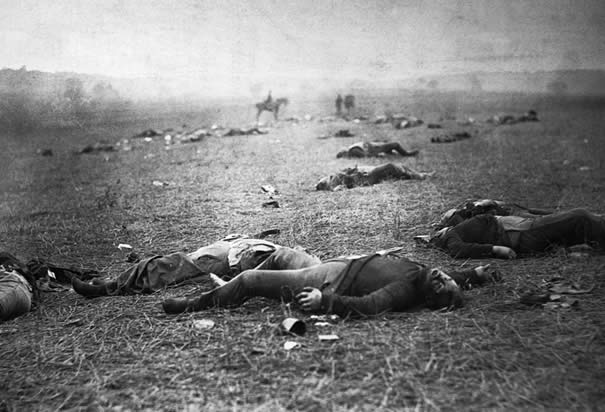
New estimates put Civil War deaths at 750,000

My daughter will be studying the Civil War this year in AP US History, and I'm going to recommend she read this book before that unit. It may just be Gettysburg, but it's a good human-scale intro to the war, and it certainly piqued my interest in that time period: we are now working our way through the Ken Burns documentary, and I've added the new, acclaimed Civil-War-era history Ecstatic Nation to my to-read bookshelf. I would highly recommend this book, even to those bored by history. Especially to those bored by history.

Edition note: The audiobook narration by Stephen Hoye was excellent. He's a slow reader and he practically sings the more lyrical parts, but that seems appropriate. He helped me get into the story — not that I needed much prodding. It's a page turner.

* I write for this blog and also for my own, Words Incorporated. I reviewed separate books for each.

Check out the other Cephalopod Reviews here:

1.The Armchair Squid2.Scouring Monk
3.Trisha @ WORD STUFF4.Counterintuitivity
5.Denise Covey, L'Aussie Writer6.The Random Book Review
7.Sally's Scribbles8.sharonhamiltonauthor.com
9.StrangePegs -- The Wizard of Oz10.Lara Schiffbauer
11.M.J. Fifield12.Julie Flanders
13.Nicki Elson14.Bird's Nest
15.Spill Beans16.Yolanda Renee
17.My Creatively Random Life18.Words Incorporated
19.Divine Secrets of the Writing Sisterhood20.Hungry Enough To Eat Six
21.Ed & Reub22.StrangePegs -- "Memories"
23.V's Reads24.Maryann Miller's It's Not All Gravy
25.Feather's Passion

Friday, May 31, 2013

Cephalopod Coffeehouse: The Dinner

Note: I am double-posting this review here and at Words Incorporated. 

For the inaugural Cephalopod Coffeehouse, I have chosen to review a book that's making pretty big waves in Europe, but hasn't quite reached the same level of buzz here in the States: The Dinner, by Dutch author Herman Koch. I'm always interested in reading books written in languages other than English, but usually they have to become megabestsellers before someone will translate them. And so it is with The Dinner. Written while George W. Bush was still president (he is referenced several times in the narrative), the book wasn't translated into English until 2012, and it's only recently been reviewed by major newspapers here.


"A European Gone Girl." —The Wall Street Journal

"An internationally bestselling phenomenon: the darkly suspenseful,
highly controversial tale of two families struggling to make the
hardest decision of their lives — all over the course of one meal."


The premise: two brothers and their wives sit down to a fancy dinner in Amsterdam in order to discuss a rather serious problem that has arisen with their respective sons. The nature of the problem is revealed fairly early on, but details are added as the novel progresses. And it's pretty grim. The novel's comparison to Gone Girl is not inaccurate: they are both compulsively-readable novels with unreliable narrators, a cast of appalling characters, and head-spinning plot twists.

In case you're wondering how a novel could take place just over the course of one dinner: it doesn't. While it's structured (rather cleverly) around the titular dinner, with each course representing a new development in the family saga, the action ranges far beyond the restaurant: we travel back in time with the narrator, Paul, who fills in the family history via recalled anecdotes. Of course, all these recollections are filtered through the black veil of his mind: you can trust what you're told only after you learn to interpret Paul's reality.

Paul Lohman. Humbert Humbert. Amy Elliot Dunne. It must be so much fun to write characters like these: twisted people who justify their unjustifiable actions to the reader. Characters who, as awful as they are, retain a certain charm. Who dare us to empathize with them, just a little bit. When you see the lengths these characters go to to exculpate themselves, you start to wonder about your own mind: do we all have a little Paul Lohman in us?

Paul starts off the novel as merely curmudgeonly, and invites the reader to sympathize with him as he mocks the pretentiousness of the restaurant and rails against his brother's slick political persona. Some reviewers who initially liked Paul found themselves unsettled when Paul goes from justifiably grumpy to pretty much unhinged. Maybe because I'd already been through that with Amy Elliot Dunne in Gone Girl, I wasn't so troubled by Paul's ever-worsening character. What bothered me more was Koch's decision to [slight spoiler alert] make Paul's personality into a neurological condition: somehow, locating the problem in the brain makes the story less urgent.

But this twist does bring up the problem of evil, free will, and heritability. Is the bad son that way because he made bad decisions of his own free will? Or was he a blank slate his dad trained into evilness? Or was he always going to be evil, due to the Evil Gene his father apparently has? The involvement of two cousins — one related, one adopted — further touches on the what-makes-men-wicked question. It's not explored directly, but Koch lets it hang there, ready for book-club discussion.

As interesting as these Bad Boys are, the truly interesting character (for me) ended up being Paul's wife, Claire. We have strong indications about why Paul and his son are the way they are, but what makes Claire a willing participant in the unfolding insanity? Because the premise is only the start of it: the two families have to decide what to do about their sons, now that the misdeed has surfaced. The brothers are set up to have conflicting solutions, but it's the wives who surprise us.

Koch makes a number of references to Tolstoy's famous line about families: "happy families are all alike; every unhappy family is unhappy in its own way." I wasn't really sure why he kept referencing this line at first, except to show how doggedly Paul was forcing his own family into that mold, in spite of all the awfulness that was being uncovered. But now I'm wondering if Koch wrote the book to overturn Tolstoy's maxim. Perhaps he wanted to show that happy families (and you could argue that the Lohmans are, in fact, a happy family) are not all alike. That happy families can have as many skeletons-in-closets and as much drama as the unhappy ones.

Visit the other Coffeehouses to read more reviews!


1.The Armchair Squid2.Cygnus
3.Scouring Monk4.My Creatively Random Life
5.Words Incorporated6.StrangePegs
7.Subliminal Coffee8.Ed&Reub
9.Back Porchervations10.WearingLemon
11.more...MILLVALLISON12.The Bird's Nest
13.Trisha @ WORD STUFF14.Writer's Block
15.Choice City Native16.Counterintuitivity
17.What's Up, MOCK?18.What It Is Like To Be A Frog (You Think?)
19.The Random Book Review