Showing posts with label Mary Mary. Show all posts

Friday, June 27, 2014

Cephalopod Coffeehouse: Outlander

Welcome to this month's round of the Cephalopod Coffeehouse hosted by the illustrious Armchair Squid! Pull up a chair and pour yourself a mug of coffee or tea!

This month I chose Diana Gabaldon's very first novel Outlander. This wasn't really a random choice. A little over a month ago I attended a event put on by the local library called "A Word With Writers." The featured speakers were Diana Gabaldon and George R.R. Martin. If you'd like to read about the event, visit Sister Lorena's post here.

Once upon a time I had tried to read Gabaldon's novel, but never finished. I knew why. I'd found it incredibly boring. But, after hearing her speak about her work, I thought I'd give Outlander a second chance. I dug around my bookshelf until I found my copy. The front cover was just as dated as I remembered and certainly didn't make me think that the lovely, delicate Claire was much of a beauty.


The cover of my copy. If you open the front
flap you'll find an equally unflattering
picture of Jamie with a late-80s
hairdo.

I flipped my book open to where I'd left off all those years ago, which was less than a quarter of the way through the novel. I even had an old, faded receipt I was using as a bookmark. It's from World's of Fun in Kansas City and says I purchased the amusement park ticket for $28.54 on July 3, 2000. So, yeah, it's been a while since I last cracked this book open.

What did I glean from reading Outlander this time around?

First off, although still boring for most of the story, I managed to get through almost the entire novel. I have to admit that I still have about 100 pages to go, but I've skimmed to the end and have a general idea of what happens. If you don't know how long Outlander is, it clocks in at 850 pages.

Next, I realized that Gabaldon has a certain beauty to the way she writes. I love how she describes Claire's surroundings in the novel. Or even some things that we take for granted. Like giving birth. Near the end, when Jenny, Claire's sister-in-law describes to Claire, who has never had a child, what birthing a baby feels like it becomes such an intimate moment filled with descriptions I never even thought about when I was pregnant. With scenes like that, Gabaldon has a magical touch to the way she writes.

Going back to the boring bit, I was disappointed to find that I felt like I never really got to know the main character, Claire. So many things that would be questions in anyone's head if they fell through time and into a strange world they knew nothing about are not raised. It's as if Claire knew exactly what to expect as soon as she fell through those rocks. No toilets? Not a problem. No bathing? Not a problem. Expected to wear suffocating clothing? Not a problem. Questionable sanitary practices in the 1700s? Not a problem. There were times when I wanted to shake Claire and ask, "Now, tell me how you really feel about the absence or lack of..." How do you go from having toilet paper to none at all and not feel just a bit nervous about the prospect? Claire never seems to mind not having modern-day amenities. And if the argument is because Frank, her modern-day husband, and all his historical research prepared her for something like this, I don't buy it. Simply put, she had no interest in what Frank did. That was apparent in the beginning of the novel. So, because I felt like I didn't really know Claire, all the strings of lovely descriptions, sex, and bits of adventure seemed to drag in many places.

On that note, the novel didn't pick up for me until around page 500 and the witch trial. Now, that I liked, and the next 200 pages were exciting. I didn't know what would happen to Claire. Would she be drowned just to find out if she was a witch? Would her knight in shining armor (a.k.a. Jamie) show up at the last minute? What I was hoping and waiting for throughout the entire novel was whether Claire would end up back at the ring of stones. If you've not read the novel, I won't spoil it for you. Her final decision between choosing Frank or Jamie was the right one, I believe.

Finally, there are some final tidbits that stopped me while reading. Claire spots Geillis's inoculation scar, but, again, she doesn't think one thing about it, and only on a side note brings it up to Jamie. What? I think my mind would be racing with all kinds of questions. Claire, from the modern world of 1945 knows an awful lot of older vocabulary from the 1700s. Somewhere I heard that Gabaldon wrote the time travel aspect because she couldn't get Claire to curb her modern-day tongue. Um, no. As soon as she's back in the 1700s, Claire seems to know all the lingo. I actually wanted more of her worldly tongue in the novel, and just felt disappointed it wasn't there. There's also an awful lot of spanking or talk of spanking going on throughout the novel. Just a head's up.

In the end, if you're debating about whether to read Outlander or not, then keep a few things in mind: 1) Gabaldon is truly a lovely writer, 2) 850 pages was way too long for something that could have used some extra editing, 3) Claire almost seamlessly fits into the 1700s, and 4) after all that, you may or may not be inclined to read the next novel in the series. I have no desire to read the next novel at the moment. But, who knows? Maybe I'll change my mind in, say, fourteen years!

Check out other reviews on the Cephalopod Coffeehouse bloghop:


Sunday, June 22, 2014

Postcards Tell a Story

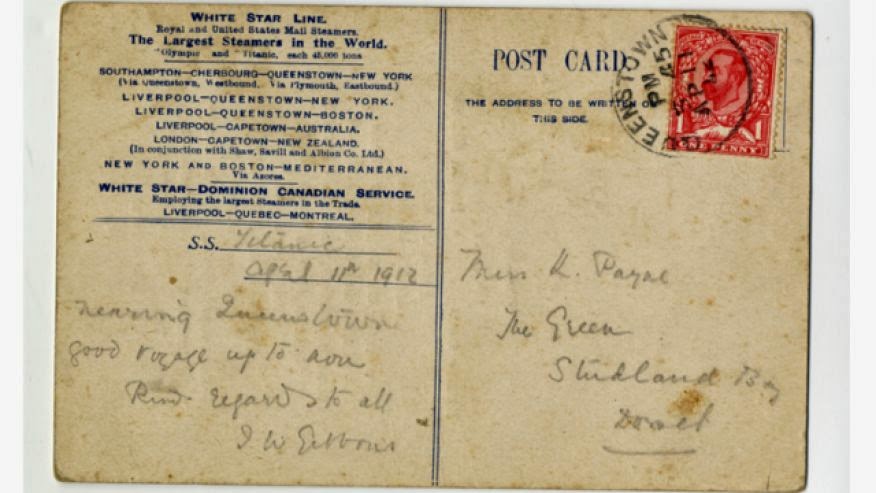
Recently I came across this article about a postcard from the Titanic that went up for auction. The postcard was reportedly expected to fetch $140,000. Why so much? Because this postcard is a rarity, and it tells a story.

The postcard to be auctioned off.
It says:
"S.S. Titanic, April 11th, 1912. Nearing
Queenstown. Good voyage up to now.
Kind regards to all.
J.W. Gibbons."

You see, the Titanic wasn't any different than the hotels of today. They plastered advertisement on just about anything, including the postcards that served as menus for each class. In this case, Gibbons, a second-class saloon steward, dashed off a quick message to his family back home before the final leg of Titanic's voyage. This postcard offers a rare glimpse into what the second-class passengers had for their breakfast:  "Yarmouth bloaters; grilled ox; kidneys and bacon; American dry hash au gratin; grilled sausage; mashed potatoes and Vienna and Graham rolls." I don't know about you, but that sounds like a filling and hearty breakfast! Very few second-class menu postcards are known to exist, so this one is especially a treasure for any collector.

Front image of the Titanic postcard.

As you can also see, this postcard also tells a story. I bet you're sitting there, wondering whether one Mr. Jacob Gibbons survived the sinking? I'll get to that in a minute.

Postcards have recently taken me on a strange trip down the avenues of history. This postcard story of the Titanic probably wouldn't have sparked much interest in me, if not for the fact that I've been researching some of the largest ocean-liners ever built. By the turn of the 20th century, immigration was at an all-time high for the United States. More and more immigrants were leaving oppressed or violent circumstances in Europe in search of a new beginning elsewhere. The number one destination for most immigrants became the U.S. and most notably, Ellis Island.

I had created a character for my story, but I didn't know where to start or where to place this certain individual. I decided to do what is often given as the first instruction to new writers: "Write what you know." At the turn of the 20th century most immigrants came from eastern Europe, from places like Germany and Austria. There were also many Italians and Irish flooding in. But I don't have much knowledge of those countries, so I went back to the one country I know best, which is France. France was more known for trying to slip prostitutes into the U.S., but they also had many immigrants who came seeking a new life like so many others. I got tangled up in researching French history and soon found myself immersed in the Champagne Riots of 1911. And guess what? I found postcards!


Revolution in Champagne -- 12 April 1911
This is a champagne house that was burned by rioters.
It was located in the city of Äy, which is found in the
Champagne region.
These postcards present some of the best lasting images of a time come and gone. They are like gold to any writer looking for historical information on a topic. 

Yes, it seems a bit strange that someone would pick up a postcard showing a burned out champagne house and decide that it was a good choice on which to write a message back home. History is strange, though. We don't always understand the mindset of the time or why things turned out the way they did. One thing we do have, if it's well-preserved, is a photographic history to offer us some insight into what once happened. That's why I like these postcards. There aren't many photos around about the Champagne Riots, but there are these snippets that are up for sale to avid collectors. They chronicle an important page in France's history.

Speaking of chronicling history, some of the very first "news" footage was filmed during the Champagne Riots. That's the only thing police had when it came to arresting those who partook in the destruction of Äy. I have no idea if the footage exists today (I've had no luck doing some simple online searches), but if anyone does know if the film is out there, I'd love to see it!

So, back to Mr. Jacob Gibbons. You can breathe a little easier, because he survived. He ended up getting rescued from a life boat. As soon as he could, he sent a brief telegram back home that read, "Saved, well, Daddy."

Do you have an interest in historical postcards?

Sunday, May 11, 2014

Some of the Best (and Worst) Moms in Entertainment!

I had a completely different post in mind for this week, but the Sisters convinced me to go with a Mother's Day theme. I thought a lot about how to narrow down the broad range of mother portrayals out there, and I couldn't come up with just one medium of entertainment to use. So, here are moms you'll find in film and television and which ones I enjoy and ones that make me so glad I had my own mom raising me. It's kind of a mixed bag, so feel free to let me know about your favorites!

MOTHERHOOD ACCORDING TO DISNEY

Now, I know there are those single fathers who are thrown into the mix like Belle's father in Beauty and the Beast and Jasmine's father in Aladdin, but, hey, dads have there own day, so let's focus on the mothers.


Snow White's Evil Queen
Wouldn't you want to sit across from her
at Thanksgiving?


  • Worst mothers in a Disney film:  I'd think most of you would agree that stepmothers get a bad rap when run through the almighty Disney machine and spit out on the other side. You have Snow White running for her life and eventually living with seven little men. I can't imagine any mother wanting her daughter to live with another man at Snow White's age, let alone seven of them. But, when your Evil Stepmother is out to kill you, you take what you can get. At least they were nice little men. Snow White's mother takes the cake for horrible mothering skills, but Cinderella's stepmother ranks right up there with her. Not only does she ban Cinderella to the ashes of the kitchen, but she locks her away in the attic when the Prince shows up. Keeping a girl from her man, especially a nice man like the Prince, is like playing with fire. Last but not least is Mother Gothel and the Tangled web she weaves. Like the witchy Evil Stepmother's downfall in Snow White, I also enjoy Mother Gothel's disappearing demise in the end.


  • Queen Leah looking very worried.
  • Best mothers in a Disney film:  I don't know if all of you would agree with me, but I have a soft spot for Aurora's (Sleeping Beauty's) mother. Here is a woman who sadly gives her brand new baby over to three fairies just so her daughter can stay alive. For me, that is such a heart-wrenching moment in the film. Grant it, maybe she should have swallowed her pride and invited Maleficent to the christening, but who would've wanted such a malicious woman like that at the special event? I think Maleficent dug her own grave when she placed a spell of death on the innocent baby. Then there's the saddest mommy story of all when it comes to a Disney film: Bambi's mother. 'Nuff said.
MOTHERHOOD ACCORDING TO PIXAR

Do you see my animation theme here? Don't worry. I'll get into some harding hitting stuff here in a minute.

She's not seen very often in the films, but here's Andy
with his mom in the Toy Story 3.

  • Worst mothers in a Pixar film:  Where's Boo's mother in Monster's Inc.? This little girl is missing for what seems like days in the human world, but we never know if her mother is worried about where her toddler has run off to. On another note, I think Remy's mother has way too many children to look after in Ratatouille. There should be a limit on the number of rats a rat can have.
  • Best mothers in a Pixar film:  Worst is harder with this category. Pixar does a great job at creating kick-ass, loving, and hard-working mothers. One of my favorites would have to be Andy's mom from Toy Story. She seems to have a sense of humor, and when you watch all three films and follow her over time, you know she's always had Andy's best interests at heart. Another personal favorite of mine is Elastigirl from The Incredibles. She puts up with a lot, especially when it comes to fights at the dinner table and saving her family from imminent danger. She's one tough cookie. Finally, I don't think I could round out this category without mentioning Queen Elinor, Merida's mother from Brave. It's not my favorite Pixar film, but their story is one of sincere mother and daughter love.
MOTHERHOOD ACCORDING TO TELEVISION

I know, I know. This is a broad category and I bet many of you fear I'm going to include June Cleaver. (Ironically enough, Barbara Billingsley, the actress who played June, was a single mom off-screen.) No, my plan is to focus on samples from the last twenty years, so don't worry.


If you haven't watched it and you
love the 80s, well...what are
you waiting for!

  • Worst mothers on television:  If you're a fan of Revenge, then you've got to know that the most scheming mother in the world shows up there: Victoria Grayson. She has one of the most fantastic wardrobes, but sometimes all her malicious scheming makes my head hurt. Then there's Regina from Once Upon a Time who has an adopted son she barely pays any attention to. Why should she when she's busy taking down Storybrooke? I always find it interesting that Alexis on Castle has a mother who's consistently AWOL. I haven't been able to watch the last half of this season, so I don't know if she pops up at all. All I know is that she certainly didn't partake in many of the child rearing duties. I don't want to inundate you with too many, because I'm sure you have many other awful mothers circling in your minds. These are simply a sample.
  • Best mothers on television:  Can I just say that even though she's a bit dippy at times that I absolutely love Lindsay and Sam's mom on Freaks and Geeks? Even though she reads her daughter's diary during that one episode, she learns from her mistake. Another, more recent, television mother who makes me roar with laughter is Beverly Goldberg on The Goldbergs. She loves her "scrumptious" boys, puts up with a pants-less husband most of the time, and does her best not to cuss out the neighbors when their son breaks up with her daughter. Priceless. Another mom I'll throw into this category to round it out is Tami Taylor from Friday Night Lights. She juggles a new baby, a temperamental husband, and an irate teenage daughter. And she always looks good doing it!
MOTHERHOOD ACCORDING TO FILM

Movies are perhaps the most relatable, since many of us have viewed the same films. Again, as I did with the other categories, I'll only give a sample of the many moms who have graced the Silver Screen.
If you haven't seen Grey Gardens,
then you're missing out on a
crazy good film!
  • Worst mothers in film:  If you're a fan of films from the 70s, then you know that Joanna Kramer in Kramer vs. Kramer is the poster child (mom?) for child abandonment. She leaves the family once, only to come back over a year later to gain sole custody of her son. She gets custody, but then leaves him behind once more. Nothing like glamorous abandonment with Meryl Streep playing the role. One bad mommy role that always gives me the creeps is April Wheeler from Revolutionary Road. The woman is so hell-bent on aborting her child that she's willing to risk her own life by doing the procedure herself, but winds up botching the whole thing in the process. And, of course, the role of horrible mothers wouldn't be cemented without a little Mommie Dearest on the side for portraying the psychotic nature of Joan Crawford. Last, but not least, I want to give a shout out to Grey Gardens. If you haven't seen it, you definitely should. Just bring a strong stomach with you.
  • Best mothers in film:  In Little Women, mother Margaret (Marmee) is always there for her daughters. She lets them be themselves during a time when it was hard for a woman to step out of any role set in stone for her. At the same time, though, she makes sure to teach them about helping the poor, loving their neighbor, and strengthening their own self-worth. Stepmom with Susan Sarandon and Julia Roberts is one of those films where you're glad to see the bond between two women trying to take care of the same set of kids. It's touching to see as their relationship melts from one of anger and cold indifference to an understanding that the baton will be passed and how to best go about doing it. Stepmoms don't seem as evil as they should be in this film. Finally, The Blind Side is one of those movies that makes you glad that people are willing to adopt children at any age. Leigh Anne Tuohy doesn't see only an aspiring ball player, but a young man struggling to keep his head above water enough to graduate high school.

A sweet one to watch with your
mom if you haven't done so
already!
Okay, so that's just a sampling of films to give you an idea of what I see as good mommy roles verses bad mommy roles. You may agree, disagree, or simply be indifferent to the whole thing, but whatever you do, go watch a great Mother's Day film with your mom. 

HAPPY MOTHER'S DAY!

Let me know what great mom films you like (or despise)!

Sunday, April 13, 2014

Let's Talk Nebraska

Last weekend, the hubby and I rented the Oscar-nominated film Nebraska. I'd seen a little bit about it before Oscar season broke out into full swing. I decided I really wanted to watch it for a couple of reasons: 1) I like just about everything director Alexander Payne has put out there (Hello? Sideways or About Schmidt, anyone!), 2) I'm from the Midwest, from a town very similar to the one depicted in Nebraska (only smaller, if you can imagine that) and I went to college in Nebraska, and 3) I just don't think the modern-day Midwest gets highlighted enough in films.

When I first heard about the film, it was being discussed among a group of friends. One woman in the group, who spent a majority of her life living in the actual state of Nebraska, vehemently denounced the movie altogether. She had no intention of ever seeing the film. At first, I thought it might be because of the film rating (R, for language), but then after watching Nebraska I think it was for a more specific reason. I think she viewed Nebraska as akin to the Holy Land with only hard-working saints living there. In other words, she believed that Nebraska would be portrayed poorly.

Not so, my friends!

I'd have to say I loved every minute of it because, in my opinion, Payne hit the nail on the head when it comes to families such as the one portrayed in Nebraska. Payne, himself, is from Nebraska, so who better to do the storyline justice than he.

Here's a little rundown on what goes on in the film:

Woody Grant, an aging alcoholic and perhaps suffering from early Alzheimer's, sets out almost weekly to claim his million dollars waiting for him in Lincoln, Nebraska. Only problems are that he can't drive and he lives in Montana. To appease his father, even though he knows the "sweepstakes" is a scam, Woody's estranged son David agrees to drive him down to Lincoln. Along the way, they get caught up with family in Hawthorne, Nebraska, where David learns more about his father than in all the years when he was growing up.

It's a sad, yet bittersweet story about family. Watching it, you realize that there were so many problems lying just below the surface of this family, waiting to come to light when the time was right. Woody's a man with long-suppressed demons, but it's David's connection to his father that twists, turns, and in the end grows into a final act of love. Even if it only means taking a drive down the center of town. Holding a lifelong grudge because someone is unwilling to sacrifice for you, only hurts you. Letting go and finally sacrificing for that other individual without accepting payment in return is sometimes the one thing you have to do. This is what David comes to realize about his father.

You may have watched Nebraska and all the while were asking yourself, "Do people really live and act like this?" The short answer is yes. Let me point out a few things about Woody and David's family that was readily recognizable with my own:

Woody and David searching for that "borrowed" tool.

  • Old men really do sit around talking about random things, like a car one of them owned once upon a time. I've been to those family reunions and have heard those conversations. And I've been down to the local diner/convenience store, which is filled with old men discussing the most random things.
  • There is the occasional relative who likes to sit alongside the road in the evenings and watch none of the traffic that goes by. Ours was, and still is, the front porch for our family. Usually while shelling peas or pitting cherries. Believe me, not much happens on my parents' street back home.
  • People really do go and pay respects in cemeteries even if no one has recently died. It's just what you do. I still do it when I go back for a visit. We'll be driving down a country road somewhere and my mother will say, "Do you know so-and-so is buried there? Let's stop by." And the next thing I know I'm standing over the grave of some unknown great aunt I never knew I had. My mother tells me her life story and introduces us like it's about time we met, probably hoping we could have coffee and bologna and butter sandwiches with the lady.
  • There's always a black sheep in the family, and that black sheep still usually lives at home (or thereabouts) and everyone acts like the sexual assault/robbery/drug bust never happened. Although, I must say my mother has warned us over the years of who to steer clear.
  • Everyone pretty much drives an American-made car. Here's why: Where I grew up, the only local dealerships were Ford and GM. If you wanted any other type of vehicle you had to go to the city, sixty miles away. No local mechanic really worked on foreign cars, so if your city-bought car broke down, guess how far you'd have to drive to get it fixed?
  • Finally, you'd be surprised at the brazenness of neighbors if you weren't used to it. The guy across the street could borrow your lawnmower, never return it, and he'd still come over all the time to talk to you. It goes the other way, too. Vegetables tend to get left quite often on doorsteps. It's like Mayday all summer long. I should know. My parents are one of those neighborly donators. 
Like anyplace in America, the Midwest has stories to tell, and they can be pretty darn good at times. I recommend seeing Nebraska if you haven't already. It's a simple storyline, but a very telling and touching one.

P.S. It really is in black and white.


✿   ❀   ✿   ❀   ✿

On another note, we just wanted to announce that for the third year in a row The Writing Sisterhood has received first place in the New Mexico Press Women Awards for best informational blog in the state of New Mexico! We're thrilled to have this award! If you'd like to check out any of the winning entries, feel free to do so:

Friday, March 28, 2014

The Cephalopod Coffeehouse: The Girl Who Played with Fire

"Salander heard a sound and saw a movement out of the corner of her eye just as she was putting the key in the door of the Honda. He was approaching at an angle behind her, and she spun around two seconds before he reached her." (The Girl Who Played with Fire, Page 193)
Welcome everyone to this month's round of the Cephalopod Coffeehouse. Make sure to make the rounds and see what everyone has been reading over the past month.

A couple of weeks ago I finished up the second book in Stieg Larsson's Millennium series, The Girl Who Played with Fire. I was going to review the third book in the series, The Girl Who Kicked the Hornet's Nest, over at The Random Book Review, but I haven't quite finished it. It's kind of been a busy week for me but, hey, I'm still reading!

This is the part where I make the assumption that everyone under the sun has heard of Stieg Larsson and his Swedish Millennium series, but considering that not everyone enjoys the same genres, I won't make that assumption. When reading Larsson's background, it's really not surprising he chose topics such as misogyny, sex trafficking, and corrupt political systems to use in his books. Here's a little bit about Larsson's background according to this website:
Stieg Larsson (1954-2004) was a Swedish writer and journalist. Prior to his sudden death of a heart attack in November 2004 he finished three detective novels in his trilogy "The Millennium-series" which were published posthumously...Altogether his trilogy has sold more than 20 million copies in 41 countries, and he was the second bestselling author in the world in 2008. Before his career as a writer, Stieg Larsson was mostly known for his struggle against racism and right-wing extremism.
He liked extreme storylines, to say the least. There is supposedly a fourth book hidden inside Larsson's computer, but much controversy surrounds who should own the rights to Larsson's estate: his father and brother or his life partner Eva Gabrielsson. Feel free to visit the website I listed if you're interested in checking out the controversy.

Stieg Larsson

About the book:

Mikael Blomkvist, crusading publisher of the magazine Millennium, has decided to run a story that will expose an extensive sex trafficking operation. On the eve of its publication, two people are brutally murdered, and the fingerprints found on the murder weapon belong to his friend, the troubled genius hacker Lisbeth Salander. Blomkvist, convinced of Salander's innocence, plunges into an investigation. Meanwhile, Slander herself is drawn into a murderous game of cat and mouse, which forces her to face her dark past.

If you've read the first book in the trilogy, The Girl with the Dragon Tattoo, then you know that The Girl Who Played with Fire picks up roughly a year or so after the first novel. After Salander and Blomkvist's harrowing ordeal in the previous book, Salander has skipped the country with her loot and has spent time abroad. We find her in Grenada at the beginning of the story, doing what she does best: saving a young woman from certain death at the hands of her husband. This element is important because as the story unfolds we see that Salander's past, which is riddled with abuse, will come back and rear its ugly head.

Where in The Girl in the Dragon Tattoo Salander and Blomkvist spend a large portion of the book together, in the sequel, they only come in close contact with one another at the end of the book. I struggled with that a little bit, because I was expecting more one on one work between the two of them. The third book is shaping up to be much of the same, but I've yet to finish it (I have about a third of the book left), so I don't know if there will be any resolution to their relationship. I'm hoping so (but please don't tell me how it ends)!

Overall, I enjoy the hacking capabilities of Salander. I'm very fascinated with every nuance of the hacking world Larsson creates. I have no idea if what he's saying is true about how hacking works, but at least it makes for an interesting read. I do struggle with Larsson's portrayal of women in his books. None of them seem like the type of woman a man would want to settle down with and raise a family. Berger, Blomkvist's longtime love interest, is tough as nails in the publishing world. She knows what she wants, goes and gets it, and stops for a little hanky-panky if the need arises. Which seems to be quite a bit with her and it usually borders on kinky. For whatever reason, Larsson feels the need to divulge all the ends and outs of the female characters' sex lives, but he doesn't go too much into the mens' unless they're the ones doing the sex trafficking. Salander is a very damaged individual and more of who she is comes out in the second novel. When Blomkvist learns the truth about her rape, I feel it's disappointing how he rationalizes his physical relationship with Salander. She had come to him not long after her rape, so that meant it was okay. Sorry, but that's just sad. What the girl really needs is someone willing to listen to her, but Larsson builds her into an individual full of mistrust and the need for isolation that all I ever feel for her is pity.

The hard-looking Lisbeth Salander from the Swedish films.

If you've not read the book, know this:  the story feels dated. Larsson drops so many brand names, especially with computer technology, that it loses some of that here-and-now feel. Grant it, the book does deliberately state that it's 2004, but time can be tricky when it comes to contemporary thrillers. Readers are constantly wanting to feel the technology and brands of today. Palm pilots may have been cool in 2004, but I don't know anyone still using them now. The book also tends to become a tedious read. There are some pretty long passages of information dumps and over explanation of the basic facts that at times the storyline gets swallowed up. As a whole, though, Larsson weaves a great story concerning Salander's background. Which, is why I had to read the third book.

Have you read any of Stieg Larsson's books? If so, what's your opinion?

Make sure to check out the rest of the Cephalopod Coffeehouse reviews:

Sunday, March 16, 2014

Being a Good Critique Partner 101

I've been at this writing thing for a while now. Eight years ago I had an idea and I ran with it. It wasn't until later that I realized I had to (*gulp*) let someone else read my manuscript. And thus, I found out about this critique partner thing.

If you're serious about having your work published one day, there is a vital key ingredient to this ever happening -- you need to eventually have a small group of writers just as serious as you are read your work and be willing to give an objective critique on what you've written.

This, my friends, is crucial.

Now, I've heard stories, read stories, have my own stories as a matter of fact, on what goes into being a good critique partner. And each story (much like a written story in real life) contains key elements as to why a critiquing partnership has held together as strong as super glue, has unravelled at the seams, or why it became just a struggle to keep. In case you didn't already know, for the past few years I've been blessed to have two of the best critiquers I could ever ask for -- the other two lovely sisters who participate in this blog, Lorena and Stephanie. I have a couple of fringe readers who may or may not read my work if the mood strikes them, but at the core I know I have these two. (You guys are awesome by the way!)

You might be asking how I managed to snag two great critiquers. Well, I'm going to give you a few pointers on how to go about looking for someone who matches what you're looking for. It's kind of like dating, but the expectations are very different (i.e. no small talk necessary, no dinners to be bought, and no wondering if he/she will call you the next day).

  • Are they even a writer? -- You might think this is an easy one to pick up on and, yeah, why wouldn't you choose a writer to read your work. Surprisingly enough, there are many unpublished writers out there who do anything but let writers read their work. I think, especially in the beginning, there's a lot of anxiety attached to having anyone read your book, let alone someone who really knows the craft. One way to ease out of those anxiety-filled thoughts is to enter a few contests that give you some sort of feedback. Any small amount of feedback will be helpful, plus it will help you get over that I-can't-let-a-soul-read-my-work hump.
  • What's a good number of readers? -- Like that saying about too many cooks in a kitchen, the same goes for critiquers. If you have so many, all with differing input, then you will be forever lost in the swirling typhoon of revisions. You won't know who to believe or what is the best route. For me, three is a good number. Why three? Well, if two partners have different opinions about an important scene, then the third will usually lean one way or the other. Anything beyond three and there's too much input for me to properly digest. Personally, I need information that will lead me in a solid direction and so far I've been fortunate enough with the readers I have.
  • Is it a good idea to have family members as critique partners? -- This one is a slippery-slope, my friends. At first, you might be inclined to have a mother, brother, or sister read your masterpiece because, hey, don't we all want our ego stroked once in a while! The fact of the matter is that you need objective readers. Family members tend not to be objective. They tend to be nice. They don't want to see you fail, so why not be a cheerleader instead. This can be one of the most harmful things for your writing. You will fail to grow if all you hear is loving feedback and that, yeah, your work is perfect, perfect, perfect!
  • Does a critique partner have to write in your genre? -- Better yet, do they even like to READ in your genre? Let's say you write horror. You meet a new friend at a writing meeting/conference/on the bus who loves inspirational romance. She finds out you're a writer and BAM! wants to read your work. You're so excited that you forget to mention you write horror. After you hand your book over to her, a day later she calls you and says she can't read such a dark, horrific storyline. You're crestfallen. The first thing you want to find out is if a critiquer has the ability to even make it through your book. Don't waste your time with grabbing up the first person willing to take a look at what you've written. Ask the pertinent questions first.
  • Do I really have to read their work in return? -- Um...yeah! That's the whole point in the critique partner relationship. After all, you're PARTNERS. This means you read what they have and they read what you have. Not that you both have to be finishing a novel at the same time to make it even-Stephen, but you do need to always be willing to take on what they've written. But don't act like they have to constantly make time in their schedules every week to read the newest novel you've started. There is a natural ebb and flow to any partnership. It's good to feel out the group, see what is expected of everyone, and make plans accordingly. As time goes by, the rules may get looser, since every writer works at his/her own pace. Never throw a snit fit if someone has to put off reading your work due to other circumstances. If you feel at some point that they are deliberately avoiding reading your work, then it's probably time to look elsewhere for a new critique partner.
  • What if I don't like the advice my partner(s) gives me? -- After any critique, you should first listen to what your partner has to say concerning your work. Don't get argumentative with them, just listen. Take it in and give it time to process. Chances are you won't agree with everything your partner says (after all, a lot of writing is subjective), but really take in what they've told you. If it's crucial critique pertaining to your plot (Is it messy? Does it flow? Is it too boring, too fast, too blah, etc.), to your main characters (Are they fleshed out properly? Does the conflict match up with them internally and externally? Are descriptions off or don't make sense?), or even dialogue (Is it boring? Is it realistic?) then pay attention! They're trying to show you where the main work needs to be done. If someone has gone to all that work to thoroughly read your manuscript, don't blow them off! Even if you hate your own book and never want to see it again. Always listen to your critiquer. Don't waste their time. After all, you chose him/her to read this book for a reason.
  • Should I follow through with changes? -- The simple answer here is yes. If you've done your homework properly and have chosen critique partners who enjoy your genre, are good at finding your problem spots in the manuscript, and aren't patting you on the back and giving you nothing useful in return, then take into account everything he/she has told you. If you have multiple critiquers telling you changes need to be made concerning the same problem spots, then you definitely should be making changes. The little bits can come later, but if you have a definite issue with plot structure, then sit down, chart out your plot, look at the critiques you've been given, and work it out accordingly. If you turn around and have that same partner read your manuscript again and you've done nothing to heed his/her advice then they will only be annoyed and chances are not have any interest in reading your work again. Don't burn your bridges!
  • How do I leave a bad partnership? -- I guess it depends on the maturity level of the other writer(s) in your partnership. Personally, I feel it's best to be straight with the individual. Don't be mean or angry about ending your critiquing partnership (you can still be friends, right?), but make sure he/she understands that this is a partnership that just isn't working. If you feel your work isn't progressing, or maybe there's more give than there is take on the other's end, then you need to move on. Eventually, though, you need to know what's best for your writing.
I was fortunate enough to meet both Lorena and Stephanie through a local writer's association. I didn't know if I would hit it off with either one of them. With my first critique group, I was the new one in the group, but that group eventually dissolved and a new one formed. Again, a member left and a new friend joined. Critique groups aren't written in stone. We all take different paths with our writing. Be willing to be flexible in your search for the right mix. If you feel damaged or thoroughly pissed off you are no longer part of a partnership, then take some time to rethink this writing thing. As writers willing to share our work, we have to be able to take on the tasks I listed above -- share your work, give productive feedback, take the advice given you, and rework your manuscript accordingly. After all, the point is to grow, and not be stuck in novice mode!

Sunday, February 16, 2014

The Resurrection of V.C. Andrews

A few weeks ago, I had the following conversation with my mother over the phone:

Mom: I have to go soon. We're going to watch Flowers in the Attic on Lifetime.
Me: Flowers in the Attic? Are you serious? Do you know anything about those books?
Mom: Well, I know your sister used to read them when she was in high school. (Which is true. My oldest sister went through a big horror stage at one time.)
Me: So, you know V.C. Andrews wrote the series. Do you have any idea what the story's about?
Mom: Abuse.
Me: Among other things.
Mom: What's that supposed to mean?
Me: Let's just say there's a relationship that develops between the older siblings.
Mom: Oh. Hey, it's on I gotta go.

The disturbing Dollanganger clan hanging out in the attic.

Who would've thought that all these years later a story like Flowers in the Attic would cut short my telephone conversation with my mother. To say I was stunned is putting it mildly. My mother never showed a shred of interest in books like that when I was growing up.

But, this conversation got the wheels in my head turning. Like many of you out there, I've read a V.C. Andrews book or two. Okay, maybe only two now that I think about it. I was never much of a fan of hers. By the time I was in high school, her work was no longer popular among the kids in my class. For those of you unacquainted with her novels, Andrews' work had a flair for Gothic horror and strange family saga, usually mixing a forbidden, or should I say taboo, love into the mix. She was, in my opinion at least, one of the few writers back in the late seventies and eighties writing genre fiction for what is now considered the YA market. Her stories had those creepy, forbidden elements that are now found everywhere in YA literature.

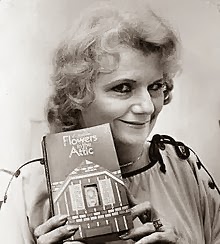
V.C. Andrews with her
first novel
For whatever reason, I decided to take a crazy trip down memory lane. I visited the local library and perused the V.C. Andrews titles on the shelves. What I discovered was something as eerie and shocking as some of the story elements found in one of her books:  Although she died in 1986 from breast cancer, new novels by her are still being published today.

At first, I was thoroughly confused, because I was almost sure she had died quite a while back. On a whim, I pulled a book off the shelf and flipped to the copyright page. This is what it said:
"Following the death of Virginia Andrews, the Andrews family worked with a carefully selected writer to organize and complete Virginia Andrews' stories and to create additional novels, of which this is one, inspired by her storytelling genius."
I was a bit gobsmacked after reading this. My first thought was, "What a ripoff!" Books are still being published under her name, but she's not even the author? My second thought was, "Why would any author want to publish under some other author's name?" The answer to that is probably a financial one, but that's just my opinion. I ended up checking the book out, because I wanted to see the style of this "other author" and how it supposedly translates to Andrews' style.

The book I chose, Delia's Crossing, is from a Mexican girl's point of view. We follow her from Mexico, after a horrific accident has claimed the lives of her parents, to California where she winds up being the household maid for her screechy, evil aunt. What I found is that although the ghost-writer, (how apropos for an Andrews novel) Andrew Neiderman, uses the same themes as Andrews did (i.e. rape, evil family members, questionable cousins, deep dark secrets, etc.) the story feels repetitive and really brings nothing new to the table. Delia's Crossing is a fast, easy read, but about halfway through, I was tired of the shrill aunt, the shrill cousin, and the almost paint-by-numbers approach to the plot. Maybe I need to be fifteen again to enjoy the salacious content.

For whatever reason, after I put the book aside, I couldn't shake the V.C. Andrews cult. That's kind of what it is really. Why do we cling the the way this author wrote to the point that we'd read a book that lures the reader in under false pretexts (i.e. Andrews' name)? Whatever it is, her estate found a lucrative foothold. Why would her estate continue to publish books that aren't even by her, but bearing her name, all these years after her death? Because just like the IRS figured out, her name alone is a valuable commercial asset. She is a business, plain and simple, plying the audience with inauthentic versions of the actual product, just like Walmart or McDonald's.

And this is what I find so disappointing about what's happened with V.C. Andrews' writing. As a writer, my story ideas come from my head alone. I don't care how many notes or half-written books I leave behind when I die, I have no intention of having posthumous stuff published unless it was already on its way out the door to the publishers. I don't want my work to be stripped to its bare bones, passed onto another writer to write as he/she wishes. I want my craft to be just that -- my craft. I have no idea what V.C. Andrews' wishes were concerning her work, but if this was not what she had in mind, then I find it very disappointing. Margaret Mitchell expressed how there would never be a sequel to Gone With the Wind, and look what happened there. J.D. Salinger, as odd as he was, viewed his work in the same light. His will states that none of his work is to be published until fifty years after his death.

So, here are my questions to you:  Are you a fan (or have you been in the past) of V.C. Andrews' books? Have you read the ones written by her ghost-writer? Do they stand up to Andrews' original works? Do you know of any authors whose work has received the same posthumous treatment?


Friday, December 27, 2013

Cephalopod Coffeehouse: American Passage: The History of Ellis Island

Immigration in the U.S. is complicated. This is a fact. And, from what I've read in Vincent J. Cannato's non-fiction account of Ellis Island's history, it's always been complicated.

Welcome to December's round of the Cephalopod Coffeehouse! I hope everyone is having a lovely holiday season! If you're not busy socializing with family, watching football, or taking in the season's festivities, then might I interest you in a discussion on U.S. immigration? Sounds fun, doesn't it?

This past month I dove into a non-fiction account of Ellis Island -- American Passage: The History of Ellis Island -- that little island in New York Harbor that initially threw its doors open to foreigners from all over Europe. Your first question might be why I felt the need to delve into such an extensive history on immigration, and I'll clear the confusion up right away. I'm researching a new book I plan on writing come the new year and the majority of it takes place on Ellis Island around the turn of the twentieth century-- a time when hundreds of thousands of immigrants were spilling into the United States. I found it all so very fascinating!

Vincent J. Cannato's book takes the reader on a journey that right away makes one see exactly where the growing pains of immigration began. His book is primarily about straightforward facts when it came to laws and regulations concerning immigrants and how to handle the rising tide. This is what Cannato says about it in his Introduction:
"Americans need a history that does not glorify the place in some kind of gauzy, self-congratulatory nostalgia, nor mindlessly condemn what occurred there as the vicious bigotry of ugly nativists. Instead, this book seeks to understand what happened at Ellis Island and why it happened."
And that's exactly what I was looking for when I cracked this book open. Cannato details the history of Ellis Island from it's early days as Gibbet Island, an execution ground for pirates (I know!), through the tumultuous and insanely busy days at the turn of the century, to its waning days as a detention center for Communist sympathizers in the 1950s. Ellis Island was officially closed as an immigration/detention center in 1954. By then, most buildings on the island had been shuttered and the main building had fallen into disrepair with some of the detainees commenting that the place was "a disgusting place," "a prison," met with "bitter disappointment," and "dirty, dingy, and grey with age."

In its heyday, Ellis Island (but initially Castle Garden before Ellis Island's main building was built) was the main immigration station in the United States, handling and processing some 12 million immigrants from 1892 to 1924. No immigrant could fully say he/she had entered the U.S. until they passed through those final doors and took the ferry into New York City. In many ways, Ellis Island also became a lightening rod for controversy. With the rise of eugenics, many stalwart Americans opposed the idea of letting just anyone into the country, especially the dirty, unwanted foreigners from over seas. On the flipside, immigrant societies and newspapers ripped Ellis Island's administration apart on many occasions, saying that not enough was being done to keep immigrants safe and free from deportation.

"The Stranger at Our Gate"
A popular depiction of immigrants first
published by the magazine Our Day
 in 1896.

With the 1891 Immigration Act the list of "undesirables" not to be admitted rose. It included "idiots, insane persons, paupers or persons likely to become public charges, persons suffering from a loathsome or a dangerous disease, persons who have been convicted of a felony or other infamous crime or misdemeanor involving moral turpitude, polygamists." As horrifying as it may sound to include immigrants in these categories, this is exactly what they did during the majority of early immigration. The idea was to sift the incoming immigrants and this was the best plan the government could come up with.

I think at times we tend to think of immigration pains as in the here and now. The truth is that the U.S.'s immigration predicament started long before now. Theodore Roosevelt had a lot on his plate at one time and, unfortunately, the passing of the immigration buck just went from president to president, hoping that in some way a solution would finally be found. We still grapple with that indecisiveness today.

Cannato does a thorough job with the historical aspects of Ellis Island, and I was happy to find such a well thought-out source. I will say that there were a few times I was put off by the way Cannato produced his facts. It was obvious he was interjecting his opinion at times. For instance, in an interview given by Vera, Countess of Cathcart in 1926, when detained for adultery (yes, that did happen under the moral turpitude clause) after her love interest the Earl of Craven fled to Canada when issued an arrest warrant for the same charge, said the following: "I am not a coward and have not run away, like the Earl of Craven. He has proved himself a coward in many ways." After this, Cannato puts into parentheses: "This was a man who had lost a leg in combat as a young officer during World War I." (Page 262) Um...is Cannato saying that when a man loses a leg in war he is no longer a coward? Or that if the man gives the authorities the slip for an arrest warrant that him losing his leg cancels out his present cowardly actions? I'm not sure, but I came across little tidbits like this from time to time. In all, though, I'd say I enjoyed reading Cannato's dissection of such a complicated piece of American history.

So, there you have it. A little breakdown on the U.S.'s history of immigration through Ellis Island. A few years ago I had the privilege to visit what is now the Ellis Island Immigration Museum. The main building has been overhauled and is fascinating to visit. What I loved most is the Registry Room where once upon a time incoming immigrants were asked a variety of questions before given or denied entry. It's large, nicely reconstructed and quiet. It's good to just sit there and maybe see if you can hear a conversation or two among the voices of the past.

Ellis Island in 1905.

Ellis Island today.
Make sure to check out other reviews in this month's Cephalopod Coffeehouse.

Sunday, December 8, 2013

Killing Them Kindly

Okay, I have a confession to make. (A new year is quickly approaching, so I can make an early resolution if I want to, right?)

I tend to laugh during movie death scenes.

There, I said it. (My resolution will be to try and stop laughing during death scenes.)

Last week, I joined some friends in viewing a film that was kind of 'meh' for me, but what really got me was the storyline. It was neatly tied in a bow and everyone lived happily ever after. Oh, except for the one guy who got shot by the drug cartel and died a slow, chatty death. And I couldn't help but laugh.

After watching the film, a friend who'd been sniffling behind me during the death scene called me out on my inappropriate behavior during such a poignant scene. Oh, for shame! He had leftover tears in his eyes, but a smile on his face when he asked, so I knew he wasn't really angry at me. But, I did have a moment of "Oh, I'm a horrible person!" And I hadn't realized I'd laughed. I guess it's become second nature when it comes to certain scenes I watch (by "certain" I mean unbelievable scenes that make the story seem cheesy).

So, why did I laugh?

Well, it goes back to that chatty character shot through with a bullet. He just wouldn't stop talking and die already. Maybe that sounds callous, but in reality, chatty deaths are not the way to take your character out of the story. It prolongs the scene as your character stands on his/her soapbox one last time, when you're almost sure he/she would be dead by now. It boils down to suspension of disbelief for the viewer or reader.

Then the question may be -- "What is the best way to kill off a character?"

Well, that depends on your genre. Even in the murder mystery realm there's a difference of opinion as to how to knock someone off right. A hardboiled crime novel will have no qualms of shooting things up as a character walks down the street. No one bats an eye when the body count rises. And the more expendable characters, the better. But, then you get into your cozy mysteries and the blood and gore is left off the page. Characters tend to "happen upon" the murder victim, and from there clues are meticulously sought out while the body is quietly removed from the scene. Literary tends to go either way. There could be a very public, gory display of death, or it could be a story centered around a mother slowly dying of cancer throughout the length of the novel. It all depends on genre and what the audience is expecting.

But, here are five things you don't want. These will leave your readers rolling their eyes:

  • Chatty Cathy Deaths -- As I mentioned above, nobody enjoys a chatty corpse. These are death scenes where it's obvious the victim is on death's door, but for whatever reason the author has decided that a long, lengthy soliloquy is needed. Unless you're Shakespeare, a drawn out, more than "merely a flesh wound" death is unnecessary. Don't let the character keep pulling his own string!
  • The Incredibly Overworked Death -- In these deaths, characters are fatally wounded, but they flail and carry on. They just won't die. A 1973 Turkish film, Kareteci Kiz, was voted in 2012 to have the worst death scene ever. (You're intrigued now, aren't you?) I didn't add the clip, but you're more than welcome to hop on over to YouTube and check it out. You'll see a useless bystander, some tragically horrible karate and knife action, about five random shots fired, lots of badly placed fake blood, and death in slow-mo. Sounds believable, right? You'll get a good laugh!

Look at all that fake blood!
And I thought the bullet wound was
 somewhere else!
  • The "No, He's Not Really Dead! It Was Just a Dream!" -- One great television show comes to mind when I think of this one:  Newhart. This show pulls off what could be seen as a death that didn't really happen (I was never really sure if Dick was supposed to have died in that final scene). After Dick is struck on the head by a golfball and the scene fades to black, we see that Newhart was nothing more than a dream during The Bob Newhart Show. Sound trippy? It kind of is if you've ever watched it. Although Newhart pulled this off beautifully, deaths that end up becoming dream sequences just don't work anymore. They've become clichéd and are seen as an easy out for the writers. Nobody likes to bid adieu to a favorite show, so why not make it seem like it was all a dream? Just ask the folks over at Roseanne. They tried to pull off something similar, only they didn't fare as well in their final episode.

One of the best season finales ever,
only, I wouldn't try this in your
own writing.
  • Fatal Cliffhangers That Fall Flat -- Arguably one of the best "will he or won't he die" cliffhangers ever comes from Dallas (the 1980s version, not the more recent one). During one hot, feverish summer in 1980, fans of the show barely slept because one question nagged their thoughts:  "Who shot J.R.?" Although J.R.'s life hanging in the balance at the end of Season 2 is one for the record books, chances are many of you can't even name his revealed shooter. As spectacular as the shooting may have been, it's best if a main character goes out at the hands of someone important, someone who holds a lot of meaning in that character's life. It took the show two months to reveal who-done-it, and it turned out to be a jealous mistress shooting him in a fit of anger. Hmm...With so many other characters out for J.R.'s blood was this the best move? That one is up for debate! Oh, and the shooter's name was Kristin Shepard.

Fascinating show, but I'm not so
sure about the shooter's reveal.
What do you think?
  • Killing the Most Beloved of All Characters -- This final point pertains more to who you take out and not how you take them out. We've all read a book or two where a beloved character gets killed off in the end. Mainly, these are stand alone novels, ones where the stakes are high and you know there is potential for death for the MC. But what happens with a series? For instance, in Catching Fire, the second book in The Hunger Games trilogy, I was pleasantly (but also horribly) surprised when Cinna, Katniss's much-loved stylist, gets killed right before she's scheduled to enter the arena. I was pleasantly surprised because Collins pulled that one off very well. (Sad, because, you know, it's Cinna.) But, let's say you take your readers through the entire trilogy and then BAM! You take out the MC? Not many series do this, but those that do tend to get angry reactions. Why? Because of the investment the reader has made. They are connected to this particular character and they want to see the best for them in the end...not death. How would you have felt if Katniss had met a random death at the end of Mockingjay? My point exactly.

Rewrite this ending:
Katniss dies.
So, there are a few pointers for you as you muddle through the decisions you must make when it comes to thinning the herd of characters in your book. At the very least, try to let your characters go out with a little dignity. Keep in mind that anything cheesy will induce eye rolling and possibly make your reader or viewer laugh!

Are there any death scenes from either books or films that just send you rolling on the floor? Are there any other pointers that come to mind for you? Share with us!

Sunday, November 10, 2013

Strengthening Your Prose

As writers, we enjoy that moment when we sit down to our computers and let our fingers wander across the keyboard to create that perfect story that we believe is going to be loved by all. But then, after that story or novel is out there and finished that first time through, we're stuck with the daunting task of the big "R" --


REVISION!
Don't you wish you looked
this good when you're
ticked off at your manuscript?

Oh, and what a difficult task it is to bring ourselves back around to that story and realize it's not as perfect as we thought it was when we were in the throes of creating our masterpiece. More often than naught, we tend to have a crazy mess on our hands that at times can sound as random as our thought process. I can vouch for more than one occurrence when I've read through a manuscript and the first thing that came to mind was, "What the heck was I thinking putting that in there?" I'm sure any writer has felt this at one time or another.

Since I'm currently in the midst of finishing up some final revisions on my novel before it goes out on the submission process, I wanted to share a few tips on how to polish up your prose, round it off until it's shiny and glowing all over the page, and perhaps help you out in the process, if not for some of the work you've written in the past, then perhaps for something you plan on writing in the future.

THE TO-BE VERB CAN OCCASIONALLY BE YOUR WORST ENEMY

I say occasionally on this one because the to-be verb tends to come off a little bit like "he said/she said": You don't necessarily see it after a while because our minds have become so conditioned by its use. But, that doesn't mean it wouldn't hurt to put a little more action into your sentences. Readers want to see the action moving along, and if everything comes off in the passive voice, you can really slow your story down. Evaluate your verb use, think about if there's a better way to form some of those sentences, and think about some stronger verbs (but not completely obscure verbs that only jump out at your readers) and finally look at the flow to make sure that what you've changed is really working in your storyline.

AVOID REPETITION

I'm sure we've all heard this more than a time or two, but I was surprised by how often I'd put similar words in sentences following one another. And they can be the most simplest of words, like "but" and "always." Of course there are the extreme cases where you might find you have a penchant for using a strong word quite often. I found out that mine was the word "bob." I know, sounds like a strange one to repeat, but when I did a word search, I had more than one manuscript should have to hold. If you find that an uncommon word is jumping out at you when you read your story, then do a quick search and if there's an over abundance of repetition, start thinking of a replacement or rewording the phrase all together.

PAY ATTENTION TO THOSE PESKY -ING STRUCTURES

You know, the ones we like to call gerunds. For whatever reason, writers are drawn to writing sentences starting in -ing. You'll find them in every book you read. Okay, maybe not every book, because I'm sure there's a big hater of gerunds out there who made sure not to use a single one. The problem with starting a sentence with gerunds is the fact that they often create a sentence filled with impossible actions. Here's a bad example:

  • Kissing the dog, Alice spoke to the mailman.
So, I think we can all safely agree that you can't kiss your dog and speak to the mailman all at the same time. Well, I guess you could, but I think that would be awkward and the mailman may never deliver a package directly to your door again. In any case, keep a close eye on how you're starting a sentence.

USING COMPARISONS WHEN THE STORYLINE CALLS FOR IT

I know I've read books where the storyline is bogged down with more comparisons than I care to read. Sometimes the author thinks "like" and "as" are her best friend, but that's when I start rolling my eyes. And you don't want to induce eye-rolling. But that doesn't mean you stay away from comparisons all the time. Sometimes it can help improve the overall length of a scene as well as offer a connection to your reader if you use something that takes a detailed, abstract description and boils it down to a simple idea. And it can help get your point across more quickly.

NARROW DOWN WHAT REALLY NEEDS TO BE IN YOUR SCENE

Taking a scene and creating a long-winded mess or being so sparse with details that your reader has no idea of setting and time can create some bad hang-ups for your manuscript as a whole. As an example, I have one manuscript where I'm describing the few belongings a character is packing away after he quits his job. I don't make a detailed laundry list of every article in his duffle bag, but instead narrow the items down to about three things that speak volumes of what will come later on in the story: A photo of a girl he was once sweet on, a Nazi pin his brother had stolen from a dead soldier and later gave to him as a gift, and the last birthday card his dead father gave him. Each item is important and each one speaks volumes of the people and circumstances surrounding the characters that gave them to him. Put into perspective what you need in a scene and why. Will it strengthen the manuscript? Or will it bog down the scene?

I could probably go on and on with other ways to polish your prose, but that's my short list for now. Let me know if there's something you struggle with, either in your own writing, or in that of something you've read!

Sunday, October 20, 2013

Writing Through the Storm

Pieter Mulier's Dutch Vessels at Sea in Stormy Weather
"When everything seems to be going against you, remember that the airplane takes off against the wind, not with it." ~ Henry Ford

"Gloom despair, and agony on me
Deep, dark depression, excessive misery
If it weren't for bad luck, I'd have no luck at all" ~ From the TV show "Hee-Haw"

I had another post in mind for today, but my mind kept circling back around to the idea of weathering storms. As many of you know, this has been a trying week for those working for, or are connected contractually to work for, the U.S. government. Needless to say, our family has been affected by the talking heads in Washington D.C., and I would be lying if I didn't admit that it has been one of those predicaments that I just couldn't seem to put from my mind no matter how many times I tried to convince myself that all of this would turn out to be fine in the end. With only a delay to the decision-making being passed, I'm not really sure when that end will be.

But does that mean my life completely stops for one unsettling moment? Does that mean my writing stops?

The answer is simple: no.

I've weathered many storms in my life (more than I care to count), and my love for writing even grew out of one of the most precarious times in my life. Feel free to read (or re-read) my success story if you're interested in knowing what that's all about. In truth, I find that writing through a little adversity, writing through those troubling and uncertain times in my life, have actually helped me grow stronger as a writer. Oftentimes, a writer will glean bits of information for his/her storytelling through the events in his/her life. And I'm pretty sure I'm one of those.

This past week, I came across an interesting post by one of our followers. The fascinating L.G. Smith of Bards and Prophets wrote a post concerning this past summer's damaging floods in Colorado and the clean-up efforts going on there. It touched me on two levels: First, I used to live in Colorado and recognized many of the places affected by the flooding. I don't know how many times we took trips up into the Big Thompson Canyon and heard the story about the flooding of 1976. And to have that type of devastating event happen all over again was heart wrenching. Second, I like how Smith engaged on a writerly level with what was going on. As a writer, I've trained myself to always be observant, always watching the people and events unravelling around me. Strangely enough, when I'm impacted on such a personal level it also impacts my writer's POV as well, much in the same way Smith wrote in her post. Disaster may be surrounding a writer, but it seems our minds are never at rest.

When a trying time hits, my first instinct is to shut down, draw myself away from those I'm close to. That might be due to my personality type, but it is exactly what I do. But, then, I have to stop and think a moment. Think about how I might best get through the storm. What techniques and ideas have I come up with or tried in the past?

Back in April of this year I attended a writing meeting where author Lynne Hinton spoke on various aspects of her writing. She shared some very good tips on getting through those tough times when all you feel like you're doing is waiting. Here are some ideas on getting your writing moving forward when the last thing you want to do is place your fingers on a keyboard:

  • Start a fresh project -- Instead of sitting around, moping about a given situation, or even something as difficult as waiting to hear back from an agent or editor on a project that's out, dive into something fresh. As I watched the news this week, wondering if a furlough would really come to our family, I found I needed something to take my mind off the uncertain circumstances. So, I visited the local library, checked out some research books on a new project I've been wanting to start and started in. Since I write American historical fiction, it's not hard to discover the trying times others before us have gone through, and maybe in the process feel a little better about the here and now.
  • Dig into your characters -- You need to shift your attention from focusing on your own problems to those of your characters. I have one book languishing on the shelf because I just don't know how to figure out my MC in the story. If I hadn't decided to dig into some new research, then that would have been another route for me to go.
  • Get in touch with your spirituality -- This helps me every single time. We all have different belief systems and find a measure of peace through that system, so take some time out and touch base. According to Dr. Robin, a consultant for Oprah Winfrey on the benefits of faith, she has the following to say:
"Dr. Robin says that people who disconnect from their faith community -- whether because of a move or other life circumstances -- often feel a sense of loss. If you feel like something's missing from your life, consider reconnecting with the faith or religious practices that you feel can enhance and enrich your spirit..." 
It may bring a calm to what you're going through, maybe even clear your thoughts for what you feel you need to do. Whatever it is that you feel you need, then take a moment and catch a calming breath.
  • Start a journal -- I'm not very good at the whole journaling thing, but there are writers out there who swear by it. Some feel they need to do it on a daily basis, and that's a big plus when facing a difficult situation. According to Psychology Today,
"Research has shown the tremendous benefits of journal writing on both our physical and mental health. Writing not only relieves stress and improves your mood, but it also boosts your immune system, which helps your body withstand the effects of further stress." 
Sometimes it helps to write out the junk that's going on in your personal life in order to tackle the lives of those characters you're creating. And, who knows, you just might find a nugget of inspiration in what you've written!
  • Stay true to the stories you enjoy writing -- When facing hard times, now might not be the time to jump ship and switch out your fantasy genre for hardboiled mysteries. As writers, we find comfort in the usual stories we like to create and it shouldn't be something we feel bad about doing. Take the turmoil that's going on in your personal life and find a way to apply it to your storyline on some level. Believe me, it can be very cathartic.
Maybe you're like me and have just finished out a stressful week. Is there something you enjoy doing that helps you and your writing weather the beating storm? One thing I know for sure, storms don't last forever. There's always a sunny, cloud-free day on the other side!

My motto is: more good times.
~ Jack Nicholson ~