Showing posts with label Storytelling. Show all posts

Sunday, March 9, 2014

Listening to Stories

Whether you're talking about hunter-gatherers sitting around a fire, or a toddler nestled in the crook of daddy's arm at bedtime, people first absorb stories through their ears. Humans are listeners before they are readers. It is curious, then, that people tend to look down on audiobooks, isn't it? My son prefers audiobooks, but his friends tell him "that's cheating," as if he's getting away with something. One of my own friends said to me, "You're not really reading books," when I confessed (why was it a confession?) that I listen to books as often as I read them. Of course, audiobook fans are less likely to have this prejudice, but I know I feel slightly embarrassed to admit I listened to, rather than read, a given book. Why do we give audiobooks so little credit?

One reason is an assumption that because audiobooks are "easier," you get less out of them. I found little data to support this theory. It hasn't been well studied, but Forbes reports on one study that indicated no retention difference between audio and visual books. "In some cases, listening offers major advantages over reading, even with material as tough to parse as Shakespeare," the article states. "That’s because an audio book pre-determines an aspect of language called prosody, or the musicality of words. Prosody is how we known that someone is being self-reflective when they ask aloud if they left the gas on (or when Hamlet asks whether 'to be or not to be')."

Saunders narrates his own book: a rare success
Whatever the reason for it, the bias against audiobooks is fading. Audiobook sales have soared as more and more people become aware of their charms. First and foremost for me is the time component: Because I'm able to combine "reading" with "doing," I nearly double my book-consumption rate. Do you know how much of your day requires little to no engagement from your brain? Washing dishes, vacuuming, folding laundry, commuting, walking the dog, cooking, gardening, jogging. We do a lot of activities by rote. You can liberate hours a week for book consumption. If you're like me, you'll also move around more as you listen, wanting to putter and find things to do so you don't have to leave the story. And less sitting is good for your health. See? Audiobooks will help you live longer.

An audiobook performance that blew me out of the water
Now, some books I truly prefer to read in visual form. YA-book narrators are often breathless and squeaky, which reminds me that I am a middle-aged woman listening to a novel for teenagers. I prefer to read those books. But other books really come to life when they're performed. When I first tried Dickens' Hard Times, I found it easy to put down. Then I came across a free version, originally recorded as a book for the blind, on iTunes. I was completely hooked: Alistair Maydon, the narrator, showed me the humor, the pathos, the personalities of the characters. From there I found Far from the Madding Crowd and Wuthering Heights. Those narrators changed the story from mere words marching across a page to a living, breathing thing. A good narrator performs a story, and when you're talking about something dry, or difficult, or written in an older style, a strong narrative performance can change everything.

The difference between reading and listening can come out in other, odder ways, too. Recently, I was reading The Good Lord Bird as I was hiking a snowy trail. There's a particular scene in that book, a gritty situation involving slaves being hanged for attempting a rebellion. I can picture exactly the spot where I was stepping as I listened to those events unfold. When I return to that spot—the 10-foot-tall rocks on the side, the patch of ice that never melts in the shadow, the way the trail curls around the rocks like a cat's tail around its paws—the scene from the book replays in my head. This happens to me frequently when I listen. The heightened emotional state seems to cause me to take mental snapshots of the scene around me, which probably has something to say about the relationship between emotions and memory.

Rewind, Scrubbing, Bookmarks: apps make it easy
One common complaint of audiobooks is that it's too easy to lose your place in a story, or space out and miss what's happening. The Audible app has a bookmarking function, which helps with this. But more critical is the 30-second rewind button. Most listening devices have this, and I use it often. I've learned to catch myself spacing out before I lose more than a minute. Another complaint is the books are too expensive. They can be: Neal Stephenson's Cryptonomicon is $47.55 on Audible. (It's also 42 hours long, so that narrator deserves every penny, plus maybe a medal.) But the Audible membership makes the books much more affordable—if you buy 24 credits, it amounts to $12 a book, which is no more than a paperback. Amazon, which owns Audible, often offers the matching audiobook for a discount when you buy an e-book. This allows the reader to go back and forth between reading and listening: each device even remembers where you left off, so you don't have to hunt for your place: I love this feature. I also pick up audiobooks from the library and from the iTunes store. Librivox is a site offering free classic novels read by volunteer narrators. If you're a Nook sort, Barnes and Noble has its own audiobook store, with its own special deals. Money doesn't have to be an impediment.

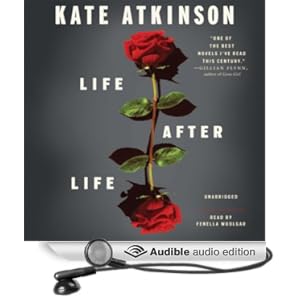
A final drawback can be terrible narrators. If someone last dipped into the audiobook world five or more years ago, you may remember some pretty bad renditions of novels. Try again. Narrators are usually professional actors, and while there are some stinkers in the bunch (review before buying), most narrators really add to a book. Some of my own favorites are Davina Porter (the Outlander novels), Fanella Woolgar (Life After Life), Jim Dale (Harry Potter), and Neil Gaiman, who narrates his own novels. Um, I just realized these are all Brits. Yes, I think I have a preference for those narrators, but I'm listening to the very American Oliver Wyman narrate an Iraq-war novel right now, and I can tell you: he is just as talented as any of my beloved UK-folk.

So what about you? Do you listen to audiobooks, or do you think they're "cheating?" If you like them, how often do you select them over a visual format? Do you have any favorites?

Sunday, November 11, 2012

Storytelling vs. Fiction Writing


After a lifelong affair with storytelling, becoming a professional storyteller was one of the highlights of my librarian career. At the time, I naively thought that being good at my craft (as I was told I was) meant I could put my stories on paper and instantly become a novelist. Think again! There is a huge difference between writing and storytelling. As the cliché goes, writers are made, storytellers are born. But like Yours Truly, you may be a fantastic tale-spinner and yet lack all the skills that makes a good novelist.

Family lore asserts that I was involved in storytelling way before I learn how to read. I used to memorize fairytales and then create my own version which I would retell to family, servants, pets and whatever captive audience I could get hold off. It was a form of oral fanfiction. As I grew old, my storytelling experiences went underground, until I found myself in Library School.

There I learned that storytelling was a crucial skill for good Children’s Librarians.  There I heard about the great Augusta Braxton Baker and other pioneer storytellers/librarians. I also got to meet and watch real storytellers performing their magic.  One of the landmarks of those wonderful years was a chance to do library programs in which I polished my old art and went through marvelous experiences that plied me with anecdotes to dine on for decades.

Augusta Braxton Baker


Technique vs. Drama
Encouraged by my storytelling success, I decided that I had the skills to become a true novelist. This crass mistake derived from my confusion between the terms “storytelling” and “story writing.” The first is all about voice, words, atmosphere, vigorous action, drama and wonder. The second is all about method, prose, rules and in-depth characterization. 


Popular commercial writers like to think of themselves as “storytellers,” consequently they rely more on dynamic action and dramatic mood than on literary technique. Their lack of fine writing skills is what their foes will bring up when attacking their work. On the other hand, think of Henry James’s novels, very little happens in them, but you can’t deny his masterful prose or his powerful characters.

The majority of fairy tales were originally found within storytellers repertoires. But when early folklorists shuffled those narratives from the oral realm to a written page, the tales underwent drastic modifications. Early versions of well known tales contained disturbing elements such as Sleeping Beauty being raped by the prince or Rapunzel having twins out of wedlock (something they forgot in the Disneysque version called “Tangled”.) Language had to be cleaned up and the whole text had to undergo a refining process. Each story found that transcription to paper meant to be bound by literary technique and conventions.

No twins for this Rapunzel!


Rules vs. Spontaneity
Storytelling is linked to an old traditional activity known as oral narrative. It goes back to cavemen telling tales around the camp fire. Most cultures will have some form of traditional storyteller, from the Irish “seancaid” to the Jewish “maggid.” In the past, storytellers have been seen as shamans, healers, keepers of tradition, even as intermediaries between the sacred and the profane. Such is the strength that comes from spinning a tale.


Telling a story, even to an adult audience, is a dynamic-spontaneous activity. You can’t go back to polish a draft or edit mistakes. What comes from your mouth is what your audience gets. It’s like acting in a play, if you goof you get booed. If you forget your character name, or skip a major moment, your audience will know and will let you know. And worse than being pelted with tomatoes, like actors of old did, is to lose your listeners’ attention. It is the equivalent of losing their respect.

You have to prepare in advance for predictable disasters. So you said “Princess Alice” instead of “Princess Alexandra”? Then you quickly explain that Alice is Alexandra’s evil twin who, in fact, is working wit Dark Forces to take over her sister’s throne. I know it sounds far-fetched, but believe me, it does work. I have tried it. Did I say the storyteller is an actor? A stand up comedian might be a better description.


Is your audience yawning and staring at the clock? Wake them up with some unexpected plot twist. In Romana, the Jewish-Italian version of Snow White, the heroine does not find shelter with benevolent dwarves; she ends up at the lair of seven ruthless thieves! I often imagine this twist must have come about as a desperate storyteller attempted to get his audience’s attention back with a “Hey, guess what? Romana has just been caught by the most dangerous gang in the entire Italian peninsula. Yes, seven hardened criminals, and there she is, hanging from a tree branch, wondering if she should climb down and take her chances with these strapping lusty outlaws.”

Darth Vader and Son


You may think this only works in front of a live audience, but surprise twists are useful in all forms of storytelling, especially in book or film series that have dragged too long and are reaching the point where the reader’s patience is wearing thin. Who would have imagined that Darth Vader would turn out to be Luke Skywalker’s father? It was the most unforeseen moment of the Star War Saga and left us waiting breathlessly for “The Return of the Jedi.”  Stephanie Meyer was aware that half her fandom wouldn’t be happier with Bella choosing to be Vampire Bride instead of the Wolf Man’s Wife. Her solution was to turn Jacob into Bella’s future son-in-law and leave her readers pondering about the possible incoming “Reneesme’s Adventures in Lycanthropy.”

Followers of George R.R. Martin’s Song of Ice and Fire were a bit confused after Clash of Kings, the second book of the series. Not only was it more slow-paced than the previous  Game of Thrones, but Martin’s surprising killing of the apparent protagonist had left his devotees treading on thin ice. The only thing they were certain was that the one great villain of the story was Ser Jaime Lannister. How else could one describe a man who had backstabbed his king, impregnated his much-married Queen (who also was his twin sister), ambushed good Ned Stark in the street, and threw children off ramparts?

Well, in Storm of Swords, the third book in the saga, Martin did the unthinkable: he presented Jaime as a victim. By turning him into a POV character, the author granted him a chance to tell his side of past events, baffling those who thought him a monster. That changed the viewer’s perception of the character forever, transformed the Kingslayer into a sort of heroic figure, and made Storm of Swords the most read, discussed and loved book of the entire saga.

Ser Jaime Lannister from Kingslayer to tragic hero


Archetypes vs. Well-Developed Characters
But storytelling is not totally devoid of pitfalls, one of them is lack of time and space to develop multifaceted characters. Thus, storytelling has to rely on archetypes: The Charming Prince, Cinderella, talking animals, and others that just by mentioning their name have the spectators imagining looks and personalities. When telling a tale in front of a live audience you don’t have the time to give a complete biography or a full physical description therefore you to have to simplify. One of my tales started like this, “Miguelito was a very poor mouse. So poor was he that his pants lacked pockets because he lacked loose change.” Obviously, if I was writing the tale I would submit to the “show not tell” clause, and never mention the word “poor.” In storytelling you just have to.


When Isabel Allende published The House of the Spirits, critics pounced on her accusing my countrywoman of creating a bad copy of Gabriel Garcia Marquez’s One Hundred Years of Solitude. Indeed, her book owed plenty to Garcia Marquez’s masterpiece, but Allende imbued enough political ideology and her own family lore into the novel to establish a distance. Moreover, she had one advantage over the Colombian author, she had well-developed characters.

This may sound like anathema. Don Gabo is a literary giant, nobody surpasses him in telling stories, describing imaginary worlds, and creating a family tree spotted with intrigue and domestic drama, but his larger-than-life characters are iconic images, never flesh and blood personages. Look at his fictional women. We know that his many Renatas, Remedios and Amarantas fall in and out of love, get pregnant by the wrong man and die in childbirth, but do we know what they think? What they like to do in their spare time?

Garcia Marquez is a terrific storyteller and as such he relies on characters that are a combination of mythical figures and anecdotes. He could stand in front of a crowded theater and verbally convey his novel because it belongs to an oral storytelling tradition. Unlike him, Isabel Allende’s characters are too complex and experience too much interior drama to be put into five words. There is no way to explain briefly about mystical Clara, forced by fate to marry a man that belonged to her dead sister. And how would you verbally express the horror, pain, and humiliation of Alba as she goes through physical torture?

Meryl Streep as Clara in "The House of the Spirits"


If I had to take one book with me to a desert island, I would pick The Holy Bible. Aside from its spiritual content, it’s the best storytelling I have ever laid eyes upon. Within its covers you find everything: political trickery, supernatural events, domestic squabbles, war epics, romance and lust. We love biblical stories and their protagonists have become household names, but do we see them as real-life characters? Do we get to know their point of view? We know King David liked women and played the harp, but what was his favorite food? We know Sarah hated her husband’s concubine Hagar, but do we know if Hagar hated her back? Do we know if Hagar was happy with Abraham?

Every March, Orthodox Jews are subject to one great story hour. The reading of Megillat Esther (The Book of Esther) is the highlight of the Purim Holiday. The synagogue becomes a big storytelling room. All gather to hear the rag-to-riches story of Esther, a nice Jewish girl who is taken away from her home, and after winning a harem beauty contest, becomes Queen of Persia. I love to hear how even after marrying the most powerful man in the land, Esther is still subject to palace intrigues, has to hide her Jewish identity, and strives to save her people from evil Haman.


The story ends in a colossal triumph after Esther manages to save Persia, the Jews and herself through cunning and courage. It’s Cinderella meets Joan of Arc, but do we know Esther? Do we know how she felt about her king-husband?  Is she home-sick? Where did she learn to play bedroom politics and how she went about it? Knowing the answer to all those questions would make The Book of Esther a terrific novel, but it would probably take two days to read it in the temple. Even the most pious audience would be snoring before the reading was over.

Continuity vs.  "The End" word
Whenever we think of the term “storyteller,” the name “Sherezade” comes to mind. Wrapped in her veils, the protagonist-narrator of the Arabian Nights is the teller of stories par excellence. She alone performed the prowess of spending a hundred-thousand-and one nights weaving stories to charm a king out of his psychotic misogyny. What is so compelling about her feat is the impression that Sherezade spends every hour of her existence at her craft, that her entire life is linked to the continuous act of fable-spinning. It’s only by the end of the book, after it’s disclosed that she has delivered two sons for the Sultan, that we realize that a lot more went on  in that bedchamber than just telling tales.

María Montez as Sherezade


Sherezade exemplifies one of the greatest joys of storytelling, its continuity. Unlike novel writing that is bound to arrive to the word “The End,” a tale could go on forever. A storyteller could call it a day just to retake the narrative thread the following day, or night like Sherezade did. A novelist can give up on his craft, never write another book, a great novel may never have a sequel, but storytelling is endless. You have cycles of tales connected to one single protagonist like Anansi, the Spider or Stupid Jack. That is what written series and storytelling have in common, the infinite possibilities.

Agnes Newton Keith was an American bestselling writer that wound up experiencing stranger than fiction events. In 1942, she and her small son were taken into captivity by the Japanese. For the next three years, she lived in a civilian prisoner camp, away from her husband and enduring privations, malnutrition, slave work, plus physical torture and a rape attempt. Throughout her captivity, her utmost preoccupation was the survival and well-being of George, her little boy. One way she found to keep up George’s morale was an evening storytelling session that centered on the exploits of a super hero known as Big Game Hunter “Keith of Borneo” (later joined by “Jack, the Giant-Killer”.)

Birthday card , Agnes Newton Keith sent to her husband while still in captivity


One night she realized that other children in her compound had gathered around her mosquito net to hear her story. At first, Mrs. Keith wanted to yell that this was only for George, but finally she gave in. Her daily story session became a source of pleasure and comfort for the youngsters in captivity and a way to maintain her narrative skills. She stretched Keith’s adventures as far as credibility could allow, sent him on trips around the world, personalized the stories and in every way proved the power of storytelling and the capacity for a tale to continue ad infinitum.

The Interactive Storyteller vs. The Writer in the Ivory Tower
Mrs. Keith’s anecdote illustrates another advantage that storytelling has over story writing: you get to know your audience. When we write our first bit of fiction, we write it mostly for ourselves. We are the target audience and we grow attached to that piece because we like it. Then we expose it to the criticism of family and friends. We start modifying our text to suit the audience’s needs, a process that expands as we move from acquaintances to agents and publishers. We are always running into new more demanding readers, while in the horizon looms the threat of the “real public,” a terrifying but foreign group.

In storytelling you have no such problems. Even if you may be awed at the prospect of meeting listeners for the first time, you’d have plenty of data on them. You will know their sexes, occupations and ages. Novelists have three abstract age groups to choose their target audience from: children, young adult or adults. In storytelling, age groups tend to be more specific.


My first story session brochures explicitly said “toddlers and pre-schoolers” and my audience were Latinos. My second storyteller job was with elementary school children and it was done in English. Even when dealing with adults, knowing in advance that you will be addressing senior citizens, middle-aged housewives, or teenage boarding school students helps you prepare tales, props and mood.

When your book hits the market you don’t know who will be buying or reading it. Whether it comes from New York Times reviewers or by readers complaining on the Amazon boards, reactions to or interpretations of a novel may shock its author. The storyteller gets to face the reaction immediately and has a chance to discuss the interpretation or even change it, because storytelling is always an interactive activity. So interactive that in some cultures the listeners actually interrupt the session with questions and even offer suggestions to improve the storytelling.


There is tremendous power in storytelling for narrator and public alike. When my mother saw the snapshots of my first story hour she was more impressed by the children’s expressions than by her daughter’s antics. “Look at their little gaping mouths!” she said. I know what it’s like to captivate an audience as well as I know what it feels to be enthralled by a fine storytelling session, or by a book that fulfills my emotional needs or by a television show that grips my attention while bringing comfort to my exhausted mind.

Modern authors tend to forget and forsake the pleasure of interacting. They cherish (sometimes with good reason) the distance that separates them from audience. A true storyteller would never sacrifice his chance to know the feedback of listeners/readers and would find a way to recognize and meet their needs.

Can you think of a novelist, or scriptwriter who combines the quality of fine fiction writing with strong storytelling skills?

Sunday, July 1, 2012

The Powerful Pull of Superheroes

Andrew Garfield and Emma Stone
in the latest and greatest version
of Spiderman.

Lately, I've been very intrigued by the comic book and graphic novel industry. Recently, I took a trip to Paris and, out of curiosity, I wanted to see if the Virgin Megastore on the Champs Elysées was still in business (considering how so many forms of entertainment have gone digital). For me, it was a trip down memory lane, being a poor broke English assistant, I spent many hours with headphones on listening to the latest CDs on the market. (Wow, do I feel old!) Of course, the store had changed and things had been rearranged but, to my surprise, the top floor was dedicated to a café, a small pricey area filled with expensive writing utensils and... comic books and graphic novels. I'm talking walls and rows of comics and graphic novels I'd never heard of and some that have been around for years. All I could think was, "Who reads these?" because I certainly don't. I didn't take a photo to share, but click here if you'd like to see what it looks like.

A few months back I wrote a guest post entitled "The Year of the Superhero," and quite frankly I wrote it because I've noticed how saturated movie theaters have become when it comes to movies about superheroes. By the end of this summer, there will have been five superhero movies released already this year. Marvel Comics alone has a new comic book on stands every Wednesday. Not being a comic book reader, that sure shocked the pants off of me!

And I'm also curious as to why so many people get pulled into these stories. There obviously has to be a market for both comic books and graphic novels if they are getting published on a very regular basis since their popularity exploded in 1939. So, I went in search of some answers.

First, let's start by defining the difference between comic books and graphic novels. According to Graphic Novels.com, here is how they define both mediums:
❝Graphic novels are, simply defined, book-length comics. Sometimes they tell a single, continuous narrative from first page to last; sometimes they are collections of shorter stories or individual comic strips. Comics are sequential visual art, usually with text, that are often told in a series of rectangular panels. Despite the name, not all comics are funny. Many comics and graphic novels emphasize drama, adventure, character development, striking visuals, politics, or romance over laugh-out-loud comedy.❞
But what is it about these storylines, with their comically dressed masked men and women and bubbles of words floating about their heads? Why do we need superheroes in our lives?
The Phantom

One of the longest running comics still on the market is The Phantom, the first ever superhero to grace the pages of a newspaper. He doesn't have any supernatural powers like those who followed in his footsteps (i.e. Superman, Spiderman, The Green Lantern, Wonderwoman, etc.), but rather relies upon his natural powers and skills like Batman, Black Widow, and Iron Man. In an informal and unscientific conversation with my husband who used to be quite the fanboy back in the day (and in some ways still is), I asked him what he enjoys about superheroes in general. Do those with supernatural powers outweigh those without? Do the female superheroes need to be sexy in order to draw the male public in? And the stories -- are they any good?

For my husband, The Punisher is his favorite. If you can remember back to the films that have been made, then you'll know they didn't fare too well at the box office. But it's the guns and the vendetta The Punisher has that makes him relatable to the reading public (or mainly to men). He's an antihero of sorts, one who goes after the criminals with any type of war weaponry available. He stands up for the little guy. And, perhaps, there in lies the key. Will any given superhero stand up for Plain Jane and Average Joe when the going gets tough? He pretty much has to if he wants the public to love him.

Here is a list of other characteristics many superheroes share:

  • Intelligent
  • Wears a Costume (I can't think of one who doesn't.)
  • Athletic
  • Role Model
  • Has a Weakness (Kryptonite, anyone?)
  • Has an Arch Enemy
  • Secret Identity (alter ego)
  • Love Interest (i.e. Mary Jane, Lois Lane, any one of Bruce Wayne's women)
  • Has a Goal
  • Special Powers (not necessarily supernatural powers)
  • Earns Respect
  • Has a sidekick
  • Unique
  • Uses Gadgets
  • Has a Lair or Hideout
  • Interesting Past (this is what motivates him in his quests)
  • Vehicle (i.e. the Batmobile, Iron Man's suit, the cool plane the X-Men use)
  • Determined
  • Strong
  • Brave
That's quite a list, but every single one of them is true. What would Superman be like if not for kryptonite weakening his powers? Batman needs his Batcave, right? And don't forget that gadgets are a must for Iron Man.

Overall, I think what most look for in a superhero is whether or not he is incredible in some extraordinary way and yet is very human and relatable to what is going on in one's life. My husband prefers those who don't possess a supernatural power because they are just like you and me. Take a look at Bruce Wayne. He has this dark past that makes him human on many different levels, but when the sun goes down, he goes out and hunts down the bad guys. At the same time most comic book and graphic novel readers enjoy the badassery of all superheroes, even the somewhat antiheroes like V from V for Vendetta. He's out there cleaning up the streets using his terrorist tactics to fight against his totalitarian government, but also keeping a cozy existence underground enjoying the simpler things in life like music and books. Superman has impressive powers, but at the same time he's just a boy who grew up on a farm and works as a reporter for his day job. You can't get more basic than that, can you?

Sometimes a superhero never
connects with the audience, like
with The Green Hornet.
But, sometimes a superhero's story just doesn't connect with the public. The most recent occurrence of this is with the 2011 release of The Green Hornet starring Seth Rogen and Jay Chou. My first thought when this film was released was "Who thought Seth Rogen could play a superhero?" (Personally, I think he lacks some of that "athletic" skill mentioned in the list above.) And many critics mirrored my thoughts. Roger Ebert didn't mince words when he said, "The Green Hornet is an almost unendurable demonstration of a movie with nothing to be about." Mike LaSalle from The San Francisco Chronicle had this to say:
"No one loved it into existence. No one had a dream...it feels less like an adaptation of The Green Hornet than a series of vague gestures on a 'Green Hornet' theme. In the place of the basic elements of storytelling, the movie offers vacancy."
In truth, consumers of comic books and graphic novels don't want to spend their money on some vague story that offers no satisfaction in return. They want to see the hero overpower the villain. They want to see what drives that character to go on a vigilante quest. They want to know what weakens the superheroes strengths and how that superhero devises a plan to get around such obstacles. The reader wants to feel his/her own vindication in the end, and, of course, there needs to be a hook to push that reader into buying the next installment in the series.

After all, what Mike LaSalle has to say at the end of his review is very true indeed:
"It's strange, but even in an action comedy, if the audience doesn't care whether the protagonist gets killed, it's a big problem. Without that one human element, all the carefully orchestrated action becomes mere commotion -- and sleep inducing."
Keep that in mind. We don't want to become noise in a reader's ear, to the point that he/she stops reading our work. Any writer needs to make the reader care about that main character -- no matter what genre you write!

Are you a comic book/graphic novel reader? If so, what's your favorite and why? Do you feel that any of the longstanding stories have jumped the shark and you just won't read them anymore? Do you feel the films ever measure up to what's written in the books?

Sunday, June 19, 2011

Confessions of a Former Telenovela-Addict

Say the words telenovela* or soap opera among a literary circle and you will get one of two reactions:

a. A smirk
b. Silence

Writers would rather have their wisdom teeth pulled out than admit that at any point in their lives they watched a soap opera.

Not me. I admit openly and freely that I once was a telenovela lover. A lifetime of watching soaps from many different countries, gives me the freedom to say without prejudice that many of them are bad and I probably shouldn’t have wasted my time on them. But there are others that I still remember fondly, which have inspired and influenced my writing. Stories that portray the idiosyncrasy, culture, history and charm of a country. Stories with complex and three-dimensional characters, or plot twists that kept me on the edge of my seat (cursing that it was Friday and I had to wait till Monday for the next episode.) Some have touched me deeply or impressed me with their settings and costumes (admittedly, historical soaps are my favorite.) As a writer, I’ve been a weary observer of contrivances, clichés and predictability of some telenovelas, but I’ve also absorbed and learned from those with the flawed heroines, entangled relationships and unexpected developments.

Ramona (2000), based on the 1884 American novel written
by Helen Hunt Jackson,
explores interracial relationships and incest.


The common misconception is that all telenovelas are the same: poor girl falls in love with rich guy, guy must marry wicked/rich antagonist (pregnant with someone else’s child.) After a series of misunderstandings (and poor protagonist’s improved look and economical status) hero and heroine come together. This formula, with hundreds of variations, is used over and over again.

Sure, many telenovelas follow this simple recipe. But there are many that have broken away from the mold. Let’s take a look at the different categories:

Classic Telenovelas

The traditional Cinderella-story that has given the genre a bad name. This is the bread and butter of the Mexican Televisa, the second largest media conglomerate (after the Brazilian Rede Globo). To be fair, it has been used in other countries, too. This easy, predictable plot still sells and Televisa would rather mass produce ten Big Macs than one Lobster meal. After all, they’re faster and cheaper to make, and they already have an audience. This category is the comfort food of many who like easy-to-follow plots and clear-cut good and bad characters.

It should be noted that when done right, this subgenre can be quite enjoyable, like the Colombian hit Café, con aroma de mujer. It only took a few tweaks from the traditional mold (a charismatic protagonist who sings while collecting coffee grains and a hero whose weakness is aguardiente and an impotence problem only resolved in the arms of the heroine.) This telenovela sky-rocketed to novela royalty, together with the Venezuelan Cristal (which is currently in its second Televisa incarnation.)

Café (1994) a classic and beloved Colombian telenovela written by Fernando Gaitán,
the author of the groundbreaking
Yo Soy Betty La Fea (Ugly Betty).


Costumbrista** or Rural Telenovelas

In Colombia, Chile and Brazil, this subgenre has proven very successful. The writers/directors figured (around the 80s?) that in order to compete with the big Televisa monster, they had to offer an alternative for viewers. Except for Brazil, the other countries couldn’t compete with the expensive production of the Mexican telenovela empire, so they focused instead on telling different stories, displaying charming traditions and idiosyncrasies through eccentric and humorous characters. And so, the Colombian novela was born. Here you can find quirky antagonists you can’t hate (their plans always go wrong and they often have colorful sidekicks) like in Gallito Ramirez (with the popular singer Carlos Vives), Caballo Viejo and Me llaman Lolita. It should be noted that Televisa has been paying attention and has now branched out from their flat, one-dimensional antagonists in some of their soaps. This is also the forte of Brazilian and Chilean telenovelas (known as teleseries). Their “themed" soaps focus on a particular immigrant group and how they relate to the locals (Gypsies, Muslims, Italians, etc.) Or a particular setting (ex: circus.) One of my favorite Chilean teleseries (Aquelarre) is about a small town with a strange problem: only females are born here. The secret behind this phenomenon drives the plot and is only revealed at the end. Rural novelas in Mexico usually involve a hero and a heroine caught between feuding families a la Romeo and Juliet (Cañaveral de Pasiones, El Manantial) but they are a lot more dramatic.

The Brazilian soap opera O Clone (2001) explores the possibilities of cloning
and introduces us to Muslim traditions and other subthemes, like drug addiction.


Historic or Period Telenovelas

I’m constantly in awe of Mexican, Brazilian or Chilean period telenovelas. The attention to detail, fashion and setting is impressive (in Brazil, they built a village for Xica da Silva.) These stories feature extraordinary characters. You can find strong heroines who are not afraid to travel alone across the continent in search of the men who impregnated them (Alborada), upper class women who become mistresses of married, older men (Alondra), protagonists who use their beauty and sexuality to become powerful (Xica, Dona Beija), vengeful women who cook those who betray them and feed them to their enemies (Xica), female doctors who dress up as men in order to be near their estranged fathers (Pampa Ilusión), women who flee their stable haciendas to follow their beloved to remote Indian tribes under attack (Ramona) or divorced mothers who become singers in spite of the rigid societal rules constricting them (Si Dios me quita la vida.)

The protagonist of the Chilean Pampa Ilusión (2001), Inés Clark,
impersonates a male doctor to learn why her father sent her away as an infant.


Unexpected pregnancy, spousal abuse, divorce and a judgmental daughter
won't stop María from pursuing her lifelong dream of becoming a singer in the 1930s.
(Si Dios me quita la vida, 1995)

You may also find heroes with serious flaws: pirates who traffic slaves for money (El Antillano in Pasión), leading men who are willingly unfaithful to the heroine (El Comendador in Xica), hardened men feared by all in town who succumb to the heroine’s noble heart. (Juan del Diablo in Corazón Salvaje.) You will also find antagonists who’ll do anything to keep their weakling sons in power (Doña Juana in Alborada), women who use religion to punish and manipulate (Violante in Xica), and daughters who cut ties with their mothers based on appearances (Tete in Si Dios me quita la vida.) Sprinkle these unusual characters with fascinating subplots and you’ll have the complete package of a good story, amazing performances and visually-stimulating scenes.

Xica da Silva (1996), the former slave-turned-most powerful woman in
El Tijuco,
never forgets her friends or forgives her enemies.


There are also telenovelas based on real historical events with fictionalized characters. The late Ernesto Alonso produced beautiful work about the history of Mexico in three series: El Vuelo del Aguila, La Antorcha Encendida and Sendas de Gloria. Currently, Colombia has ventured with a historical piece based on the life of a mestiza who fought against the Spaniards during post-colonial times but fell in love with one. (La Pola) (Currently broadcast in the US.)

The pirate El Antillano (Pasión, 2007) carries the trafficking of slaves
on his conscience.
Will the love of his life ever forgive him?


Contemporary Telenovelas

These are the kinds of stories you find in American soap-operas. The protagonists are professional women who are no longer virgins and may have more than one boyfriend. They may have marital or infertility problems. Or they may be older women having extra-marital affairs. These telenovelas usually take place in urban/cosmopolitan settings, and more often than not, are stories with “issues” (the soap opera equivalent of Jodi Picoult.) In Brazil, Globo found a gold mine telling controversial stories about surrogate mothers, cloning, drug abuse, twins separated at birth, mothers and daughters in love with the same man, etc. Many of them revolve around the world of fashion. My favorite of this category is the Brazilian Tititi (80s version), a modern-day Romeo and Juliet where the feuding fathers are competing fashion designers. These telenovelas often show two sets of characters: the affluent in their mansions and the poor in marginal neighborhoods (usually the humorous characters are found here.) Colombians have also found success in this subgenre with the iconic Yo soy Betty, la fea, the original version of Ugly Betty, and more recently Vecinos (Neighbors) where these two conflicting worlds meet when a taxi driver wins the lottery and buys an expensive apartment in an exclusive Bogotá neighborhood. As an alternative to Televisa’s classic telenovelas, their Mexican counterpart, TV Azteca, produces this type of scenarios. Televisa has also tried this subgenre. An example is Alguna Vez Tendremos Alas, the story of a tormented orchestra director who loses the will to live after his wife dies, but finds true love in a much younger woman with a trauma of her own.

This far-from-perfect hero is a temperamental womanizer with alcohol and
anger issues. He's also a musical genius who loves his daughter above all.


Gothic Telenovelas


This subgenre was quite popular in the 80s. Usually the protagonist enters the lives of a powerful family in an obscure mansion (as a maid or an impostor or a naïve young wife) where she’ll make allies and enemies, uncover warped family secrets and find true love. (Some are inspired by Daphne du Maurier’s novels.) Examples: La Intrusa in Venezuela, Cuna de Lobos in Mexico, Luz María in Peru (also historical) and Antonella in Argentina, among others. The most recent loosely-gothic novela I watched (and loved) is Televisa’s La Otra.

Crime or Drug-Trafficking Telenovelas

These telenovelas are fast-paced, bloody and often feature male protagonists. They show us the underworld of drugs and crime and it’s not unusual for the protagonist to spend time in prison (guilty or not.) My favorite is the Colombian La Mujer del Presidente, the story of a man who hides the body of his boss’s wife after she drops dead while seducing him. This is only the beginning of the protagonist’s nightmare who becomes the target of a powerful enemy and goes from prisoner to fugitive while trying to prove his innocence. Every episode ends with a cliffhanger, but even in this dark world, there are enormous sacrifices, loveable characters and touching scenes. (If you're a fan of The Fugitive, you'll love this one.)

More recently this subgenre feature powerful drug lords in Mexico and Colombia and the women beside them. A few of them are based on literary successes, such Arturo Perez Reverte’s La Reina del Sur and Gustavo Bolivar Moreno's Sin Tetas No Hay Paraíso (Without Boobs There's No Paradise--thought you all would get a kick out of the title, ha!)

Young Adult Telenovelas

Popular in Argentina and Mexico, this subgenre often features a group of teenage friends at a boarding school or in a music band. Many of these stories originated in Argentina and were later remade in Mexico, where the careers of many singers bloomed (RBD). Members of Timbiriche and Menudo (including Ricky Martin) participated in these telenovelas.

The young Ricky Martin tried his luck in Mexican soap operas
(after Menudo)
before becoming a world-wide musical sensation.


Children Telenovelas

One of the biggest stars in Mexico started as a child actress in soap operas: Lucero. At the same time, in the other extreme of the continent, her Argentinean counterpart, Andrea del Boca, was also featuring orphan girls in search of their mothers and adopted by lovable widowers. Other soaps feature a group of kids in a school without one single protagonist (Carrusel).

The child star Lucerito went on to become one of the
most respected actresses in Latin America.


Telenovelas in the US


The youngest industry of telenovelas is based in the US. During the last decade, Telemundo (now owned by NBC) has been working hard at co-producing with Colombian, Mexican and Brazilian companies telenovelas of quality. One of their most successful endeavors has been Doña Barbara (based on the literary classic by Rómulo Gallegos ). Their casts usually feature an eclectic group of popular actors of different nationalities. Their biggest competitor, Univision (partly owned by Grupo Televisa) has also been featuring US-produced telenovelas for years.

Based on the novel Doña Barbara, this dark
heroine loses
the man of her life to her daughter, Marisela.


My Conclusions

As in literature, there are well-executed products and a lot of mediocre ones, but it’s hard to assign them a label since appreciations of this nature are subjective. As writers, we should study all forms of storytelling, be it novels, films, theatre and yes, telenovelas.

Telenovelas are part of the Latin tradition. Wherever Latin families are found, there will be a telenovela in the background (or a soccer game). Telenovelas have the power to paralyze a city (when the final episode is aired) or have everyone at work or school taking about them (yes, even men.)

Alondra (1995) and the two men in her life.
Her pick was revealed during the final episode.


Confession time: have you ever watched a soap opera (American or from another country)? Is there any one that you remember fondly? Have you ever been happily surprised by a performance, character, plot or setting in a telenovela?

*Unlike their American counterpart, telenovelas differ from soap operas in that they have an ending. They can last from three months to more than a year, but no matter how long they are, there is an ending in the horizon. Telenovelas in Latin America are also given prime-time schedule and not the morning slots, like American soaps.

** Costumbrista: Sp. Describing the customs of a country or region. (Also an artistic and literary genre in Spain and Latin America.)

This article first appeared in La Bloga on June 7, 2011