Whether you're talking about hunter-gatherers sitting around a fire, or a toddler nestled in the crook of daddy's arm at bedtime, people first absorb stories through their ears. Humans are listeners before they are readers. It is curious, then, that people tend to look down on audiobooks, isn't it? My son prefers audiobooks, but his friends tell him "that's cheating," as if he's getting away with something. One of my own friends said to me, "You're not
really reading books," when I confessed (why was it a confession?) that I listen to books as often as I read them. Of course, audiobook fans are less likely to have this prejudice, but I know I feel slightly embarrassed to admit I listened to, rather than read, a given book. Why do we give audiobooks so little credit?
One reason is an assumption that because audiobooks are "easier," you get less out of them. I found little data to support this theory. It hasn't been well studied, but
Forbes reports on one study that indicated no retention difference between audio and visual books. "In some cases, listening offers major advantages over reading, even with material as tough to parse as Shakespeare," the article states. "That’s because an audio book pre-determines an aspect of language called
prosody, or the musicality of words. Prosody is how we known that someone is being self-reflective when they ask aloud if they left the gas on (or when Hamlet asks whether 'to be or not to be')."
 |
| Saunders narrates his own book: a rare success |
Whatever the reason for it, the bias against audiobooks is fading. Audiobook sales have soared as more and more people become aware of their charms. First and foremost for me is the time component: Because I'm able to combine "reading" with "doing," I nearly double my book-consumption rate. Do you know how much of your day requires little to no engagement from your brain? Washing dishes, vacuuming, folding laundry, commuting, walking the dog, cooking, gardening, jogging. We do a lot of activities by rote. You can liberate hours a week for book consumption. If you're like me, you'll also move around more as you listen, wanting to putter and find things to do so you don't have to leave the story. And less sitting is
good for your health. See? Audiobooks will help you live longer.
 |
| An audiobook performance that blew me out of the water |
Now, some books I truly prefer to read in visual form. YA-book narrators are often breathless and squeaky, which reminds me that I am a middle-aged woman listening to a novel for teenagers. I prefer to read those books. But other books really come to life when they're performed. When I first tried Dickens'
Hard Times, I found it easy to put down. Then I came across a free version, originally recorded as a book for the blind, on iTunes. I was completely hooked: Alistair Maydon, the narrator, showed me the humor, the pathos, the personalities of the characters. From there I found
Far from the Madding Crowd and
Wuthering Heights. Those narrators changed the story from mere words marching across a page to a living, breathing thing. A good narrator
performs a story, and when you're talking about something dry, or difficult, or written in an older style, a strong narrative performance can change everything.
The difference between reading and listening can come out in other, odder ways, too. Recently, I was reading
The Good Lord Bird as I was hiking a snowy trail. There's a particular scene in that book, a gritty situation involving slaves being hanged for attempting a rebellion. I can picture exactly the spot where I was stepping as I listened to those events unfold. When I return to that spot—the 10-foot-tall rocks on the side, the patch of ice that never melts in the shadow, the way the trail curls around the rocks like a cat's tail around its paws—the scene from the book replays in my head. This happens to me frequently when I listen. The heightened emotional state seems to cause me to take mental snapshots of the scene around me, which probably has something to say about the relationship between emotions and memory.
 |
| Rewind, Scrubbing, Bookmarks: apps make it easy |
One common complaint of audiobooks is that it's too easy to lose your place in a story, or space out and miss what's happening. The Audible app has a bookmarking function, which helps with this. But more critical is the 30-second rewind button. Most listening devices have this, and I use it often. I've learned to catch myself spacing out before I lose more than a minute. Another complaint is the books are too expensive. They can be: Neal Stephenson's
Cryptonomicon is $47.55 on Audible. (It's also 42 hours long, so that narrator deserves every penny, plus maybe a medal.) But the Audible membership makes the books much more affordable—if you buy 24 credits, it amounts to $12 a book, which is no more than a paperback. Amazon, which owns Audible, often offers the matching audiobook for a discount when you buy an e-book. This allows the reader to go back and forth between reading and listening: each device even remembers where you left off, so you don't have to hunt for your place: I love
this feature. I also pick up audiobooks from the library and from the iTunes store.
Librivox is a site offering free classic novels read by volunteer narrators. If you're a Nook sort,
Barnes and Noble has its own audiobook store, with its own special deals. Money doesn't have to be an impediment.
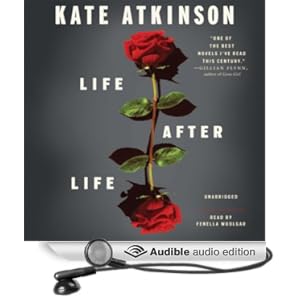
A final drawback can be terrible narrators. If someone last dipped into the audiobook world five or more years ago, you may remember some pretty bad renditions of novels. Try again. Narrators are usually professional actors, and while there are some stinkers in the bunch (review before buying), most narrators really add to a book. Some of my own favorites are Davina Porter (the Outlander novels), Fanella Woolgar (Life After Life), Jim Dale (Harry Potter), and Neil Gaiman, who narrates his own novels. Um, I just realized these are all Brits. Yes, I think I have a preference for those narrators, but I'm listening to the very American Oliver Wyman narrate an
Iraq-war novel right now, and I can tell you: he is just as talented as any of my beloved UK-folk.
So what about you? Do you listen to audiobooks, or do you think they're "cheating?" If you like them, how often do you select them over a visual format? Do you have any favorites?