Showing posts with label Non-fiction. Show all posts

Sunday, June 3, 2012

The Story of a Navajo Code Talker: Interview with Nonfiction Author Judy Avila


The Sisterhood would like to welcome Judy Avila, author of 
Code Talker: The first and only memoir by one of the original Navajo code talkers of WWII.


Judy Avila grew up in New York and New Hampshire, before graduating from Duke University in North Carolina. After Duke, she moved to New Mexico and wandered through a number of careers: artist, social worker, air traffic controller, computer consultant. Then she discovered writing, and was hooked. She quit working for someone else, lived off her savings, and threw herself at her writing. She has written four unpublished novels and Code Talker: The first and only memoir by one of the original Navajo code talkers of WWII, which is published by Berkley/Caliber (a division of Penguin). Judy is thrilled with the glowing reviews of Code Talker. The memoir has maintained a first-percentile rating on Amazon and bestseller status at Costco.

Her husband, Jim, died in 2004. Judy now lives in a cottage among the evergreens near Albuquerque with her two dogs, Blue and Red. New Mexico is a land of rich, diverse cultures. It is the perfect retreat for a writer.

  • How did you get started in the writing industry? Was it something you always wanted to do or did it come later in life?

I have always been a voracious reader, but I viewed writers as Gods and Goddesses, knowing I was not one of them. However, I always enjoyed writing assignments at work. (I worked as a computer consultant.) Then once, when I was in my late forties, I sat down at my home computer and wrote about an issue that was upsetting me. I dashed off 50 pages without stopping and thought, “Wow!  Maybe I can do this.” 

  • Which do you find more challenging -- writing fiction or nonfiction?
I can’t make a clean call on that one. Both are challenging, but in different ways.
Non-fiction challenges because it must hold the readers’ interest without straying from the truth.  Tension and a thread of continuity must be developed and maintained without breaking the veracity of the narrative.  Also, in the case of “Code Talker” I felt personal pressure to present Chester as the fine man he is, but not to be gushy or overdone.
Fiction is challenging because – of course – it must all come from the writer’s imagination. And some days my imagination goes on strike.  In writing fiction I feel more personally accountable for its value or lack thereof, since it all comes out of my head. The characters, their passions, and the dilemmas they face must be manufactured – an often daunting task.

  • When it comes to Chester Nez's memoir, what prompted you to take on such a story? 
I had the extreme good luck to meet Chester through a friend.  Once I heard a small portion of his story, I was hooked.  Although I had never before written non-fiction, I had to write his book. The story was compelling from all angles – the history, the many things I learned about Navajo culture, and the mystery of the code.

  • In the book you state that Chester Nez is the only surviving Code Talker of the original twenty-nine. Articles in the past year or two claim that seventy Code Talkers are still alive today. Could you clarify what makes Chester Nez’s position in the Code Talkers different from others still alive today?
The original 29 Navajo code talkers were the men who first volunteered for the Marines’ “secret project.”  They developed the doubly-encrypted code based on English and Navajo.  They proved to the Marines that the code would work, then took it into battle in the Pacific Arena of WWII. They are special because they were the pioneers of this code that saved our butts in the Pacific. The code developed by those 29 men (or 32 men in Chester’s opinion as expressed in the book) was the only code in modern warfare never to be broken.

The approximately 400 code talkers who followed in the footsteps of the original 29 learned the code and then enhanced it, making it more complex. Of those men, between 40 and 70 are thought to be alive today.

  • Is this why you choose Chester Nez’s story? During your writing of his memoir was there something in particular that either surprised you or really intrigued you concerning either Nez’s story or Code Talkers in general?
I think I would have been compelled to tell Chester’s story whether or not he had been an original code talker. After meeting him, I couldn’t get his story or his voice out of my head!
Chester always shrugs off the slights he endures at the hands of whites. His equanimity is both surprising and inspiring. His attitude has taught me a lot.

Chester and Judy

  • When it comes to writing someone else’s memoir, are there times when it’s challenging to either collect the information or put it on the page in a great storytelling fashion?
I felt a tremendous sense of responsibility to Chester and to his Navajo people.  I struggled to represent him accurately as a man, and to represent his culture accurately.  Expressing someone else’s most private thoughts is a unique challenge. Chester and I reviewed every paragraph of the memoir together, probably four or five times.   

  • Can you tell us a little bit about your road to getting published? What are some roadblocks you've encountered along the way?
Initially, I tried unsuccessfully to find an agent to represent Chester and me.  Then, a university press said they were interested in publishing “Code Talker.”  After I waded through their review process for a year, they informed me that publication was unlikely.  That was devastating! 

At that time, the book was a biography of Chester. But Chester is still alive, and I realized that our book would have more clout if it were a memoir. We rewrote it as a memoir. After that, it took only two days to get an agent. He sold the memoir to Penguin in four days for a six-figure advance.  In the space of less than a month I traveled through abject misery to elation!!!

  • Do you believe you've developed a "thick skin" from the process?
I have learned a lot about the publishing industry along the way, and I realize that even though I consider something to be fascinating, not everyone will agree. I try to be brave, but find I am still pathetically thin-skinned.  I take every criticism (good or bad) to heart.

  • You've written four novels. Is there one you're particularly partial to, perhaps one you would consider your favorite?
None of the four is published.  My favorite is “Love, Murder and Mama’s Tortillas.”  It’s the story of America Davila, who graduates from Columbia thinking she has escaped the clutches of her over-protective Hispanic family. Then 98-pound Mama pulls her back to New Mexico by pretending to be sick.

  • When it comes to writing fiction, what inspires you to choose the characters and settings you use in your novels? Do you go through a certain process before sitting down and writing the story (for instance, do you create an outline, do initial research, interviews of any kind, etc.)?
In general, I am first attracted to a hypothetical situation that involves a dilemma and invokes characters who are embroiled in that dilemma.  One I’m tossing around in my head now is an elderly lady who realizes she is losing her ability to think clearly.  She is responsible for caring for her granddaughter, and the two of them get into a lot of scrapes because of her challenged faculties.

I never create an outline before beginning a novel, but I have occasionally created one when I’m already deeply involved in the story. That helps to keep all of the complexities sorted out.

  • Do you have any tips for writers trying to break into nonfiction (or fiction) that you believe are important for them to know?
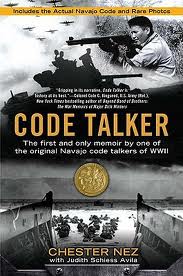
Code Talker
by Chester Nez with
Judith Avila
The creative process is different for everyone, but here’s what works for me.  My non-fiction work, “Code Talker,” is a subject that completely fascinates me. That all-consuming interest is essential. I was so enthused about my topic that others caught my enthusiasm.

In writing fiction, I must first know my characters inside and out. I live with them in my head for at least a few months before beginning to write their story. After that, large sections of the story pour out as though the characters are telling me the events.  Of course, I still hit snags that I have to plow through, but really knowing my characters expedites a lot of the process.

The most important thing, however, is to never, never, never give up.  If you persevere, you will succeed.

  • If a writer who is interested in writing both fiction and nonfiction had to choose between which one to work with, which would you encourage them to pursue and why?
From my own experience (and from extensive reading I’ve done on the topic), I believe that non-fiction is a much easier sell than fiction.  For a writer who is interested in publication, I suggest non-fiction.  However, any type of writing can be cathartic.  If it’s the catharsis you want, and if publication is not an immediate issue, then write what speaks to you, whether it’s fiction or non-fiction.

  • If you could give one final word of advice to many of the aspiring writers out there, what would it be?
Never, never, never give up.  Listen to criticism, evaluate it, implement changes when warranted. But NEVER give up.


Thank you, Judy, for your wonderful insight into the world of Code Talkers and getting published. Feel free to visit her author's website at www.JudithAvila.com.

Monday, August 1, 2011

Interview with Western Author Melody Groves

The Divine Secrets of the Writing Sisterhood would like to welcome Western author and SouthWest Writers' president Melody Groves!


New Mexico native Melody Groves has a deep love for anything cowboy and Old West. As a member of New Mexico Gunfighters, she “shoots” sheriffs and outlaws every other Sunday in Albuquerque’s Old Town.
           
Winner of two first-place writing awards, Groves is President of SouthWest Writers and publicity chairman for Western Writers of America. She writes for American Cowboy, True West and New Mexico magazines. Her non-fiction book, Ropes, Reins, and Rawhide: All About Rodeo, is a guide to understanding the sport. Additionally, Hoist a Cold One! Historic Bars of the Southwest, a look at the history and beauty of 26 front and back bars, launched in mid-July.

She is also author of the Colton Family Saga series, Border Ambush, Sonoran Rage, and Arizona War. Recently, her essay about living in New Mexico was published in Voices of New Mexico.

As an author, what drew you to not only become a writer, but specifically the genre of Westerns?
 I’ve always been a writer—I think it’s a passion that comes from within. And specifically the genre of Westerns, it also comes from within. I wrote them kind of in a closet for years until realizing that they’re a valuable, viable part of literature. Since I grew up in southern New Mexico and spent time on horseback and visiting old ghost towns, Westerns are sort of in my blood, so to speak. I feel a definite connection with the past.


Border Ambush
by Melody Groves
When people think of Western novels, they tend to think of writers such as Louis L’Amour and Zane Grey. Do you think their work still properly represents the types of Westerns being published today? Are Western novels as popular today as when authors such as L’Amour and Grey were being published?
L’Amour and Grey’s Westerns are similar and yet different from today’s. All of the Westerns speak to redefining oneself and also the landscape is usually a character. Westerns today aren’t quite as popular as say, in the 1950s, but we’re seeing an increase in readership and sales. I think it’s because people want a good story and are looking for something with moral characters. People would buy them if bookstores would promote them. There’s definitely a need and a market for Westerns.


Why do bookstores shy away from promoting Westerns? Is there something specific about the genre that keeps them from doing so?
It's a nasty spiral. Bookstores don't carry a wide range of Westerns because people don't request them. People don't request them because they don't know about them. I've attended many Western events where we sell a wide range of Westerns, and people are always so very grateful. They say they can't get them anywhere else. And I don't think it's necessarily the genre itself, it's the sales that guide the book sellers. WWA is doing what we can to change people's reading habits. It's frustrating, to say the least.


What was your experience like on the road to getting published?
My experience to getting published was up and down, pretty much like everybody else’s. Once I decided that I really, truly wanted to get published, then I attended workshops, conferences, classes and talked to everybody I could. A ton of rejections later, I got an article published in a magazine, and the rest as they say…is history.


Your novels are published through La Frontera Publishing, a smaller press. Can you give some insight as to what it’s like to work with a smaller press as opposed to having your work published through one of the “Big Six”?
A small press has tons of advantages and disadvantages. The publisher knows you and you know him/her. It’s usually easier to get him on the phone than a larger publisher. They’ll also keep your book in print longer than the Big Six. The down side is: they’re small, which means even more of the marketing burden is on you and if they have a personal crisis (I know one small publisher who had pneumonia and then hip surgery, so was out for almost a year), the work pretty much stops.

A larger press has a staff to handle everything that needs to be done to get a book published. It’s a bit more impersonal, but their books could have a wider distribution range. The down side: if your book doesn’t perform well, it’s taken off the shelf in a matter of months.


Would you recommend a smaller publishing house, or does it depend on the genre and what a writer hopes to accomplish with his/her work?
My recommendation as to whether to go large or small—just go. There’s nothing wrong with small publishers, I like them a lot. The important thing is that if your book is on the shelf, somebody will pick it up and buy it. If your small publisher isn’t doing his job, then try to find another who will. Genre really doesn’t matter.
Ropes, Reins and Rawhide
by Melody Groves


You’ve also written a non-fiction book entitled Ropes, Reins, and Rawhide: All About Rodeo, plus you have another non-fiction book that was recently published about historic bars of the Southwest. Is it more challenging to write non-fiction as opposed to fiction or vice versa? 
Non-fiction or fiction—which is more challenging? Both. Writing is hard work, whether it’s made up or real. In both areas, you’ve got to be accurate with your facts, whether it’s the date of a certain battle or what kind of matches they use.


What type of advice would you give to an aspiring writer of a non-fiction work?
Write about something you love. You’re going to spend thousands of hours with the topic and if you don’t have passion about it, you’re going to end up hating it and probably not doing your best work. Also, pick a topic that will appeal to a wide audience. That’s your best chance of getting published.


What I mean by that is instead of writing about say, hummingbird nests of Albuquerque, make the topic something like “Small birds of the Southwest.” That way, people in Phoenix may buy it, too. After my rodeo book came out, I decided to write a book on Ranch Rodeo. What I discovered was that very few people knew the difference and even fewer knew what one was. I didn’t want to spend my time promoting a book to people who needed to be educated first. So, I abandoned the idea, even though I had a publisher for it!


I’m seeing a wide audience for my bar book, Hoist a Cold One! Historic Bars of the Southwest, which just came out in June. Everyone knows what a bar is and they’re even more interested when I tell them that it’s not about the building, but about the wooden bar itself.
Melody Groves' newest release!
If you could pick out one scene in your writing that proved to be the most challenging, what would it be and what made it so difficult to write?
One of the first scenes I ever wrote in a Western was the most challenging.--a cattle stampede! Why did I think it would be easy? Not only did I have a thousand steers running in various directions, thunder, lightning, rain, dust and cowboys yelling all had to be described. Needing to bring in all the senses: smell, sight, sound, taste, seeing…it was organized chaos. I got through it and then realized I’d forgotten wind. Any time I have a barroom fight or some such, those are tough because there are so many moving parts.

You are the current president of SouthWest Writers, an all-genres writing group in Albuquerque, New Mexico. As the president, what kinds of challenges do you face when it comes to managing a fairly large writing group?
As president of SouthWest Writers, the biggest challenge is providing speakers, classes, workshops and conferences that address the various levels of writing skills our members have. Unlike Western Writers of America where in order to join you must be published in the Western genre, SouthWest Writers accepts anyone who is even vaguely interested in writing. Our members range from those who just like to be around writers, to those who’ve won national awards. Trying to please everybody is tough.

Conferences are a large part of any aspiring writers journey to getting published. In the last year, SWW has not held a writers conference. Can you give a little insight as to what goes into organizing a conference and what happens if for some reason the conference has to be cancelled?  Do you have any alternate suggestions if an aspiring writer is unable to attend a conference due to any number of reasons (i.e. financially unable, time conflict, conference doesn’t offer what writer is looking for, etc.)?
Conferences are extremely important, so in developing one, we look for wide appeal but a specialized topic that many genres can learn something from. To organize one, we need about five dedicated people to select topic, place, date, speakers, etc. The best is to start at least a year out. We’re organizing a February 2012 conference on screen and script writing, which at first blush sounds like it’s a limiting topic. But from my own personal experience, I know that two classes on screenwriting I took drastically improved my dialogue and understanding of structure in my fiction. This conference will offer something for everyone.

This year we had a perfect storm for not being able to put together a conference or two for SouthWest Writers. In a span of five months, I had two conference coordinators quit, even though the conferences were in the works. The executive board and I sat down and did some hard, cold number crunching. We decided that no matter what, we’d lose money and we didn’t have enough time to put on the quality of conference we wanted. Canceling it was one of the hardest decisions I’ve had to make.

There is no good substitute for conferences, but the next best thing would be to read on line about the various writing topics. With today’s online blogs and websites, writers can pick up a lot of helpful tips. But my recommendation: save your pennies and locate a conference that you’re interested in and go!
 
According to your website, http://www.melodygroves.com, you make several appearances throughout the year for book signings and conventions such as Western Writers of America. When it comes to publicity and marketing your work, how important are these scheduled events to your career?
Publicity and marketing—hugely important. Scheduled events such as signings and presentations have several benefits. First, you meet people who are unfamiliar with your work. Now, they know your name. Second, you become more and more comfortable speaking about your work and talking to strangers. Third, you get to meet some amazing people.

When I attend Western Writers of America conventions, not only do I get to renew my friendship with writers across the US, but meet editors and agents who become not only friends but critical elements in my career. I look at it this way: I can write all I want to, but if I want someone to read it, I need to get out in public. Thankfully, I’m no longer shy.

On your website you also list that you are a gunfighter re-enactor. You play “Mad Mel” and you “know what it feels like to shoot a sheriff.” This sounds like it would be so much fun. Does doing something like this allow for you to feel, in some small way, what the characters in your book would be going through? How important is re-enacting when it comes to your writing? 
 Believe it or not, my Old West gunfighting re-enacting is vital to my writing. While it’s a ton of fun, and we do use blanks, I learn something new every show that I can put in my writing. I’ve stood toe to toe with sheriffs and outlaws, shooting at them, they shooting at me. And while the bullets aren’t real, the adrenaline is. It’s scary to stand facing someone with a gun.

And I know what it feels like to hit the ground after being “shot.” It hurts, unless it’s on grass.

A couple of years ago, my group was in Tombstone playing at the OK Corral. I was Morgan Earp, so I was lined up on one side with my “brothers” and Doc. On the other side stood the McLowry’s and Clanton boys. Two things happened that I’ve used in my writing. Doc’s shotgun had a hair trigger—it went off before the cue was given. We all started shooting, ducking, dying earlier than we’d rehearsed. Secondly, there was so much dust from our boots and smoke from our guns that I couldn’t see across the corral. I knew they were there, but I couldn’t see my target. That was the way it really happened. Spontaneous and smokey.   


If you could give two words of advice to any writer out there trying to break into the publishing world, what would those two words be? 
Keep Writing. Pure and simple. You won’t get any better or published by not writing.

My mantra, especially when I’m discouraged: “Never Give Up. Never surrender.”  Thank you “Galaxy Quest” movie. 


And thank you, Melody Groves, for your wonderful insight into the world of Western writing!

Feel free to visit her website at http://www.melodygroves.com.