Showing posts with label Memoirs. Show all posts

Friday, April 25, 2014

The Cephalopod Coffeehouse: Waiting to be Heard


By now, you’ve probably heard of Amanda Knox. You may even have an opinion about her case and whether or not you think she was involved in the murder of her roommate, Meredith Kercher. My interest in the case started when Amanda was acquitted a couple of years ago, but it grew with recent developments (in January, her appeal was reversed). In addition to the popularity of the case, I became interested in her memoir as a source of research for my third novel since it also deals with an exchange student who gets into trouble abroad.

After all that has been said about Amanda on news shows, magazines, the internet and even a made-for-TV movie, Amanda finally gives us her version of the story. In a prose that is easy to follow and insightful, we meet Amanda a few months before she moves to Perugia, Italy. We get to know her parents, her siblings and her sometimes quirky and adventurous nature in her native Seattle, where she has planned in some detail her year of studies in Italy—a lifelong dream of hers.

Amanda is not very different from other people her age who travel abroad. I also traveled to Europe in my early twenties and Amanda seemed as ordinary as any other girl I met during my trip. I won’t go into too much detail about her story since: a) it’s all over the internet and b) if I tell you too much, you won’t want to read it (and if you’re interested in her story, I believe it’s worth reading. Especially because we’re so used to making quick judgments based on what the media tells us.)  I’ll just say that Amanda goes into great detail about those first months in Italy, the people she associated with, her relationship with her roommates, the boys she met, etc. She doesn’t portray herself as a saint as she admits to having smoked pot and engaged in sexual activity with two or three guys. This, she says, were mistakes the media and the prosecution exploited during her first trial.

Amanda claims her relationship with Meredith was good. According to her, they were confidents and friends who explored the city together and shared similar experiences (both were English speakers trying to find their way through a new culture and a new language). Then she describes the moment she met Raffaele—her then boyfriend and partner in this ordeal—their short-lived but intense relationship, the day Meredith died, the police interrogations, her two trials and her life in prison. She brings insight into a few things that are not explored much on the internet or news shows:
  • What, according to Amanda, happened during the interrogation where she accused her boss of killing Meredith (and later admitted to lying about it). She offers a theory as to why she lied that night.
  • During her appeal, there was an important testimony from a man who’d been imprisoned with Meredith’s convicted killer (Rudy Guede, who’s DNA was all over Meredith’s room). This man said Guede confessed to having raped and stabbed Meredith in conjunction with “a friend” (who wasn’t Raffaele or Amanda, which is what the prosecution alleges). In fact, Guede was supposedly having a moral dilemma as to what to say during their appeal. (Guede had a separate trial and conviction from Amanda and Raffaele.) This story made more sense to me than the prosecution’s theories of a “sexual game gone bad” or a “Halloween Eve sacrifice.”
  • Explanations as to why there were traces of Amanda and Raffaele’s DNA in a couple of items that the prosecution assigned as proof of their culpability.
  • Insights on the people in Amanda’s life in prison and outside. I was especially touched by three people in her life: a Catholic priest who befriended Amanda—an agnostic—during her hardest times in prison (Don Saulo); one of her best friends from Seattle who moved to Perugia to be near Amanda after she was sentenced to 26 years in prison (Madison) and Laura, an American inmate who grew up in Ecuador and became sort of a foster mom or older sister to her. Amanda’s family is also commendable as they never abandoned Amanda and during her four-year-ordeal always made sure someone was in Italy on visiting days. Her stepfather went as far as to move to Perugia for some time. Amanda’s story, as sad as it is, also serves as a testimony that goodness is sometimes found in the most unexpected places.
After reading Amanda’s memoir, I conclude that yes, she made MANY mistakes, primarily not taking the police interrogations seriously—she didn’t wait for a lawyer to be present and she never called the American embassy before answering questions in a language that she didn’t speak well. Her lying during one of her confessions, I admit, is hard to understand and made me wonder if she was covering up for something else (heavy drug use?) however, I do not believe she was involved in Meredith’s attack. It just doesn’t make sense. Our civilization has become SO reliant on technology that sometimes we drop common sense out the window. The prosecution claims that a girl like Amanda—with no prior convictions and a model student who came from a good family—is guilty of murdering (savagely) and raping her friend (when she doesn’t even have the *right* equipment, if you know what I mean). What we do know is that there is no motive. The prosecution claimed Amanda and Meredith argued over the bathroom’s cleanliness, but only a psychopath would kill over this, right? Not to mention the fact that there is no evidence of her presence in Meredith’s room. The prosecution claimed Amanda and Raffaele wiped their own DNA in the room but left Guede’s, as though it was possible to see DNA! Plus, there was no proven relationship between Guede and Amanda or Raffaele (Raffaele said he’d never met the man and Amanda said she saw Guede once or twice with her downstairs neighbors but couldn’t even remember his name.) 

I truly believe that Amanda’s problems stemmed from her immaturity and naivety at the time of her trip. Not only was she cavalier about who she spent time with (including working at a bar with people she barely knew) smoking pot on a regular basis and having sex with guys she’d just met. Unfortunately, this is not uncommon in people her age. When I moved to the US to go to college, I had the fortune of having a couple of family members here to guide me through the process of moving to a different country and start a new life as an adult. Also, my parents came with me and helped me settle in the dorms. When Amanda arrived to Italy, she had nowhere to live and found her new roommates on a bulletin board. I know, LOTS of college kids do this, but this doesn’t mean it isn’t dangerous. ESPECIALLY in a different country where you barely speak the language and you don’t know the “rules of the land.”

By the end of the book, however, you see Amanda as a different woman. Not sure this has to do with the fact that Amanda is a writer (currently studying Creative Writing in Seattle) and she knows that in every journey, the hero must show change and growth, or that she truly matured with all the hardship she went through, but her transformation was evident to me.

Have you been following this case or read her memoir? Do you believe in her innocence? What do you think will happen now that her appeal got reversed? Do you think the US will extradite her to Italy? Do you think it’s fair that she was tried twice for the same crime?

Check out these coffeehouse reviews!

1.The Armchair Squid2.My Creatively Random Life
3.Wishbone Soup Cures Everything4.Valerie Nunez and the Flying Platypi
5.Huntress6.Servitor Ludi
7.MOCK8.StrangePegs -- Mrs. Frisby and the Rats of NIMH
9.Words Incorporated10.Agatha Friggin' Christie
11.Ed&Reub12.The Writing Sisterhood
13.Read, Write, Repeat14.V's Reads
15.The Cephalopod Coffeehouse: April 2014 16.Debi O'Neille, writing against the wind

Sunday, June 3, 2012

The Story of a Navajo Code Talker: Interview with Nonfiction Author Judy Avila


The Sisterhood would like to welcome Judy Avila, author of 
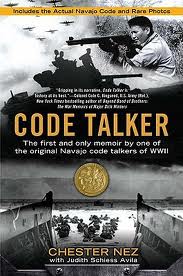
Code Talker: The first and only memoir by one of the original Navajo code talkers of WWII.


Judy Avila grew up in New York and New Hampshire, before graduating from Duke University in North Carolina. After Duke, she moved to New Mexico and wandered through a number of careers: artist, social worker, air traffic controller, computer consultant. Then she discovered writing, and was hooked. She quit working for someone else, lived off her savings, and threw herself at her writing. She has written four unpublished novels and Code Talker: The first and only memoir by one of the original Navajo code talkers of WWII, which is published by Berkley/Caliber (a division of Penguin). Judy is thrilled with the glowing reviews of Code Talker. The memoir has maintained a first-percentile rating on Amazon and bestseller status at Costco.

Her husband, Jim, died in 2004. Judy now lives in a cottage among the evergreens near Albuquerque with her two dogs, Blue and Red. New Mexico is a land of rich, diverse cultures. It is the perfect retreat for a writer.

  • How did you get started in the writing industry? Was it something you always wanted to do or did it come later in life?

I have always been a voracious reader, but I viewed writers as Gods and Goddesses, knowing I was not one of them. However, I always enjoyed writing assignments at work. (I worked as a computer consultant.) Then once, when I was in my late forties, I sat down at my home computer and wrote about an issue that was upsetting me. I dashed off 50 pages without stopping and thought, “Wow!  Maybe I can do this.” 

  • Which do you find more challenging -- writing fiction or nonfiction?
I can’t make a clean call on that one. Both are challenging, but in different ways.
Non-fiction challenges because it must hold the readers’ interest without straying from the truth.  Tension and a thread of continuity must be developed and maintained without breaking the veracity of the narrative.  Also, in the case of “Code Talker” I felt personal pressure to present Chester as the fine man he is, but not to be gushy or overdone.
Fiction is challenging because – of course – it must all come from the writer’s imagination. And some days my imagination goes on strike.  In writing fiction I feel more personally accountable for its value or lack thereof, since it all comes out of my head. The characters, their passions, and the dilemmas they face must be manufactured – an often daunting task.

  • When it comes to Chester Nez's memoir, what prompted you to take on such a story? 
I had the extreme good luck to meet Chester through a friend.  Once I heard a small portion of his story, I was hooked.  Although I had never before written non-fiction, I had to write his book. The story was compelling from all angles – the history, the many things I learned about Navajo culture, and the mystery of the code.

  • In the book you state that Chester Nez is the only surviving Code Talker of the original twenty-nine. Articles in the past year or two claim that seventy Code Talkers are still alive today. Could you clarify what makes Chester Nez’s position in the Code Talkers different from others still alive today?
The original 29 Navajo code talkers were the men who first volunteered for the Marines’ “secret project.”  They developed the doubly-encrypted code based on English and Navajo.  They proved to the Marines that the code would work, then took it into battle in the Pacific Arena of WWII. They are special because they were the pioneers of this code that saved our butts in the Pacific. The code developed by those 29 men (or 32 men in Chester’s opinion as expressed in the book) was the only code in modern warfare never to be broken.

The approximately 400 code talkers who followed in the footsteps of the original 29 learned the code and then enhanced it, making it more complex. Of those men, between 40 and 70 are thought to be alive today.

  • Is this why you choose Chester Nez’s story? During your writing of his memoir was there something in particular that either surprised you or really intrigued you concerning either Nez’s story or Code Talkers in general?
I think I would have been compelled to tell Chester’s story whether or not he had been an original code talker. After meeting him, I couldn’t get his story or his voice out of my head!
Chester always shrugs off the slights he endures at the hands of whites. His equanimity is both surprising and inspiring. His attitude has taught me a lot.

Chester and Judy

  • When it comes to writing someone else’s memoir, are there times when it’s challenging to either collect the information or put it on the page in a great storytelling fashion?
I felt a tremendous sense of responsibility to Chester and to his Navajo people.  I struggled to represent him accurately as a man, and to represent his culture accurately.  Expressing someone else’s most private thoughts is a unique challenge. Chester and I reviewed every paragraph of the memoir together, probably four or five times.   

  • Can you tell us a little bit about your road to getting published? What are some roadblocks you've encountered along the way?
Initially, I tried unsuccessfully to find an agent to represent Chester and me.  Then, a university press said they were interested in publishing “Code Talker.”  After I waded through their review process for a year, they informed me that publication was unlikely.  That was devastating! 

At that time, the book was a biography of Chester. But Chester is still alive, and I realized that our book would have more clout if it were a memoir. We rewrote it as a memoir. After that, it took only two days to get an agent. He sold the memoir to Penguin in four days for a six-figure advance.  In the space of less than a month I traveled through abject misery to elation!!!

  • Do you believe you've developed a "thick skin" from the process?
I have learned a lot about the publishing industry along the way, and I realize that even though I consider something to be fascinating, not everyone will agree. I try to be brave, but find I am still pathetically thin-skinned.  I take every criticism (good or bad) to heart.

  • You've written four novels. Is there one you're particularly partial to, perhaps one you would consider your favorite?
None of the four is published.  My favorite is “Love, Murder and Mama’s Tortillas.”  It’s the story of America Davila, who graduates from Columbia thinking she has escaped the clutches of her over-protective Hispanic family. Then 98-pound Mama pulls her back to New Mexico by pretending to be sick.

  • When it comes to writing fiction, what inspires you to choose the characters and settings you use in your novels? Do you go through a certain process before sitting down and writing the story (for instance, do you create an outline, do initial research, interviews of any kind, etc.)?
In general, I am first attracted to a hypothetical situation that involves a dilemma and invokes characters who are embroiled in that dilemma.  One I’m tossing around in my head now is an elderly lady who realizes she is losing her ability to think clearly.  She is responsible for caring for her granddaughter, and the two of them get into a lot of scrapes because of her challenged faculties.

I never create an outline before beginning a novel, but I have occasionally created one when I’m already deeply involved in the story. That helps to keep all of the complexities sorted out.

  • Do you have any tips for writers trying to break into nonfiction (or fiction) that you believe are important for them to know?
Code Talker
by Chester Nez with
Judith Avila
The creative process is different for everyone, but here’s what works for me.  My non-fiction work, “Code Talker,” is a subject that completely fascinates me. That all-consuming interest is essential. I was so enthused about my topic that others caught my enthusiasm.

In writing fiction, I must first know my characters inside and out. I live with them in my head for at least a few months before beginning to write their story. After that, large sections of the story pour out as though the characters are telling me the events.  Of course, I still hit snags that I have to plow through, but really knowing my characters expedites a lot of the process.

The most important thing, however, is to never, never, never give up.  If you persevere, you will succeed.

  • If a writer who is interested in writing both fiction and nonfiction had to choose between which one to work with, which would you encourage them to pursue and why?
From my own experience (and from extensive reading I’ve done on the topic), I believe that non-fiction is a much easier sell than fiction.  For a writer who is interested in publication, I suggest non-fiction.  However, any type of writing can be cathartic.  If it’s the catharsis you want, and if publication is not an immediate issue, then write what speaks to you, whether it’s fiction or non-fiction.

  • If you could give one final word of advice to many of the aspiring writers out there, what would it be?
Never, never, never give up.  Listen to criticism, evaluate it, implement changes when warranted. But NEVER give up.


Thank you, Judy, for your wonderful insight into the world of Code Talkers and getting published. Feel free to visit her author's website at www.JudithAvila.com.

Monday, June 6, 2011

Want to Write a Memoir? If so, Be Honest!

What is the memory capacity of the human brain? This might be a question some of us think about from time to time, or perhaps you're one of those who doesn't remember to think about much at all. According to Scientific AmericanPaul Reber - a professor of psychology at Northwestern University - says:
The brain's exact storage capacity for memories is difficult to calculate. First, we do not know how to measure the size of a memory. Second, certain memories involve more details and thus take up more space; other memories are forgotten and thus free up space. Additionally, some information is just not worth remembering in the first place.
When it comes to writing a memoir, sometimes, it seems, that fudging our memories means more money in the end. If you are planning to write your life story down for all to read, keep in mind that those who lie about their pasts tend to (a) Still be read about today and (b) Carry a never-ending shame when it comes to a story that should have been slapped with a "fiction" label in the first place.

Here are some of the more notoriously failed (?) memoirs filled with a lot of fibbing and a thin (if any) thread of truth:
A Rock and a Hard Place: 
One Boy's Triumphant Story


by Anthony Godby Johnson
A Rock and a Hard Place: One Boy's Triumphant Story is the heartwrenching "memoir" by Anthony Godby Johnson. That is if Anthony Godby Johnson had existed. When the book first came out in 1993 it was described as an autobiography of a boy who'd survived an abusive childhood with parents who repeatedly beat and raped him. Questions were raised when several magazines and journalists attempted to interview Anthony, but only got through to his adoptive mother, Vicki Johnson. Only Vicki had ever actually "seen" Anthony, therefore leading many to suspect the boy never existed in the first place. In the end, many suspected the story to be a mere fabrication of Vicki Johnson's imagination.
Note to self: If I'm going to completely create all my characters from scratch, then I might as well avoid calling it an autobiography.

A Million Little Pieces
by James Frey


This story is now touted as the semi-autobiographical memoir by James Frey. This is the story of a 23-year-old alcoholic and drug abuser rehabilitating through a 12-step program. Now, if you haven't heard the brouhaha over Frey's little book (and who hasn't), then visit Oprah's website. She flogged him royally on her show back in 2003 (and forgave him just a few weeks ago in one of her farewell episodes), after being forced to see that the author had pretty much elaborated on many aspects of his so-called "memoir." Note to self:  No one likes to be made a fool, including Oprah.

Three Cups of Tea
by Greg Mortenson

Greg Mortenson's 2006 memoir has recently come under attack by 60 Minutes. The story states that in 1993, to honor his dead sister, Mortenson attempted and failed to reach the summit of K2 (the second largest mountain peak in the world). He got separated from his party and ended up in the small town of Korphe. The non-profit organization Mortenson set up afterwards has come under fire for mismanagement of funds. Many of his early backers (including President Obama who donated $100,000 to his charity that promotes education in remote parts of Pakistan and Afghanistan) have cried foul over the story Mortenson wrote. According to *Entertainment Weekly, his memoir "has fallen under suspicion, particularly passages about finding the Korphe village and being captured by the Taliban." Note to self: Don't make up the story, make up the charity, and then use all the money on myself.


Love and Consequences:
A Memoir of Hope and Survival

by Margaret Seltzer
I read a blurb about the hoax behind this wonderful little gem of a story (sarcasm intended) about a year or so ago when I learned that all copies of this "memoir" were being recalled due to the fact that the whole story was essentially a work of fiction. According to Wikipedia, this is what they have to say about Margaret Seltzer's book:
Her first book, Love and Consequences:  A Memoir of Hope and Survival, about her alleged experiences growing up as a half white, half Native American foster child and Bloods gang member in South Central Los Angeles, was proven to be fictitious. She actually was fully white, grew up with her biological parents in the upscale San Fernando Valley community of Sherman Oaks and attended Campbell Hall, an affluent Episcopalian day school in the North Hollywood area of Los Angeles.
Note to self:  If I'm planning on creating a completely different story from the life I've lived, then perhaps I should just call it a work of fiction.

As humans, we all have what James Frey coined as "individual recollection." Our recollection of a given situation may not be like that of another individual who experienced the same event. Facts can be checked, but in the end it does boil down to how and what we remember. As Reber stated in the quote above, we tend to forget certain memories, freeing up that extra space in our brains. But if we want to revisit that fuzzy or forgotten memory how do we go about putting it into words? Should we make it up as we go along or, perhaps, even make it a blatant lie just for the sake of putting a well-written "nonfiction" story on the page? As you can see from the "memoirs" I've highlighted in this article, those lies can bring about a notorious sort of fame one may never live down in his/her lifetime.

How about for you? Can you think of any memoir you've read that turned out to be mostly false? How did that make you feel as the reader? Perhaps you're writing your own memoir. Are you tempted to slip a few fabrications in just to enhance the story?

Be sure to stop by The Random Book Review and check out what I've read this week!

* This quote can be found in the May 6, 2011 issue, #1153, in the article "The Biggest Book Hoaxes of all Time."