
The Sisterhood would like to welcome Judy Avila, author of
Code Talker: The first and only memoir by one of the original Navajo code talkers of WWII.Judy Avila grew up in New York and New Hampshire, before graduating from Duke University in North Carolina. After Duke, she moved to New Mexico and wandered through a number of careers: artist, social worker, air traffic controller, computer consultant. Then she discovered writing, and was hooked. She quit working for someone else, lived off her savings, and threw herself at her writing. She has written four unpublished novels and Code Talker: The first and only memoir by one of the original Navajo code talkers of WWII, which is published by Berkley/Caliber (a division of Penguin). Judy is thrilled with the glowing reviews of Code Talker. The memoir has maintained a first-percentile rating on Amazon and bestseller status at Costco.
Her husband, Jim, died in 2004. Judy now lives in a cottage among the evergreens near Albuquerque with her two dogs, Blue and Red. New Mexico is a land of rich, diverse cultures. It is the perfect retreat for a writer.
- How did you get started in the writing industry? Was it something you always wanted to do or did it come later in life?
I have always been a voracious reader, but I viewed writers as Gods and Goddesses, knowing I was not one of them. However, I always enjoyed writing assignments at work. (I worked as a computer consultant.) Then once, when I was in my late forties, I sat down at my home computer and wrote about an issue that was upsetting me. I dashed off 50 pages without stopping and thought, “Wow! Maybe I can do this.”
- Which do you find more challenging -- writing fiction or nonfiction?
I can’t make a clean call on that one. Both are challenging, but in
different ways.
Non-fiction challenges because it must hold the readers’ interest without
straying from the truth. Tension and a
thread of continuity must be developed and maintained without breaking the
veracity of the narrative. Also, in the
case of “Code Talker” I felt personal pressure to present Chester as the fine
man he is, but not to be gushy or overdone.
Fiction is challenging because – of course – it must all come from the
writer’s imagination. And some days my imagination goes on strike. In writing fiction I feel more personally
accountable for its value or lack thereof, since it all comes out of my head.
The characters, their passions, and the dilemmas they face must be manufactured
– an often daunting task.
- When it comes to Chester Nez's memoir, what prompted you to take on such a story?
I had the extreme good luck to meet Chester through a friend. Once I heard a small portion of his story, I
was hooked. Although I had never before
written non-fiction, I had to write his book. The story was compelling from all
angles – the history, the many things I learned about Navajo culture, and the
mystery of the code.
- In the book you state that Chester Nez is the only surviving Code Talker of the original twenty-nine. Articles in the past year or two claim that seventy Code Talkers are still alive today. Could you clarify what makes Chester Nez’s position in the Code Talkers different from others still alive today?
The original 29 Navajo code talkers were the men
who first volunteered for the Marines’ “secret project.” They developed the doubly-encrypted code based
on English and Navajo. They proved to
the Marines that the code would work, then took it into battle in the Pacific
Arena of WWII. They are special because they were the pioneers of this code
that saved our butts in the Pacific. The code developed by those 29 men (or 32
men in Chester’s opinion as expressed in the book) was the only code in modern
warfare never to be broken.
- Is this why you choose Chester Nez’s story? During your writing of his memoir was there something in particular that either surprised you or really intrigued you concerning either Nez’s story or Code Talkers in general?
Chester always shrugs off the slights he endures at the hands of whites. His equanimity is both surprising and inspiring. His attitude has taught me a lot.
 |
| Chester and Judy |
- When it comes to writing someone else’s memoir, are there times when it’s challenging to either collect the information or put it on the page in a great storytelling fashion?
I
felt a tremendous sense of responsibility to Chester and to his Navajo people. I struggled to represent him accurately as a
man, and to represent his culture accurately.
Expressing someone else’s most private thoughts is a unique challenge.
Chester and I reviewed every paragraph of the memoir together, probably four or
five times.
- Can you tell us a little bit about your road to getting published? What are some roadblocks you've encountered along the way?
Initially, I tried unsuccessfully to find an agent
to represent Chester and me. Then, a
university press said they were interested in publishing “Code Talker.” After I waded through their review process
for a year, they informed me that publication was unlikely. That was devastating!
At that time, the book was a biography of Chester.
But Chester is still alive, and I realized that our book would have more clout
if it were a memoir. We rewrote it as a memoir. After that, it took only two
days to get an agent. He sold the memoir to Penguin in four days for a six-figure
advance. In the space of less than a
month I traveled through abject misery to elation!!!
- Do you believe you've developed a "thick skin" from the process?
I have learned a lot about the publishing industry
along the way, and I realize that even though I consider something to be
fascinating, not everyone will agree. I try to be brave, but find I am still
pathetically thin-skinned. I take every
criticism (good or bad) to heart.
- You've written four novels. Is there one you're particularly partial to, perhaps one you would consider your favorite?
None
of the four is published. My favorite is
“Love, Murder and Mama’s Tortillas.” It’s
the story of America Davila, who graduates from Columbia thinking she has
escaped the clutches of her over-protective Hispanic family. Then 98-pound Mama
pulls her back to New Mexico by pretending to be sick.
- When it comes to writing fiction, what inspires you to choose the characters and settings you use in your novels? Do you go through a certain process before sitting down and writing the story (for instance, do you create an outline, do initial research, interviews of any kind, etc.)?
In general, I am first attracted
to a hypothetical situation that involves a dilemma and invokes characters who
are embroiled in that dilemma. One I’m
tossing around in my head now is an elderly lady who realizes she is losing her
ability to think clearly. She is
responsible for caring for her granddaughter, and the two of them get into a
lot of scrapes because of her challenged faculties.
I never create an outline before beginning a
novel, but I have occasionally created one when I’m already deeply involved in
the story. That helps to keep all of the complexities sorted out.
- Do you have any tips for writers trying to break into nonfiction (or fiction) that you believe are important for them to know?
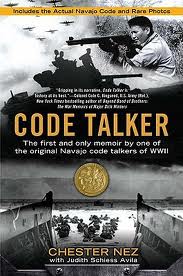 |
| Code Talker by Chester Nez with Judith Avila |
In writing fiction, I must first know my
characters inside and out. I live with
them in my head for at least a few months before beginning to write their
story. After that, large sections of the story pour out as though the
characters are telling me the events. Of
course, I still hit snags that I have to plow through, but really knowing my
characters expedites a lot of the process.
- If a writer who is interested in writing both fiction and nonfiction had to choose between which one to work with, which would you encourage them to pursue and why?
From my own experience (and from
extensive reading I’ve done on the topic), I believe that non-fiction is a much
easier sell than fiction. For a writer
who is interested in publication, I suggest non-fiction. However, any type of writing can be
cathartic. If it’s the catharsis you
want, and if publication is not an immediate issue, then write what speaks to
you, whether it’s fiction or non-fiction.
- If you could give one final word of advice to many of the aspiring writers out there, what would it be?
Never, never, never give up. Listen to criticism, evaluate it, implement
changes when warranted. But NEVER give up.
Thank you, Judy, for your wonderful insight into the world of Code Talkers and getting published. Feel free to visit her author's website at www.JudithAvila.com.
Thank you, Judy, for your wonderful insight into the world of Code Talkers and getting published. Feel free to visit her author's website at www.JudithAvila.com.

