Sunday, May 4, 2014

The Death of the Independent Bookstore

For a few years we had a real treasure in our neighborhood: a locally-owned bookshop. It was in a shopping plaza nestled between a coffee shop and a bike store. Both those businesses failed but the book store persisted. And then it expanded: from a fairly mainstream setup, like a smaller-scale Barnes & Noble, it went niche and grew. They acquired another location nearby — though not, unfortunately, adjacent — and opted to brand themselves as a children's bookshop. One location stocked mostly baby through middle-grade books, with a few shelves of nonfiction; the other concentrated on YA books and speculative fiction, although it had a healthy stock of general fiction as well. Around Christmas, when I went in to do my usual holiday shopping, I saw they were clearing a space for a coffee bar. A few months later I went in on a Friday night and a local band was playing: this was, they told me, a regular Friday event now. The YA store had become (appropriately) a hangout for teens. Only ... very few teens were actually in the store. Nobody was really in the store.
Then, last week, I saw the news on their Facebook page: "With heavy hearts we are facing the last days of our wonderful bookstore adventure. We will be closing our doors this summer." I can't say I was entirely shocked, as too frequently I was the only shopper there, but I was very disappointed. This bookstore added to the community what independent bookstores always add: a place to meet other book nerds, a warm and intellectual richness to the plaza, a shopping space that was quiet and peaceful, and a place to go and get book recommendations from real people. Knowledgable people. I had come to know the men and women who worked at our bookshop, and we'd fall into long geeky conversations about our favorite books, often excitedly running to the shelves to pull out some treasure, pressing into each other hands and gushing, "You have got to read this!" The kind of recommendations I got from these guys was totally different than what Amazon's big-data bots would tell me to buy. Just yesterday, the Bookshop Guy handed me this book to read — a quirky little delight, he said, that I'd never have heard of otherwise.

So what's killing these bookstores? I suspect one problem in this case was just a matter of sinking too much money into the store too quickly, expanding beyond what it was able to sustain. It was doing OK when it was just the one store. But in general, one cause is obvious: print books are giving way to ebooks. For a quality rant on this topic, you can read Seth Godin's grumpy-old-man screed here. Although I do find it a bit odd for a young technophile to be this curmudgeonly about ebooks, he has plenty of company. Most people, I have found, feel and think this way about books these days ... even as they participate in the new, "worse" paradigm.


Another cause, which encompasses the former, is capitalism. As much as I favor Adam Smith over Karl Marx, it's not hard to see various downsides of laissez-faire these days. Market forces are rarely going to favor tiny-local over giant-corporate, so any shop that is local and independently owned is inherently fragile. You can find lots of blogs and articles urging consumers to buy local, to support independent alternatives, to keep City X "weird," and so forth. But exhortations are unlikely to overcome the allure of cheap goods ... especially when said goods can be delivered right to your door. (Or to your e-reader.) I can't see a way out of this, myself: it seems we're on an irrevocable course to the disappearance of all things small and local and to the Walmartization of everything.

Hmm ... now I'm the one being curmudgeonly.


But wait! Rescuing me from this doom and gloom is a wisp of promise. As I began writing this piece, I googled "death of independent bookstore," because of course. Curiously, however, most of the hits I got were about the resurgence of independent bookstores. Apparently, in spite of the death of my neighborhood shop, many indie bookstores are doing all right. The key seems to be "small and niche." Of course, our store tried that tactic and it didn't work, but they may have been working against a few other obstacles, too. Expanding too quickly, as I noted earlier, and locating themselves in a shopping plaza without much foot traffic. When I've gone to successful indie bookshops in other cities, such as this one and this one, I've noticed that they're located in pedestrian-heavy areas, especially in vibrant downtowns. Foot traffic and local-indie go together. People who are out shopping as an event, like tourists, or girlfriends having a shop + coffee afternoon, are the kind of people who end up patronizing the cute little bookshop. It's not the sort of destination people build into their schedule, like trips to the grocery store.

For local indie bookstores to survive and thrive, they (and we who love them) have to think of what they offer that Barnes & Noble does not, that Amazon does not. What magical ingredients could we think of to help this happen? Combining bookshop with coffee shop? Book shop with ... wine bar? (Now that would draw me in.) Cookbookery shop with cookware and specialty foods store?

What do you think could keep these community assets alive ... or do you (like Farhad Manjoo) think it's time for these "cultish, moldering institutions" to give up the ghost, already?
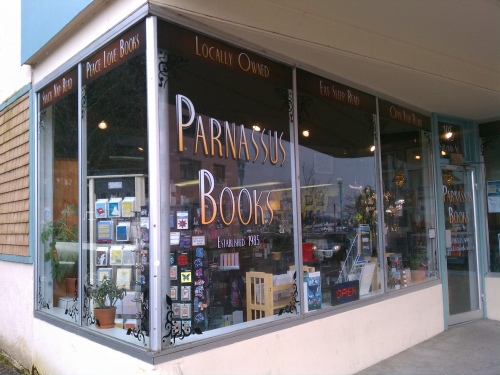
Parnassus Books: author Ann Patchett's own indie bookshop

Friday, April 25, 2014

The Cephalopod Coffeehouse: Waiting to be Heard


By now, you’ve probably heard of Amanda Knox. You may even have an opinion about her case and whether or not you think she was involved in the murder of her roommate, Meredith Kercher. My interest in the case started when Amanda was acquitted a couple of years ago, but it grew with recent developments (in January, her appeal was reversed). In addition to the popularity of the case, I became interested in her memoir as a source of research for my third novel since it also deals with an exchange student who gets into trouble abroad.

After all that has been said about Amanda on news shows, magazines, the internet and even a made-for-TV movie, Amanda finally gives us her version of the story. In a prose that is easy to follow and insightful, we meet Amanda a few months before she moves to Perugia, Italy. We get to know her parents, her siblings and her sometimes quirky and adventurous nature in her native Seattle, where she has planned in some detail her year of studies in Italy—a lifelong dream of hers.

Amanda is not very different from other people her age who travel abroad. I also traveled to Europe in my early twenties and Amanda seemed as ordinary as any other girl I met during my trip. I won’t go into too much detail about her story since: a) it’s all over the internet and b) if I tell you too much, you won’t want to read it (and if you’re interested in her story, I believe it’s worth reading. Especially because we’re so used to making quick judgments based on what the media tells us.)  I’ll just say that Amanda goes into great detail about those first months in Italy, the people she associated with, her relationship with her roommates, the boys she met, etc. She doesn’t portray herself as a saint as she admits to having smoked pot and engaged in sexual activity with two or three guys. This, she says, were mistakes the media and the prosecution exploited during her first trial.

Amanda claims her relationship with Meredith was good. According to her, they were confidents and friends who explored the city together and shared similar experiences (both were English speakers trying to find their way through a new culture and a new language). Then she describes the moment she met Raffaele—her then boyfriend and partner in this ordeal—their short-lived but intense relationship, the day Meredith died, the police interrogations, her two trials and her life in prison. She brings insight into a few things that are not explored much on the internet or news shows:
  • What, according to Amanda, happened during the interrogation where she accused her boss of killing Meredith (and later admitted to lying about it). She offers a theory as to why she lied that night.
  • During her appeal, there was an important testimony from a man who’d been imprisoned with Meredith’s convicted killer (Rudy Guede, who’s DNA was all over Meredith’s room). This man said Guede confessed to having raped and stabbed Meredith in conjunction with “a friend” (who wasn’t Raffaele or Amanda, which is what the prosecution alleges). In fact, Guede was supposedly having a moral dilemma as to what to say during their appeal. (Guede had a separate trial and conviction from Amanda and Raffaele.) This story made more sense to me than the prosecution’s theories of a “sexual game gone bad” or a “Halloween Eve sacrifice.”
  • Explanations as to why there were traces of Amanda and Raffaele’s DNA in a couple of items that the prosecution assigned as proof of their culpability.
  • Insights on the people in Amanda’s life in prison and outside. I was especially touched by three people in her life: a Catholic priest who befriended Amanda—an agnostic—during her hardest times in prison (Don Saulo); one of her best friends from Seattle who moved to Perugia to be near Amanda after she was sentenced to 26 years in prison (Madison) and Laura, an American inmate who grew up in Ecuador and became sort of a foster mom or older sister to her. Amanda’s family is also commendable as they never abandoned Amanda and during her four-year-ordeal always made sure someone was in Italy on visiting days. Her stepfather went as far as to move to Perugia for some time. Amanda’s story, as sad as it is, also serves as a testimony that goodness is sometimes found in the most unexpected places.
After reading Amanda’s memoir, I conclude that yes, she made MANY mistakes, primarily not taking the police interrogations seriously—she didn’t wait for a lawyer to be present and she never called the American embassy before answering questions in a language that she didn’t speak well. Her lying during one of her confessions, I admit, is hard to understand and made me wonder if she was covering up for something else (heavy drug use?) however, I do not believe she was involved in Meredith’s attack. It just doesn’t make sense. Our civilization has become SO reliant on technology that sometimes we drop common sense out the window. The prosecution claims that a girl like Amanda—with no prior convictions and a model student who came from a good family—is guilty of murdering (savagely) and raping her friend (when she doesn’t even have the *right* equipment, if you know what I mean). What we do know is that there is no motive. The prosecution claimed Amanda and Meredith argued over the bathroom’s cleanliness, but only a psychopath would kill over this, right? Not to mention the fact that there is no evidence of her presence in Meredith’s room. The prosecution claimed Amanda and Raffaele wiped their own DNA in the room but left Guede’s, as though it was possible to see DNA! Plus, there was no proven relationship between Guede and Amanda or Raffaele (Raffaele said he’d never met the man and Amanda said she saw Guede once or twice with her downstairs neighbors but couldn’t even remember his name.) 

I truly believe that Amanda’s problems stemmed from her immaturity and naivety at the time of her trip. Not only was she cavalier about who she spent time with (including working at a bar with people she barely knew) smoking pot on a regular basis and having sex with guys she’d just met. Unfortunately, this is not uncommon in people her age. When I moved to the US to go to college, I had the fortune of having a couple of family members here to guide me through the process of moving to a different country and start a new life as an adult. Also, my parents came with me and helped me settle in the dorms. When Amanda arrived to Italy, she had nowhere to live and found her new roommates on a bulletin board. I know, LOTS of college kids do this, but this doesn’t mean it isn’t dangerous. ESPECIALLY in a different country where you barely speak the language and you don’t know the “rules of the land.”

By the end of the book, however, you see Amanda as a different woman. Not sure this has to do with the fact that Amanda is a writer (currently studying Creative Writing in Seattle) and she knows that in every journey, the hero must show change and growth, or that she truly matured with all the hardship she went through, but her transformation was evident to me.

Have you been following this case or read her memoir? Do you believe in her innocence? What do you think will happen now that her appeal got reversed? Do you think the US will extradite her to Italy? Do you think it’s fair that she was tried twice for the same crime?

Check out these coffeehouse reviews!

1.The Armchair Squid2.My Creatively Random Life
3.Wishbone Soup Cures Everything4.Valerie Nunez and the Flying Platypi
5.Huntress6.Servitor Ludi
7.MOCK8.StrangePegs -- Mrs. Frisby and the Rats of NIMH
9.Words Incorporated10.Agatha Friggin' Christie
11.Ed&Reub12.The Writing Sisterhood
13.Read, Write, Repeat14.V's Reads
15.The Cephalopod Coffeehouse: April 2014 16.Debi O'Neille, writing against the wind

Sunday, April 20, 2014

Trimming the Fat (aka Expendable Scenes) in Your Novel

 
I don’t blame you if you don’t want to read this post. Revisions can be dreadful, overwhelming, confusing and frustrating for many writers and the idea of doing them (or reading about them) may sound as fun and exciting as standing in line at an airport security check point. But revisions have a strange quality, they can also be infinitely satisfying once you figure out what needs to be done and the end result is a stronger manuscript.

One of the reasons why revisions are so difficult is because you must tackle several elements at once: character development, plot progression, pace, prose (to include style, grammar and dialogue), among other monsters. Today, I’m going to focus on what constitutes the structure of your novel: scenes.

Since your novel is basically a sequence of scenes with transitional sentences/paragraphs/thoughts, it's essential to evaluate each and every one of them as both a unit and a part of a whole. My writer friends tease me because I’m ruthless with them (“If I were you, I would delete this scene” is my motto!) But there is a good reason for my callousness. More often than not, a pacing issue is the result of a scene—or several—that aren’t serving an important purpose in your novel. These “problem scenes” are difficult to spot because we often grow so attached to them. (Very often we need someone else to point them out.)  So how do we determine if a scene is important enough to keep or if it’s more problematic than useful?

Here are the five questions I ask myself when evaluating a scene.

1. Is the scene active or reflective?

Ideally, you should have a good balance between active and reflective scenes. Active scenes being the ones where something important happens (an action that moves the story forward), and reflective scenes are those where the character ponders on his situation, informs other characters of his problem or fills the reader with backstory and/or information dumps. In my experience, agents and editors often complain that novels are “too slow.” This problem may be the result of too many introspective scenes or instances where characters engage in ordinary activities. Arguably, you will need more active than reflective scenes to create a good progression, but the balance of active vs. reflective heavily depends on the genre you’re writing (though the consensus seems to be that even in literary fiction there must be enough action to keep the reader’s interest). In genres such as adventure and thrillers, most of your scenes should be active, but in Women’s Fiction, for example, it’s tolerated and even expected to have many introspective scenes to reflect the author’s voice and the character’s personality. Once you figure out if your scene is active or reflective, determine whether or not you have too many of one or the other. Perhaps you have too many reflective scenes in a row and the pace would benefit from moving them around (if it doesn’t affect your sequence of events, of course). The same goes for active scenes. Perhaps it’s time to give your character a coffee break from all the chaos surrounding him!

2. Is the scene repetitive?

Do you have similar scenes throughout your book? In other words, have you used the same setting many times before, have you had similar conversations or too many scenes between the same characters? Perhaps it’s just a matter of condensing two scenes together.

3. Is an entire scene necessary to convey this information?

Sometimes we hold on to a scene because we think that the information shared on a particular line of dialogue is vital but we don’t realize that an entire scene may not be necessary in order to divulge this one, tiny, bit of information. When I’ve recommended my friends to cut scenes that are dragging forever, I try to spot what is important about them and suggested they move this information elsewhere. But what about “show, don’t tell,” you may ask? As you know, “showing” (in this case, enacting a scene) is fundamental for a reader to identify with a character or situation, but not all events are equally interesting or deserve this much attention. It’s your job to determine which events are relevant enough to turn into a scene.

4. What purpose is this scene serving?

It’s important for a writer to understand why a scene deserves to take room in his or her novel. Is the scene in question advancing the story? Enlightening the reader about the character’s past or his quirky personality? Developing a bond or conflict between characters? If you don’t understand the purpose of a scene you’re holding on for dear life, you may have a problem.

5. If I remove this scene, will it affect the flow of my novel?

I may have told you that my first novel started as a telenovela for the Latin American market. As you know, soap operas have tons of characters and last A VERY LONG TIME. Therefore, writers have the luxury of penning what I call “peripheral scenes.” These are scenes where secondary characters catch up with the main action, or where the heroine ponders her decision with friends, or where a subplot between secondary characters develops (but does nothing for the main plot). When I translated my soap opera to English and formatted it as a novel, I had tons of scenes like these (no wonder my novel was over 143,000 words!) In novels, these scenes are sometimes hard to spot because they can be considered “bonding scenes” between characters. A good test is to evaluate if your novel will suffer if you remove a particular scene. From my experience, it probably won’t. Readers are smart and will catch up with the action without you having to over explain how things came to be. If you’re doubting the validity of a scene, you’re probably on to something.

In conclusion, the trick to revisions (especially if you’re going to do them on your own) is to be honest with yourself—which can be difficult considering your emotional attachment to your work. As a critique partner, I have noticed that many writers are very resistant to deleting superfluous scenes. (Sometimes they’re more willing to kill a character than a beloved scene!) I think it has to do with the fact that these scenes become familiar to us and it becomes harder to envision our novels without them. However, many times after the deed is done, writers realize how much better their novel flows and they don’t look back (it’s happened to me several times). It’s rare that after deleting a scene, a writer will bring it back (at least not in its entirety).

What do you think? Do you have an emotional attachment to your scenes or are you ruthless when it comes to evaluating (and getting rid of them)?