So what's killing these bookstores? I suspect one problem in this case was just a matter of sinking too much money into the store too quickly, expanding beyond what it was able to sustain. It was doing OK when it was just the one store. But in general, one cause is obvious: print books are giving way to ebooks. For a quality rant on this topic, you can read Seth Godin's grumpy-old-man screed here. Although I do find it a bit odd for a young technophile to be this curmudgeonly about ebooks, he has plenty of company. Most people, I have found, feel and think this way about books these days ... even as they participate in the new, "worse" paradigm.

Another cause, which encompasses the former, is capitalism. As much as I favor Adam Smith over Karl Marx, it's not hard to see various downsides of laissez-faire these days. Market forces are rarely going to favor tiny-local over giant-corporate, so any shop that is local and independently owned is inherently fragile. You can find lots of blogs and articles urging consumers to buy local, to support independent alternatives, to keep City X "weird," and so forth. But exhortations are unlikely to overcome the allure of cheap goods ... especially when said goods can be delivered right to your door. (Or to your e-reader.) I can't see a way out of this, myself: it seems we're on an irrevocable course to the disappearance of all things small and local and to the Walmartization of everything.
Hmm ... now I'm the one being curmudgeonly.

But wait! Rescuing me from this doom and gloom is a wisp of promise. As I began writing this piece, I googled "death of independent bookstore," because of course. Curiously, however, most of the hits I got were about the resurgence of independent bookstores. Apparently, in spite of the death of my neighborhood shop, many indie bookstores are doing all right. The key seems to be "small and niche." Of course, our store tried that tactic and it didn't work, but they may have been working against a few other obstacles, too. Expanding too quickly, as I noted earlier, and locating themselves in a shopping plaza without much foot traffic. When I've gone to successful indie bookshops in other cities, such as this one and this one, I've noticed that they're located in pedestrian-heavy areas, especially in vibrant downtowns. Foot traffic and local-indie go together. People who are out shopping as an event, like tourists, or girlfriends having a shop + coffee afternoon, are the kind of people who end up patronizing the cute little bookshop. It's not the sort of destination people build into their schedule, like trips to the grocery store.
For local indie bookstores to survive and thrive, they (and we who love them) have to think of what they offer that Barnes & Noble does not, that Amazon does not. What magical ingredients could we think of to help this happen? Combining bookshop with coffee shop? Book shop with ... wine bar? (Now that would draw me in.) Cookbookery shop with cookware and specialty foods store?
What do you think could keep these community assets alive ... or do you (like Farhad Manjoo) think it's time for these "cultish, moldering institutions" to give up the ghost, already?
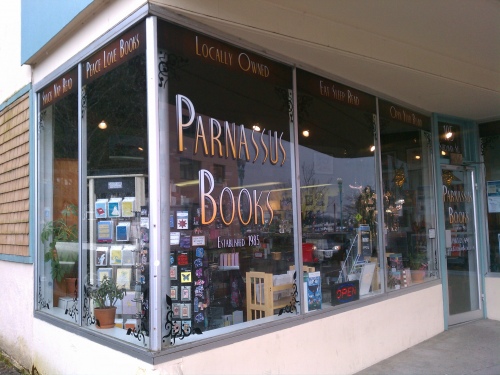 |
| Parnassus Books: author Ann Patchett's own indie bookshop |