Showing posts with label censorship. Show all posts

Sunday, September 30, 2012

The Freedom to Offend


“What is freedom of expression? Without the freedom to offend, it ceases to exist.”  ~ Salman Rushdie

Sir Salman Rushdie
Salman Rushdie’s free speech is easy to defend. He writes award-winning literature with clear artistic merit. The author bravely suffered for his art, having spent a decade in hiding after an Iranian fatwa was issued against him for his 1988 novel, The Satanic Verses. The novel was considered an insult to Islam, and in addition to the fatwa, protests erupted all across the Muslim world. For years Rushdie lived under a pseudonym, the Joseph Anton of his new book’s title.

The hero and villain are clear in this story: Rushdie, on the side of democratic values and free expression, is the good guy. The Ayatollah Ruhallah Khomeini, who called for Rushdie’s head? Bad guy. We can all rally behind Rushdie. We champion his right to offend without breaking a sweat … mostly because he doesn’t offend us.

But what about the case of Nakoula Basseley Nakoula?

Several weeks ago, a trailer for a low-budget film went viral on YouTube. The film was reportedly made in the US by Nakoula, an Egyptian-born Coptic Christian, and was intended to do what it accomplished: really upset Muslims. Riots and protests have broken out all over the world in response to the clip, often from people who haven’t seen it. As with Rushdie’s novel, the protesters just know that their religion was insulted: they don’t ask for details.

Most of us in the US are appalled by Nakoula and his film. We want nothing to do with him. Thanks, but we’ll stick to defending Rushdie. The problem? This easy-out allows those who are most easily offended, who are least reasonable, to decide what everyone else gets to say. That’s not the point of living in a democracy. We went through that whole Enlightenment thing not just to defend the likes of Rushdie (easy) but to defend the likes of Nakoula (ick). We can, and should, denounce the content of Nakoula’s film: it was, according to virtually all who have seen it, obnoxious and incendiary. But we should also, and more loudly, denounce the protesters who hold an ideological gun to our heads, and tell us we better speak the proper speak or the world will go up in flames. We cannot allow their outrage to control our tongues.
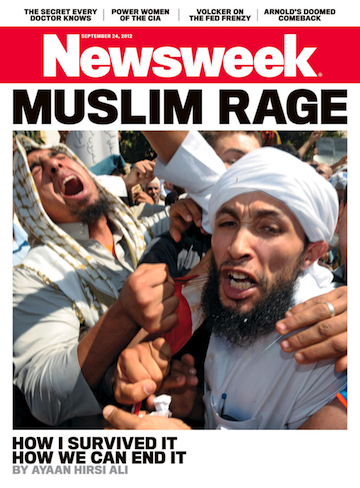
A loud minority
I should take a moment to emphasize here that most of those engaging in violent protests are the Muslim equivalent of Neo-Nazis or the Westboro Baptist Church: they are fringe, they are not representative of Islam. But they are loud and they make magazine covers. However, moderate Muslims are also upset, if not violently so. They are confused about how such a film was allowed to exist. They have blasphemy laws: where are ours?

The United States indeed has no blasphemy laws per se, and fewer hate-speech laws than, say, Europe, where Holocaust denial is illegal. In contrast, many Islamic countries have no free presses at all, only government-controlled media. Blasphemy is criminalized and strictly enforced. It is difficult for people in such places to understand that anyone can say pretty much anything in a democracy: the government doesn’t vet or sponsor the speech of its citizens.

While many in the western world accept the notion of free speech, we can be a little muddier on how it plays out. I am free to tell my Scientologist friend* that her beliefs are ridiculous, that Xenu the Intergalactic Overlord is a sham, a joke, a way to part fools from their money. And by “I am free” I mean my friend cannot have me arrested for hate speech or blasphemy. The government can’t censor me. I am not, however, free from my friend’s reaction to my opinion. My friend can argue with me, delete my posts, unfriend me. When I decide to question her beliefs, I have to deal with these potential consequences. As obvious as this may seem, it’s a concept too many free-speech advocates struggle with: Our freedom to offend doesn’t protect us from anger. This is quite a serious limit on speech, actually: we have to live alongside other people. Just because we can’t be jailed by an action doesn’t mean it’s consequence-free.

As a writer, I frequently self-censor for this reason. I worry that my autobiographical fiction might upset a family member or friend, and I take pains to disguise an anecdote to avoid offense. I worry that a liberal use of foul language or sexuality, appropriate and honest as it may be for the scene or character, will cause an agent, editor, or audience to turn away from me. Writers may also self-censor if their viewpoints on religion, sex, class, and war stand apart from their peers, and this is more insidious. We may feel we must bend to the mainstream in order to have a voice. But if we do that, what are we really saying? In fact, we have nothing to say at all. We’re just parroting the zeitgeist: we end up in an echo chamber. The most influential and important voices are those that can break out of those restrictions and say something new, uncomfortable … and possibly offensive.

This is not to say that offensive speech equals useful speech. Rushdie and Nakoula may both have offended Muslims, but only one had anything constructive to say. Offensive speech can be quotidian or game-changing: the offense in itself isn’t the point. The content is the point. To be a game-changer, you’d better have more than just the ability to piss people off. You had better be able to make them think.

Gay Talese, Susan Sontag, Norman Mailer, and Gore Vidal 
As worried as Rushdie is about the fatwa, and this new tide of offense sweeping the radicalized world, he seems almost more worried about the silencing effect this manufactured outrage has had on potential provocateurs. Is fear of offense causing people to be silent, where they used to speak up? “If you look at America, for instance, there is a generation older than mine in which writers like Susan Sontag and Norman Mailer and Gore Vidal would have a significant public voice on issues of the day,” he said in an interview with Reuters news agency a few days ago. “Now, there's virtually no writers. Instead you have movie stars.”

I think that point is debatable, as we do have the Sam Harrises and Richard Dawkinses of the world—but they are not novelists. I recently reread Margaret Atwood’s 1985 novel The Handmaid’s Tale, which imagines future America as a tyrannical theocracy, and Steinbeck’s grim call for reform, The Grapes of Wrath, and I wonder where we can find such impassioned, daring novels today. The subject doesn’t have to be religion: it can be politics or economics. Steinbeck and Ayn Rand each vehemently criticized economic systems, though in completely different ways. A quick glance through the past decade’s literary standouts fails to reveal anything similar. Novelists can have an enormous impact on culture: Conservative politicians today cite Rand as if she were an actual economist, and Orwell’s novels serve as an admonition across the political spectrum. Today, when we want to warn against the dangers of government surveillance, we still have to say “Big Brother is watching you!” We’ve come up with nothing better on that front since 1949.

Not banned from MY bookshelf
But perhaps Rushdie and I are looking in the wrong place. Perhaps there are some boundary-pushing novels hiding somewhere other than the Pulitzer and Man-Booker shortlists. If you want to know which novels are getting people thinking, which are a bit subversive, you go to the banned-book list. Lately, there aren’t too many lofty literary books on there. But you know what we do find? Kid lit. That’s right, the American Library Association’s “most-challenged books” list is dominated by books written for children and teens. Kids’ books are prone to being banned for a number of reasons, of course: first, they are read by kids. You know, those innocent little people with fresh untainted minds. We don’t want ideas getting in those minds. Second, you can actually ban kids’ books, by having them removed from school libraries. It’s much harder to ban books written for grown-ups in this way.

At its peak, Phillip Pullman’s series His Dark Materials was ranked second in the top-ten books people have tried to ban in the US. The series has a question-dogma message buried within its exciting adventure plot—buried, but not deeply enough. The easily-offended caught wind of blasphemy and pounced right on the series, denouncing it and demanding it be removed from libraries.

In response, Pullman told the Guardian newspaper, “Of course it's a worry when anybody takes it upon themselves to dictate what people should or should not read. The power of organized religion is very strong in the US, and getting stronger because of the internet.” Possibly the most famous challenged author of recent years is, of course, JK Rowling, for her Harry Potter series. Before he was made Pope, Joseph Ratzinger himself condemned the books, writing that their “subtle seductions, which act unnoticed ... deeply distort Christianity in the soul before it can grow properly.” One cannot imagine Ratzinger read the series any more than the Ayatollah read Rushdie. At least nobody asked for Rowling’s head.

Burning blasphemous books at a church in Shreveport, LA
Number three on the current most-challenged list is yet another series, the wildly popular Hunger Games trilogy by Suzanne Collins. As Collins’ main political message is “tyranny is bad,” this seems especially bizarre. The ALA lists reasons pro-censorship people have given for banning this series, and they include “anti-ethnic; anti-family; insensitivity; offensive language; occult/satanic; violence.” Violence, okay. The rest—what the heck? How did anyone find “occult” or “satanic” messages in the Hunger Games? It goes to show that the easily-offended, which seems primarily to consist of the most-religious, will find any reason to ban almost any book. While there is an enormous difference in the methods used, it is clear that the book-protestors in the Middle East and the book-protestors in the west have one thing in common: they don’t want unsettling ideas to get out there.

At last week’s UN General Assembly, many Muslim leaders called on the international community to tighten restrictions on free speech and to ban blasphemy. Egypt’s new president said that his country “respects freedom of expression” unless it is “used to incite hatred against anyone [or is] directed toward one specific religion or cult." In other words, free speech is great as long as it’s totally inoffensive. The president of Yemen opened his speech to the UN by demanding similar limits to free speech: “These behaviors find people who defend them under the justification of the freedom of expression,” he said. “These people overlook the fact that there should be limits for the freedom of expression, especially if such freedom blasphemes the beliefs of nations and defames their figures.” The Arab League’s secretary-general went further still, proposing a binding “international legal framework” to “criminalize psychological and spiritual harm” caused by statements that “insult the beliefs, culture and civilization of others."

Criminalizing “spiritual harm?” One can only imagine what George Orwell, Ayn Rand, and Margaret Atwood would have had to say to that. It is up to us, as writers, not to allow the outraged to silence us. If we aren’t actively writing “blasphemous” books, we ought to be doing everything we can to stand up for those who do.

*My “Scientologist friend” is purely rhetorical: i.e., nonexistent.
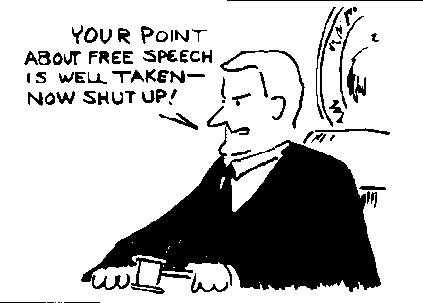

OK! I'm done! I'm done!


Monday, May 14, 2012

Self-censorship and the lost art of subtlety


When it comes to writing, I just hate rules. I particularly detest when the industry imposes arbitrary rules that limits my creativity.  In an age where there are relatively few taboo subjects, those rules are tantamount to censorship. And yet they serve a purpose. Whether we follow or bypass them, they force us to improve our writing skills, to develop crafty ways in which to please this new form of censorship while retaining our personal style. Thus we become subtle writers.

Repression breeds good writers
Once in graduate school, a professor shocked our class by saying that political repression usually breeds the best writers. He used Boris Pasternak and Alexander Solzhenitsyn as examples. In those Glasnost days, my teacher prophesied that no good writer could come from the freer atmosphere of the New Russia. Time has proven him right. I haven´t heard of any Russian literary masterpiece written after the fall of the former Soviet Union.

Moreover, Tom went on saying, and this time we had to agree, that all the genius of the Spanish Golden Age, whether it was reflected on Velasquez paintings or Calderon´s plays had seen the light under a climate of extreme social and political oppression. The Holy Office, the most dreadful censor that has ever existed, was in charge to approve or obstruct any form of artistic expression not only in the Iberian Peninsula but in its overseas empire as well.

The proof was that during their lifetime, Cervantes, St. Teresa and St. John of the Cross ran into trouble with the Inquisition. So, how could Spain reach such artistic zenith during those heavily censored times? Every great artist had to work with what they have, to create code ways to express their true ideas, to skirt around dangerous subjects. In sum, they had to learn to be subtle.
St Teresa and St John of the Cross


Subtlety is something modern writers and scriptwriters no longer recognize.  Despite constant whining about censorship, contemporary artistic expression has no boundaries, few taboo subjects and absolutely no nuance. It´s why we can hardly notice great films since their “greatness” is cloaked by profanity, gore and cascades of graphic sex. I am not saying writing or audiovisual entertainment should lack four-letter words, violence or sexual content, but the lack of delicacy that characterizes its usage diminishes its potential.

To torture or not to torture
Graphic violence has made me close a book several times, but I have to say it seldom happens when reading fiction. Depictions of torture, human experiments, and horrid ways of execution have made me ill, but only if I find them in history books.  Violence in novels doesn’t have that same effect because we know it is fictional, and because good writers know how to use it.

As a child I used to shake all over with Isaac of York’s ordeal in Ivanhoe. The funny thing was that Isaac is never really tortured by the dastardly Norman Front de Boeuf. A fortunate and timely attack by Robin Hood´s Merry Men saves the Jew from being roasted alive, but Sir Walter Scott carefully depicts the torture instruments, the iron grill, the oil, the fire, making the reader as terrified as Isaac of what is about to happen in that torture chamber.
Sir James Mason playing Isaac of York in Ivanhoe


In The 25th Hour, Constant Virgil Gheorghiu portrays with crudeness the suffering of Rumanian people before, during and after World War II, but its strongest scene does not include physical violence. Nora West, the female protagonist, finds herself in an East Germany cell.  When she bangs on the door demanding an explanation for her arrest, the jailer threatens her: next time she calls, she´ll be punished. Although he doesn´t specify what punishment expects her, Nora is terrified.

Unused to hardship or extreme fear, she crumbles apart. The author describes everything that goes through her head from the possible causes behind her arrest to the lice in the bed in the cell. Worse is to come, she needs to urinate but she can´t call the jailer to take her to the bathroom. With exquisite detail, the author describes her need to perform the bodily function: “She felt as if a hundred needles pierced her bladder and she couldn´t force her muscles to obey her.”
Nora West in the Spanish edition of The 25th  Hour


When The Sunday Herald serialized the novel in 1951, the censor cut that piece considering it too strong for their readers. To me is much more powerful and painful than any torture scene, like the one Robert Crichton includes in his The Secret of Santa Vittoria.

After the fall of Mussolini, the village of Santa Vittoria elects Italo Bombolini, the town´s drunkard, as their mayor.  When Germans invade Italy, Bombolini knows they´ll seize the wine the village produces. With the townspeople’s help, he hides over a million bottles of wine in a nearby cave. The Germans arrive and Captain von Prumm, the officer in charge, confiscates a couple of thousand bottles to send over to Germany.
Anthony Quinn as Bombolini


Then the S.S. turns up in Santa Vittoria. Furious because according to the pre-war statistics Santa Vittoria yields over a million bottles,  they demand hostages to torture into giving away the wine´s whereabouts. Bombolini, who has been reading The Prince, devices a Machiavellian plan. He tells von Prumm that to avoid guilty feelings, they should select as hostages the fist two men that walk into to the town square. Previously, Bombolini has arranged so those men are Copa, the former mayor, and another of his Fascist cronies.  The men are taken to the torture chamber and Crichton spends over a page depicting their torment:

“After that they did things with the blowtorch on Copa's body that cannot be written down. After the torch they cooled him with water. He was still conscious and they put the funnel in his mouth so that it went far down his throat and they bent his neck back and brought him to the point of drowning.”

When the time came to get Crichton’s novel to the silver screen, director Stanley Kramer was in a quandary. He wanted to sell his film as a comedy, so how could he balance that with a gruesome torture scene? (Moreover, 60’s sensibilities were not partial to such scene.)His solution was to reach out for subtlety.

Kramer had the camera focus not on the tortured men but on the villagers’ faces as screams are heard in the background. Like in a Greek tragedy, violence occurs off the stage, we don´t see the torture, and we don’t see the torturer or his victims. And yet it is a blood curdling scene (I am glad I found it in YouTube) with those sporadic shrieks of pain breaking perfect silence and the camera recording the reactions of both Bombolini‘s (Anthony Quinn) and von Prumm (Hardy Krueger.)


A reviewer once said that the torture scene was proof of Crichton´s masterful style. I agree, but I also feel that Stanley Kramer deserves some accolades for his timely self-censorship and skillful subtlety in directing a difficult scene. Too bad we cannot say the same about Rosemary Rogers.

Gifted with a fertile imagination and an almost elegant prose, Rosemary Rogers stood apart from the other bodice-ripper authors as the most “literary” of the lot, but she cramped her style with a taste for violence. Not only were her heroines incessantly raped, but her antiheroes were not immune to victimization either. With gusto, Rogers would subject her male protagonists to flogging, beatings, and stabbings. She reached heights of cruelty such as bounding them to cacti, slowly choking them with wet leather and staking them to the ground just to be covered with hungry ants. She even had he favorite macho hero Steve Morgan threatened with male rape. Rosemary Rogers was a good writer but she went too far. Too bad there was no censor around to curtail her sadistic imagination.

“And the earth moved…”
Over the years I have run into many books and films that could be perfect except for one flaw: excess.  An overflowing of shocking material can cause mental indigestion and it’s a sign of artistic immaturity. A writer doesn´t have to return to Victorian literature inhibitions and leave the reader wondering how and when the heroine got pregnant, but a bit of self-censorship will force the writing to be more ingenious and subtle.

I don´t want to linger too much on the subject of explicit bedroom scenes , but I think the most arousing books and films are those that display restrain. A friend of mine once complained about the amount of euphemisms historical romance authors used for male genitalia.  “Why can´t they just call it a penis?” she said. I explained that the word didn´t matter, much more important was what the penis did, something even authors forget. They shouldn’t focus on body parts or positions, but feelings and emotions.

 Guy de Maupassant wrote fantastically sexy short stories and novels and yet he never had to use anatomical references or lewd language. He concentrated on atmosphere, sexual tension and feelings. Just describing the shrill provoked by a girl’s fist orgasm was much more exciting that spending two pages illustrating every action that brought about that shriek. Just think of Hemingway’s phrase "and the earth moved out and away from under them” in For Whom the Bells Toll.  That immortal metaphor for an orgasm is all you need to realize that Robert and Maria are having a good time upon the Spanish ground.
Robert and Maria before making the earth "move"


Forbidden words
Recently Regis reminded me that the word “impotence” is not used in The Sun Also Rises to explain the hero’s malady, yet every reader knows Jake is impotent, just as we know Oscar Wilde’s The Portrait of Doryan Gray is all about homosexuality. Sometimes a writer doesn´t need to state the obvious. However, the fact that the film version includes the word “impotent” was a major breakthrough in an industry that couldn´t use the word “virgin” (referring to a physical condition) until “The Moon is Blue" (1955) and the term “pregnant” until “A Summer Place” (1960.) Nowadays those words are so common in television and moving pictures that we don’t even notice them. It´s only the first time they are used that they cause the desired shock.

Norman Mailer´s epic war novel The Naked and the Dead presented the reader with a new verb: “to fug.”Mailer had to yield to his publisher´s advice not to use the “F” word since books that had previously used it (i.e. Joyce´s Ulysses and Lawrence´s Lady Chatterley’s Lover) had been banned in the US. But two years late, James Jones dared to actually use the “F” word (60 times) in From Here to Eternity.
Nowadays profanity is so widespread in fiction that I hear a good way to attract an agent is to begin a novel with a dialogue line that includes a “bad” word. I guess that after rating a dozen manuscripts that start with “F...k” or “S...t”, agents are probably immune to such novelties. The problem of overusing resources is that they become boring and predictable.

I remember the first “bad word” heard on national TV. It was uttered by Hawkeye Piece (Alan Alda) in the “M.A.S.H” episode “Guerilla My Dreams.”A M.A.S.H.  fanatic, I still recall the electric current running down my spine when that “Son of a Bitch!” was hurled by Hawkeye to a Korean intelligence officer bent on torturing a patient. In the 80's, profanity was unknown in open television. Nowadays the S.O.B term is used even by children on the small screen and we scarcely bat an eyelash.
"Guerrilla My Dreams"


My father once gave me a great piece of advice. “Never use a four-letter word when you have a better term at hand. Extreme profanity is a sign of ignorance and lack of vocabulary.” Every time I watch “True Blood” I remember Dad’s advise because everyone in the show from sophisticated vampires to working-class shapeshifters suffer from a bad case of gutter-mouth. This applies to the heroine as well.  Sookie Stackhouse in her books doesn´t curse as much as her television counterpart who comes across (excuse the non PC word) as the prototypical “white trash.”


 I am tired of hearing that “explicit sex, gore and foul language sell.” How come extremely successful shows such as “Downton Abbey” and “Mad Men” do not use that cheap device?  “Mad Men,” a show that is all about sex, keeps profanity to a minimum. In five seasons it has yet to show nudity or naked sweaty couples huffing and puffing like the Big Bad Wolf about to blow away the homes of The Three Little Pigs.


After this tirade, I have to confess that I have been guilty of every fault I criticize in this post. I have written gory and sexually explicit scenes, and twice wiser-than-me Beta Readers have counseled me to erase an untimely “F” word. We are the product of what we see and read. How could we then circumvent the inevitable excesses of poor taste?

My advice is read, read and read. And watch your reaction to all that reading. Could you name novels (or films) where offensive subjects were skillfully and tastefully managed? Have you turned off the TV, walked off the movie house or closed a book because of a particular mishandling of delicate themes? In general, how do you feel about too much sex, violence and profanity in literature?  Should we exercise self-censorship to balance the excess?

Monday, March 7, 2011

Age and blood-ties: Do readers impose their taboos on the industry?


Oscar Wilde did not believe in "dangerous" books


The publishing industry claims there are no forbidden themes in fiction, agreeing with Oscar Wilde´s quip that there is no such thing as bad books, only badly-written ones. But we, readers, know very well what topics disturb us. What happens when the public refuses to read novels dealing with controversial topics? Won´t the industry budge to its clientele´s tastes? What are the once safe subjects that now upset modern sensibilities?

I begin by saying that my comments are on the American scene, since the United States is still the leader in book-publishing in the world. Other publishing industries have their own idiosyncrasies and prohibited subjects, but to all of us who write in English, it´s the American industry that matters.

I am fifty-one years old, and like most people my age, I am painfully aware of the distinction between Twentieth Century’s and contemporary cultures. Our way of thinking has evolved tremendously and that applies to literary tastes as well. A Third Millennium reader might be shocked and offended by the way classical works of literature dealt with love in times when spousal rape, underage sex, and sibling marriage used to be the norm.


As modern critics applaud the erasure of racist epithets in Huckleberry Finn, so they show antipathy towards certain subject matters in current fiction. Exploring user´s comments on Amazon and other sites, I have come to recognize what issues are considered “icky” and elicit the most “how gross!" and ”eeews!” from readers. Among those controversial scenarios are cousin-marriage and May-December affairs, even when they take place in historical settings.


From Jane Austen to Louisa May Alcott, “kissing cousins” were frequent romantic elements in Victorian novels. Over a hundred years, and several medical and social misconceptions later, marriage among cousins disgusts American audiences. Unless it is shown as illegal, incestuous and negative, such a relationship in modern literature is unthinkable. Not surprising since the only Western country that bans those unions is the United States (and it´s unlawful just in thirty states).

Cousin-marriage a la Austen


The British YA novel How I Live Now, has been widely criticized on the Internet for depicting a love affair between a fourteen-year old and her first cousin. Users and critics agree that books should carry warnings signs to alert readers about unsavory content. Not even children’s literature is safe from such displeasure. I heard that copies of the well-loved Babar series now have been censored so there is no mention that Celeste, the elephant’s wife, is also his first cousin. Are they doing the same with Beatrix Potter’s Peter Rabbit? Because if I don’t ill recall, Peter married his first cousin, Topsy.


The same distaste applies nowadays to that old romantic staple: May-December love affairs. Even if it happened in days of yore, the idea of an underage wife makes readers flinch. It’s no use telling people that until World War I, men married old and women married in their teens. Just remember Scarlett’s fear of becoming a spinster like 20-year old India Wilkes. But perhaps, Gone with the Wind is, by present standards, a dangerous novel.

May-December romance in GWTW

I was nine-years old when I came across my first copy of Gone with the Wind. It took me two days to finish it and less than fifty pages to turn it into my favorite novel of all time. It might come as a surprise that Melanie marrying her first cousin or Scarlett marrying the much older Rhett Butler did not shock me. I am embarrassed to say, I was not even offended by Rhett raping the heroine. I guess, many felt that way because in 1987, conducting a poll among my high-schools students, I found that GWTW was still a YA bestseller. I wonder if that would hold true today. Do teen readers, and adults, still fall in love with GWTW, or are they uncomfortable with it´s racism and sexism, not to mention the odd matrimonial customs of the Old South?


Gigi and her much older paramour

With that in mind, I can understand why modern sensibility cringes at films like Gigi, based on Colette´s novel, which has a fourteen-year old reforming and marrying a bored womanizer. How do people feel about Jo March marrying old, but loving, Professor Baher? And how many complaints have I read about Twilight because 100-year old Edward is a tiny bit older than teenaged Bella? The fact that Bella is an “Old Soul”, who would much rather cook and read Jane Austen than do drugs at the nearest disco, should be taken into consideration.

Bella messing around with an "older man"


As I wrote once, Fantasy and Science Fiction offer great refuges for taboo-breaking. George R.R. Martin became a bestselling author after creating a world, in his saga Song of Ice and Fire, where incest is not a crime, thirteen-year-old brides are acceptable. The hottest craze for vampire romances lets May-December thrive as long as, quoting a reader, “the hundred-year old vampire looks good!”


Must add, so this doesn´t sound like an attack on people´s preferences, that certain novels do disturb me , even if set in fabled worlds or historical settings. Today, many of us are uncomfortable with early bodice-rippers that dealt with “rape fantasy” romances (i.e. heroine raped by hero). Visiting a romance forum, I sympathized with comments repudiating Rosemary Rogers and Kathleen Woodwise’s works for including that scenario, but then I was appalled when the same readers embraced Diana Gabaldon’s Outlander that has the villain raping the hero. Talk about a double standard!


To anyone that asks, I wholeheartedly recommend Jacqueline Carey´s Kushiel series. It offers elegant prose, plenty of intrigue and adventure stories, and Carey has created a wonderful parallel world that mirrors the European Middle-Ages. Having said that, I confess that after reading the first book in the series, I gave up on it. I found it excessive , not to mention sickening, to read about a society that made sex the number-one priority, where girls were trained to become sacred prostitutes , and where the heroine’s greatest gift was to experience pleasure through pain.


I realized that only the “Historical Fantasy” label permitted the Kushiel series to become part of mainstream literature. I don’t believe it would have worked if masochist Phedre had been the protagonist of a contemporary romance or a historical novel, because reader tolerance does not encompass historical settings. And one of the best examples is The Kindly Ones, Jonathan Littel’s award-winning novel.


American- born Littell chose to write this novel in French, he had it published by the prestigious Gallimard publishing house, and eventually went on to get Le Prix Goncourt, the French equivalent to the Pulitzer Prize. The Kindly Ones is an exploration of the Holocaust written from the point of view of an SS officer, a highly educated, but deeply-disturbed human being.


Although vastly praised, The Kindly Ones has come under fire by several critics that begrudge its historical inaccuracies, the handling of the Holocaust, and last but not the least, the almost pornographic juxtaposition of sex and violence. Add to the fact that the protagonist is homosexual and has this obsession with somodizing his sister, and you´ve said it all.

There´s even a story that Littell, having been rejected initially by many American publishing houses, eventually rewrote his novel in French. What fuels the possibilities of this rumor being true is that The Kindly Ones’ translation, bought by HarperCollins, did very poorly in the American market. Which shows the industry knows its readers and their likes and dislikes.

Now it´s your turn to tell us what subjects you find repellent? What novels have made you cringe? And should the industry stay away from controversial themes?

Monday, January 17, 2011

The Controversial World of Slang

Huh??
Being a historical writer certainly comes with its challenges. I'd say one of the more interesting and, often times, more fascinating aspects is the use of slang. If you're a more contemporary writer, or one of those who delves into Fantasy, Science-Fiction or other-worldy genres then you might not feel the need for believable slang in your writing. But for me, it's essential.

When I wrote my first novel, which takes place during the mid-1800s, the first major roadblock I ran into was that my dialogue was just not convincing enough. "Why would a slave speak like an everyday, ordinary human being?" one critiquer asked. And you know what? That particular critique was spot on. I had written flat characters onto the page, simply because I had ignored the speech patterns of each individual character. And I had avoided the lingo of the time period.

Among the three time periods I've tackled (1850s, 1920s, and 1940s) I'd say the one that takes place in the 1850s was the hardest for which to research the slang. Why, you may ask? Because it's not as easy to trace slang when no one today was alive during that time period (let alone really speak it since most of it is viewed as derogatory). Yes, it gets passed down and we find certain references in other literary works, but writing styles during the 1800s were quite unlike the writing styles we find today. Those writers may not have followed the slew of rules that bog down the more modern tippy typers, but a majority of literature one reads in a World Lit class, American Lit class, European Lit class, etc. was written by highly educated individuals (or incredibly detailed individuals). Now, I'm not saying that writers today aren't a wonderfully educated bunch, but the difference lies in the fact that colloquial speech is much more acceptable this day and age. But that also depends on the words one chooses to use.

When contemplating the use of slang in your manuscript there are a few things to keep in mind:

  • First, take a look at your genre. Some genres (like sci-fi and fantasy) don't necessarily require the use of slang. In actuality, it might even age your writing. If you're using today's slang, then five, ten, twenty years from now, readers are going to see that what you wrote has become outdated (just take a look at some of those sci-fi movies from the eighties). There are a few exceptions, like with Steampunk, where history is mixed in, therefore the use of slang would actually add to your story.
  • Secondly, don't overuse it. Slang is good in small portions. If you decide to go back and infuse your manuscript with this element, make sure you aren't writing large portions of dialogue or prose that get bogged down with slang. This just makes your writing ridiculous. Just like with any other element you decide to use (flashbacks, multiple POVs, the "to be"verb, etc.) keep it to a minimum. You don't want to draw unwelcomed attention to your writing -- you want that writing to sing, uninterrupted.
  • Thirdly, don't confuse your reader. Finding a treasure trove of words from say, the 1920s, doesn't mean your audience is going to understand what you choose to use. Make sure your target audience is going to grasp the meaning of your chosen slang. With historical, readers expect a different vocabulary, but again, don't use the most obscure terms you can find. And put it into a context that can lead the reader to its meaning. For instance, when I referred to my protagonist as a partier I used the term "liberally spifflicated." It's an old term referring to one being drunk, and one of my critiquers instantly picked up on it and actually enjoyed the use of it. 
  • Lastly -- and keep this in mind -- know you're not writing to be "Politically Correct." If this mindset sets in, then know that you're not really writing -- you're putting things on a page that a PC-populous would want from you. As writers, we need to respect the lingo of our chosen time period, no matter how offensive it would be viewed today. There was a reason for its birth -- don't squash that reason with your seat-shifting need to avoid it. If you're not comfortable with writing certain words, then perhaps you should change aspects of your story around in order to avoid them.
This final point brings me to a debate about which I recently read. As a writer, my hope is that through the years my work will be passed on from generation to generation. I'm sure Mark Twain had that in mind as well. There was an interesting article published on Entertainment Weekly's website concerning The Adventures of Huckleberry Finn debate. Basically, what the article states is that a new version of this wonderful novel will be published with the "n" word and the word Injun removed and replaced with the less offensive terms slave and Indian. There is the argument that this is a form of censorship. I believe Mark Twain had a purpose for writing the story as he did. Does that mean that years later a PC public should come along and change it just because we now view these words as offensive? You can read the article and responses and decide for yourself.

The Indian War Memorial monument
(2006) courtesy of Wikipedia
Another example I'd like to point out involves The Indian War Memorial monument at the center of the Santa Fe plaza. I bring this up because this is the first I've seen like it. Just so you know, I'm not condoning the use of derogatory or hateful language of any kind, especially this day and age. I'm simply stating that there is a reason why writers choose the language they place in their work.

If you've ever been to the monument, seen the inscriptions, and then read the plaque in front of it, then you've seen that some of the original inscriptions have been chipped away. It once read "Savage Indians", of which only "Indians" remains. It's been a while since I last visited the monument, but I also believe a couple other offensive terms have been removed (correct me if I'm wrong). Even so, should a monument, with an inscription that once reflected the charged, strife-filled atmosphere of Santa Fe, have its historical meaning removed in order to placate those who don't want a reminder of history staring them in the face? History is just that -- history. If we remove the words that created our world, simply because today we find them offensive, then how will we ever fully understand the past? As a historical writer that's exactly what I need to know in order to craft my story properly and bring a bit of what was once known to the world we live in today. Otherwise, we may just end up repeating that past so many others want to believe doesn't exist.

How about for you? Do you think The Adventures of Huckleberry Finn debate is a form of censorship? Or do you view it as minor corrections to a work children will read in their classrooms? Should we erase offensive slang of the past so as not to bring up the children of today in a world that still bears the scars those terms created? Can you think of other instances where either literary works or public inscriptions have been changed?

Just food for thought that I believe is worth munching on!

♥ Mary Mary

Thanks, for this lovely award, goes out to the The Blogger Formerly Known As and also over at Jennifer Lane Books. Stop by and show them some love! Perhaps I will pass it on at a later date, but I'm just unable to at the moment.


Stop by and see what I've got going on over at The Random Book Review!