Showing posts with label Publishing industry. Show all posts

Monday, March 19, 2012

The Novel 2.0


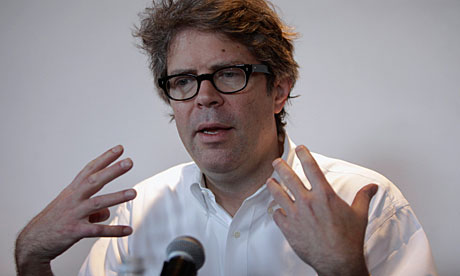
Jonathan Franzen is afraid: should you be, too?
“When I read a book, I'm handling a specific object in a specific time and place. The fact that when I take the book off the shelf it still says the same thing – that's reassuring." This is author Jonathan Franzen, speaking on the evils of the ebook earlier this year. Like many über-literary types, Franzen is not a technophile. He would like the publishing industry to stay the way it is, which is to say, aggressively static. "Someone worked really hard to make the language just right, just the way they wanted it. They were so sure of it that they printed it in ink, on paper. A screen always feels like we could delete that, change that, move it around. So for a literature-crazed person like me, it's just not permanent enough ... Everything else in your life is fluid, but here is this text that doesn't change ... Will there still be readers fifty years from now who feel that way? Who have that hunger for something permanent and unalterable?” Franzen's fear of change extends to a dislike of people who disagree with him: if you, dear reader, are a consumer of ebooks, you are not a "serious reader." Not according to Franzen, who might just possibly still be reading books in cuneiform chiseled onto clay tablets.

I hate to break it to Franzen and his fellow Luddites, but the ebook is not going away. As papyrus was superseded by parchment, and the quill was superseded by the printing press, the Kindle will almost certainly be superseded, eventually, by some new bit of technology. The point is that in spite of Franzen’s obvious desire to freeze the world in place, things do change. Gutenberg's technology didn’t bring the end of civilization (in fact, it might have helped it along), and I think it’s fairly safe to assume that neither will the inexorable march of the ebook herald the apocalypse.

Old harbinger of doom
New harbinger of doom

First, it’s worth pointing out that the static-book concept is something of an illusion. Books can change from their original; we call those changes “editions.” Orson Scott Card, for example, had the chance to change some things about his bestselling novel Ender’s Game, originally published in 1985, but with an “author’s definitive edition” released in 1991. Other books have been changed against their author’s wills: Huckleberry Finn suffered a more ignominious rewriting when the n-word was recently expurgated by well-meaning but clueless censors. D.H. Lawrence and other authors ahead of their times have had their words changed: the fact that their books were printed in ink, on paper, did not make them immutable. Actually, D.H. Lawrence benefited from the passage of time: unlike Twain, his original words were released in later editions, as reader sensibilities liberalized.

Not "permanent and unalterable"
So, Mr. Franzen, even before the ebook, novels were not always "permanent and unalterable." But they are about to become quite a bit more dynamic, and as writers we have to prepare ourselves for this change.

In 2007, ebooks accounted for one-half of 1 percent of the trade book market, according to an annual survey conducted by the Association of American Publishers. Just a few months later, the Kindle was introduced, followed by the Nook in 2009. Ebooks went from a trickle to a tsunami at that point: their sales and markets have doubled every year since then. In 2011, ebook sales were up 117 percent, representing nearly 20 percent of all book-publishing revenues. 

It’s not simply that books are moving from paper to digital format, though. The book itself is changing, as indicated by Franzen’s fretting over “permanence.” Authors can now get immediate feedback on their work from readers, before the book has even been officially published. Authors may begin releasing their books bit by bit, with readers giving feedback nearly in real-time on plot development and character. This means the book becomes something like a collaboration between writer and reader.


Dominque Raccah, CEO and publisher of Sourcebooks, calls this the “agile publishing” model. “You really are publishing into a community already," Raccah says in this NPR interview. "So what you are going to be doing is developing that book in front of that community, having the community interact with the author to develop the book [and] provide feedback."
The writer and her readers, collaborating

I find this concept rather mind-boggling: exciting, a little bit scary, and full of possibility. We may even need to rename the book itself, replacing it with a "word that will describe the digital, transmutable, readable, platform-agnostic, weightless, immersive, elastic creation, hitherto known as a book."


I’m not an especially adept technophile — I always feel I’m limping along after trends, trying to keep up, and missing a variety of revolutionary boats. But I am not afraid of the future, for the most part, and I think some of the changes in the publishing world could go our way, as writers. If e-publishing is a tsunami, we writers have a choice to run screaming from it, or to grab our surfboards and ride this sucker.


What do you see as the pitfalls and possibilities of this frontier in publishing?

Sunday, September 4, 2011

The Woes of Word Counts

A sentence should contain no unnecessary words, a paragraph no unnecessary sentences, for the same reason a drawing should have no unnecessary lines and a machine no unnecessary parts. This requires not that the writer make all his sentences short, or that he avoid all detail and treat his subjects only in outline, but that every word tell.
  ~William Strunk, Jr.

The dreaded red pen
Being concise is difficult; so difficult many writers won’t do it unless forced. Most of us regard the red pen with fear and loathing. We don’t want to edit, we don’t want to cut. So why do we have to? We love words. Why can’t we write as many of them as we want?

The simplest reason is that the publishing industry clearly demands it. The magic number is 100,000. You can’t go over that word count for a novel without severely hampering your chances of getting published. (In some genres, it’s even less.) To be honest, I don’t really understand why this is. Maybe one of our readers in the publishing industry can explain it. In a recent informal, completely nonscientific survey, the majority of my friends said they prefer long books: the longer, the better. They like getting lost in another world. We can all think of a dozen bestselling exceptions to the 100,000 rule: War & Peace. Pillars of the Earth. Gone with the Wind. Harry Potter. According to this guy, all modern books (all!) are too long. So we may be forgiven for feeling sniffy when agents tell us to keep our submissions short.

Doubles as a doorstop
One thing to keep in mind is that the demand for succinctness seems to apply primarily to unpublished writers. The Deathly Hallows is 759 pages, but The Sorcerer’s Stone is only 309. Rowling was probably forced to be more terse than she wanted with that first novel: once she established herself as a bestselling author, she was allowed to indulge. It is also true that some debut novels are massive: Special Topics in Calamity Physics, Marisha Pessl’s first novel, is 514 pages long — which translates to about 200,000 words. We look at her, cross our envious arms over our chests, and think, well if she can do it …

But the most salient truth here is this: many literary agents really do reject on word-count alone, and it’s never a good idea for a novice to assume she’s the next Marisha Pessl. Getting published is hard enough. To ignore the word-count guideline is to run a marathon with one leg hobbled.
Not an ideal way to enter a marathon
Another reason to write shorter is that it will force you to write better. “The only art is to omit,” said Robert Louis Stevenson. “If there is anywhere a thing said in two sentences that could have been as clearly and engagingly said in one, then it’s amateur work.” When I write freelance articles, I’m usually required to write no more than 800 words. My notes and interview transcripts run thousands of words, and it all seems important.

This is going to hurt
But I have to be economical: if I don’t slice those words, my editor will, and I’d rather be the one holding the scalpel. This forced concision means I have to think hard about word choice. Not only word by word, but paragraph by paragraph. Some passages, especially descriptive ones, add nothing substantive. They’re decorative, and when you’re on a word budget, decoration is the first thing to go.

Not everyone, of course, is inclined to write long. Last summer I took a writing class with a woman struggling to complete a middle-grade book. She’d been told she needed to add about 2,000 words to get it to the “right” word count for that genre, and she was devastated. “I don’t know if I can do that,” she said, mournfully regarding the pages in her hands. I was puzzled: for one thing, 2,000 words doesn’t seem like that much. For another thing: think of the chances she had to develop character! To wax eloquent with a scene description! To throw in some snappy dialogue! But for some writers, reaching the word-count minimum is the trick. (That magic number, if you’re wondering, is 50K for mainstream adult fiction; 30K for middle-grade.)

What about you? Do you feel hampered by industry’s word-count limits, or do you find the guidelines helpful? Do you wonder, especially with the growing popularity of e-readers, if this limitation is becoming irrelevant? Have you been told by an agent or editor you need to cut — and if so, how did it affect your story?
 Too many notes, Herr Mozart

Sunday, May 29, 2011

Culture Shock: The American and the Spanish Publishing Industries


For the past two years, Sister Lorena and I have been comparing the Spanish and American publishing process, and current literary scenes. At first glance, they were so different that I switched from writing in English to doing it in my native language, hoping that the Iberian market would prove more hospitable. Alas, the differences are fewer than the similarities.

Although the Spanish industry is much smaller than its American counterpart, it still manages to bring out 70,000 new titles to bookstores every year. Aside from producing material for its native population, it also caters to the literary needs of three million Spanish-speaking people throughout the globe.

The publishing process is not dissimilar from its American equivalent. Agents and publishers rule supreme. The process includes proposal, query letter and credentials. Having a mentor or knowing someone in the business could be crucial, as well as having a reputation in journalism. Bestselling authors like Julia Navarro, Carlos Ruiz Zafon and Arturo Perez Reverte share a common journalistic background.


When it comes to target audience, the Spanish industry also has a much broader reader profile than the American, and it’s filled with extraordinary generalizations. Apparently, the target reader is female, under forty-five years of age and has a college degree. This potential client favors Dan Brownish conspiracy tales and historical novels a la Ken Follet. She reads for leisure, but her reading hobby competes heavily with TV, films, music and video games. Last, but not least, she suffers from attention deficit.

I know that in United States, the publishing industry does profile and have target groups, but hopefully it does not pigeonhole potential clientele in such an imprecise, indiscriminate and almost offensive manner. Although, the easily distracted reader is a universal misconception. At work, I’m constantly berated for writing long articles. “Remember,” I am told, "users get bored after the third paragraph.”

So, you may ask, what are the main differences between both markets are. The major differences lie in content. Spanish novelists are not afraid of the caveats we are so familiar with. On reading any bestseller, you are bound to find backstory and head-hopping galore. Length is not an issue (despite the attention deficit that supposedly afflicts its users). Spanish bestsellers usually run over six hundred pages. They are the type of book that, after falling on your foot, will have you limping for a day. I speak from experience since I was almost crippled after La Catedral del Mar landed on my toes at the supermarket, where I was leafing though Idelfonso Falcones' bestselling historical novel.


Spanish writers don’t need to be glamorous, gorgeous or young. A couple of years ago, an 80-year old great-grandmother won a literary award for a historical novel. And Manuel Maristany, well in his eighties, published his debut novel, La enfermera de Brunete (another huge volume) in 2006. For years, Maristany had been seeking a publisher for his Spanish Civil War epic. He eventually sold it to a small publishing house. Then, Planeta, a larger house, bought it and turned it into a success, despite the fact that the content was written from a point of view that might be considered “politically unfashionable” in 21th century Spain.


Unlike American publishers, Spaniards are not too interested in genre, aside from historical fiction and thrillers of all kinds (some of which are described as “mainstream” literature). That explains why their bestsellers lists always include mysteries and historical novels. Most probably, writers know better than attempt other genres. I will include a link to current Spanish bestsellers (Los más vendidos) as provided by "El Corte Inglés", the largest department store in Madrid. You may see that, aside from Jean. M. Auel and the well-loved Follet, you find native novels set in medieval Barcelona, World War II Morocco, and Early 20th century Spain.

Another surprise is the lack of local YA literature. It appears that young adults are not a target group. El Corte Inglés includes a brief list of books for young adults. Curiously, all are written by foreign writers, half of them are fantasy and yet are not cataloged as such. Claudia Gray vampire’s saga is described as “novela romantica."


I ‘m sure there are more differences and similarities between both industries, but those are the ones that hit the eye. Does it seem as they are poles apart? In which ways would you like the American publishing process to copy its Spanish counterpart? Are you familiar with the ways the publishing business operates in other English-speaking countries?