Sunday, November 27, 2011

The Cage of Myself


Pretty homemade bars
There was a time, not too long ago, when I loved to write. All I wanted to do was write. I preferred writing to socializing, cooking, and even eating. Which is saying something, because I really love eating.

Then something happened, and I still don’t know what. About a year ago, it became harder to write, and about six months ago, the writing machine in my head began shutting down almost entirely.

I am now at a complete standstill. I am locked in a cage of my own making, of my own mind. Somewhere in the depths of me, there might be a key — there must be — but that sucker is well hidden.


This is distressing, to say the least. I’ve tried various tricks to free my inner writer: reading excellent fiction, reading how-to-write books, trying out writing prompts, reviewing my works-in-progress, joining NaNoWriMo, and finally, simply forcing myself to sit down and pound out words. “Even if it’s terrible,” I said to myself, “do it anyway.” I granted permission to write crap, to write a string of nonsense words, anything. I figured if I faked it for a bit, my little prison might open. At least, the gap between the bars might widen a tiny bit.

I figured wrong.

This is not writer’s block. At least, not the way I understand it. Writer’s block is when you can’t think of what to say next, isn’t it? When you lack inspiration. I know what needs writing. I write in my head every night as I drift off to sleep. I already have a first draft of one novel mostly written. I’ve got an outline, solid characters, and a trajectory of scenes. It really should be quite straightforward. 

No, this is not writer’s block: it’s more like writer’s phobia. When I sit at the computer and open up Word, I feel nauseous. Literally sick to my stomach. Even the icon for Word, that little blue W, makes me break out into a cold sweat.

The stuff of nightmares

White Page of Doom
It’s not just with fiction, either: I got it writing my last non-fiction piece — and normally that’s work I can knock out practically in my sleep. I got the shivery-jivvers today, too, when I readied myself to write this blog post. I moped around the house for fifteen minutes, moaning to my family, clutching a cup of tea in my chilly hands, before I worked up the courage to face The White Page of Doom.


I never thought this would happen to me. I used to zone out at parties or school functions, daydreaming of my characters, desperate to get back to my computer so I could write more, more, more. I was so smitten with the act of creation; it felt like falling in love. It was blissful. It was maddening.

I miss it.

I’m not sure what to do next. Faced with a lack of alternatives, I’ve accepted that there’s nothing I can do. As I’ve watched the end of NaNoWriMo ticking by, I’ve hit a point of fatalistic ennui. A sad kind of acceptance.

But! There is a silver lining to my little cloud of writerly doom. I have a feeling, for no good reason whatsoever, that this phobia (or whatever it is) will pass. I have a feeling that not only will the ability to face the white screen come back to me, someday, but the joy of writing, the obsession of it, will come back, too.


I just hope it doesn’t take too long. I don’t want this cage getting too comfortable.

Sunday, November 20, 2011

The Mysterious World of ... Ghostwriting

Lions and Tigers and Bears, oh my! No, silly. There's nothing scary about ghostwriting, unless you consider the lack of recognition many of the "real" authors receive.

Let's play a little game, shall we. Can you tell me which one of the following five books has been written by someone other than the name slapped on the front cover?

  1. Ronald Reagan:  An American Life
  2. Ecstasy and Me:  My Life as a Woman
  3. Tennis as I Play It
  4. Under the Pyramids
  5. The Hardy Boys:  The Secret of Wildcat Swamp
Unless you cheated and looked at the links above, then you might not know that all of them have been ghostwritten. (Here's a link to "The Top 50 Ghostwritten Books" if you'd like to see more.) Perhaps you're thinking about taking on the role of ghostwriter, or maybe you're searching for the perfect ghostwriter to write your self-help book, series, or memoir. If this sounds like you, there are a few things you'll need to know.

What is a ghostwriter?

According to Toni Robino's essay,* "Secrets of Ghostwriting and Collaboration Success," this is what ghostwriting boils down to:
❝...a ghostwriter gathers the author's original materials and research and turns them into a book, based on the author's specifications (if the book will be self-published) or the publisher's specifications (if the book has been sold through the proposal process.) Theoretically, although ghostwriters do conduct interviews and undertake additional research, they do not contribute their own thoughts or ideas to the content of the book.❞
Robino later goes on to say:
❝Do not overstep your boundaries as a ghostwriter by adding your own thoughts to a book, unless the author specifically asks you to do this.❞
Book Series:  Rainbow Magic fairy books are
all by Daisy Meadows, who is really
four women.
While researching the topic of ghostwriting I learned that the majority of what's ghostwritten can be broken down into three main categories:

  1. Book Series -- In this category, you'll see books from longstanding series such as The Hardy Boys or Nancy Drew. A more current example would be the Rainbow Magic series for grade school-aged girls. All of them are written by Daisy Meadows, but according to goodreads, "Daisy Meadows is the pseudonym used for the four writers of the Rainbow Magic children's series: Narinder Dhami, Sue Bentley, Linda Chapman, and Sue Mongredien."
  2. Celebrity "Autobiographies" and "Memoirs" -- Ronald Reagan's life story would fall into this category as would just about any other celebrity autobiography out there (grant it, there are a few who write their own life stories). A well written memoir or autobiography needs the proper writing skills behind it, and this is why many celebrities turn to ghostwriters. I found a little humor in a Wall Street Journal article -- "Fascinating Story, but Who Wrote It?"✠ -- "Earlier this month, the Borders bookstore at Time Warner Center hosted a reading of 'Fall to Pieces,' a memoir by Mary Forsberg Weiland, the former wife of rocker Scott Weiland. As photographers snapped pictures of the author, another woman stepped up to the podium. 'Hi,' she said. 'I'm Larkin Warren, and I was Mary's midwife on the project." I think the role of midwife is an appropriate way of describing the work of ghostwriters.
  3. One of the biggest questions
    plaguing the free world today:
    Did Ronald Reagan really write
    his own autobiography?
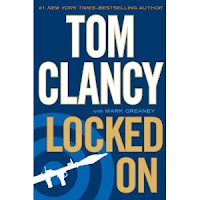
  4. Writers under a popular author's name or author's novel series -- In this category you'll find long-time authors doling out rights to other authors who want to continue a series under the original author's name. A couple of recent examples are The Race by Clive Cussler and Justin Scott and Locked On by Tom Clancy and Mark Greaney. In both instances, Scott and Greaney would be considered the main authors, but in order for the books to sell they are written in a popular series (like Clancy's Jack Ryan series) and titled under the bold lettering of Cussler's and Clancy's names.
Can you see Mark Greaney's
name in teeny tiny blue?
Then there are those who ghostwrite just about anything else, from self-help books to short stories to cookbooks. But how do you know if you could succeed at being a professional ghostwriter? Robino says you need to treat writing as a business and the more you learn about running a business, the better off you'll be. Here are ten things Robino says you need to learn before going into operation:
  1. Assess Your Writing Skills -- The more published you are the better your odds are at landing a deal.
  2. Make Your First List -- Who are the experts you know and are they pioneers in their fields? Resist the urge to contact these individuals until you are professionally prepared for your meeting.
  3. Prepare a Professional Package -- This should include your resume, bio, services you offer, writing samples, and different styles and topics.
  4. Set Your Rates -- Know how fast you can write a final copy, and remember the chapter isn't finished until you've edited, polished, and proofread it. Also, be aware of what first time ghostwriters make -- anywhere from $1,000 - $8,000.
  5. Polish Your Interpersonal Skills -- Practice listening closely to what the client wants without interrupting.
  6. Know When to Run -- Not every book will be a good match.
  7. Close the Deal -- Make sure you sign that contract and don't be afraid to ask questions.
  8. Capture the Author's Voice -- I good way to get a sense of the author's voice is through taped interviews.
  9. Create and Keep Deadlines -- Stay accountable to the deadline.
  10. Ask for Referrals -- The best way to market yourself is through word of mouth marketing from clients who are satisfied with your work.
If you're still wondering if ghostwriting is a good fit for you, then I encourage you to read up on the subject. Toni Robino's essay is quite insightful on the matter and there is plenty of info out there on the web for you to devour. If you do decide to jump into the mysterious world of ghostwriting -- Best of Luck to You!

Are you interested in ghostwriting or have you ever done similar work? If so, what was your experience like? Would you encourage other writers to become ghostwriters?

*"Secrets of Ghostwriting and Collaboration Success" by Toni Robino can be found in the 2010 version of Jeff Herman's Guide to Book Publishers, Editors, & Literary Agents.

✠"Fascinating Story, but Who Wrote It?" by Joanne Kaufman was published in The Wall Street Journal on Dec. 1, 2009.

Friday, November 18, 2011

Time to open your surprise package!


Dear Friends and Followers,
I know we’ve been keeping you in stitches all week, but the time has come to reveal our great surprise (s).
The first has already hit your eye-. How do you like our new design? Feel free to comment.
Second as you may see above this message, we have opened a new gadget, a Sisterhood Forum. Come, visit us and learn what it is all about. We hope it serves you well and you turn it into your home.
Third. Now you may follow us on Twitter @DSWSisterhood. Become our followers and tweet us all you like.
And then there is a bonus. Sister Violante has finally decided to crawl out of her lair and let you know her true identity. Se shall be posting and replying in the forum under her real name “Maria Elena Venant”. For bureaucratic ad technical reasons (e-mail, avatar, etc.) she’ll continue to blog under her “Violante” nick. But now you know who she is and may contact her at exviuda2003@yahoo.com or follow her at @malenav2010.
Well, that’s it folks! It´s your turn to comment, follow, ask, etc.
With all our affection
The Sisterhood