Showing posts with label autbiographical novels. Show all posts

Sunday, July 8, 2012

Writing from Life


During a writing workshop I took not too long ago, one of my classmates submitted an excerpt from a piece he was working on: a memory of his, which he’d embellished and turned into a story. It was a ghost story, and we’ll leave off for the moment that the “ghost” bit was something he believed was reality. The problem I had with the opening scene was the dog’s name.
“I don’t think ‘Smoodgy’ really matches the feel you’re going for here,” I said.
“But it was really his name,” he said.
“Right. But this is fiction, so you can change the name.”
“But why should I?”
“Because it’s a ghost story, and that name lightens the mood. I don’t think you want a light mood here.”
He stared at me. “It was really his name.”
I gave up at that point. But the student’s difficulty in deciding which real bits to keep, and which bits to change for the sake of the scene, was all too common. I face similar problems with my own work, only it’s much easier to spot it in other writers’ stories.

But Cujo really looked like this!
Our own lives are the richest source of material we have for fiction. Even the most out-there spec-fiction writer is drawing from her experience in some way or another. But stories that very closely mirror reality can still legitimately be called “fiction”: it’s up to the writer (within reason) to decide. It seems to me that as long as names and details are changed to protect others’ privacy, it’s totally legit to present memoir as fiction – though not the other way around.

At the moment, I am most moved to write about my own life, probably because I’ve been reading a lot of microscopic navel-gazing autobiographical fiction. Suddenly that thing that happened in fourth grade with the large boy who pretended he was the Incredible Hulk until we all ganged up on him and literally kicked him as he lay howling Hulkishly on the ground … it seems like fodder for a good story. It begs to be fictionalized. But I have to keep some caveats in mind:

Don’t be too literal. It doesn’t matter what really happened. Reality is merely a suggestion here. To break yourself out of reality, deliberately change at least one thing about the story before you even start: change the sex of a major player, change the setting, change the year. This will help you break out of the mode of “memoir” and release yourself into “fiction.” This is important because real life is messy and, frankly, mostly pointless; stories, on the other hand, must be meaningful and organized in order to be emotionally satisfying.

Don’t be vague. Writers who tell a story that really happened to them may forget that the reader wasn’t there. They make assumptions, letting the reader fill in the blanks. Don’t forget to provide details. Describe the setting, describe how the people looked, describe the time period. You can always go back and edit things out if you’ve overdescribed, but get the details clear first.

Don’t mistake ‘anecdote’ for ‘story’:  Many of us have been warned against “slice of life” stories, but we don’t really know what that means. It means you don’t have conflict. All you have is description. A curious event is not a story, quirky people are not stories. You have to have problem. If there was none in your anecdote, make it up: conflict is the heart of every story.
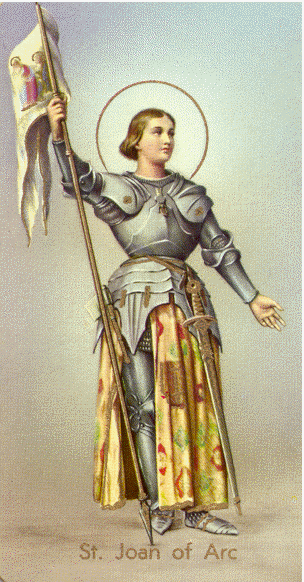
This is not you
Don’t portray yourself as a saint: Stories in which we star have a major potential pitfall: we make ourselves look way too good. In that anecdote about the Hulk Boy, I would be sorely tempted to make myself the person who did none of the kicking; especially since I was bullied myself, I certainly don’t want to tell everyone about what a horrid little mutant I was that day. But that fact may be the heart of the story: it’s more interesting to be behind the spectacles of the nice person who makes a terrible decision than to observe a nice person just … being nice. If your anecdote has you being heroic or merely passive, change it. Switch POVs, if you need to: write the story from the most dynamic person’s viewpoint.

Don’t implicate real people: I touched on this before, but if your characters are based on real people, change enough things about those people so nobody can tell who they are. As Violante mentioned in her post on Romans-à-clef, Miranda Priestly in The Devil Wears Prada was widely assumed to be based on Anna Wintour, the very real Vogue editor. You can get away this kind of thinly-disguised character assassination, probably, but it’s safer and kinder to disguise your characters thoroughly. It will also make high-school reunions and family Thanksgivings less awkward.

An addendum to this “Don’t” is the flipside “Don’t be afraid to write about real people.” Someone told me she recently trashed all her journal entries about one crazy family she’s been peripherally involved with, because she was afraid the information might somehow get out and cause problems. I thought this was a terrible shame; she's been telling me these stories, and they’re quite colorful. All she needs to do is hide the identifying details. I’ve been afraid to write about my own (significantly less crazy) family, for fear of causing rifts. But writers need to write. As long as you are protecting people’s privacy, don’t stop yourself from writing a good story, for any reason. At least get the words down: you can always vet the story before publication, if you are so lucky as to get a publication offer.

Now that the Don’ts are over, let’s focus on the Dos: much more fun. (For a more thorough exploration of these, see “Turning Life IntoFiction,” by Robin Hemley.)

Keep a journal: Writers are usually more observant than the average person, by nature, but you can train up this quality by keeping a writer’s observation journal. Notice conversations, jot down memories, describe scenes. Not only does this sharpen your perception skills, but the notes may later serve as filler for your stories. An anecdote or fragment of a dream may even be the seed for a complete story. Writing every day also keeps you in the habit of, well, writing every day.

Scenes from life
Experiment with form: Since this is a post about turning life into fiction, I’ll skip the memoir and focus on short story vs. novel. My favorite autobiographical fiction form is the short story: it allows for a more impressionistic approach. If you go on like that in a novel, you’re likely to bore the reader: there has to be more conflict and more action in a novel. The downside of the short story is that you have to be extremely economical with language: every little word counts. The short story also tends to be less character-focused, since you don’t have time to develop the characters except in rough portrait. Description reigns.


Although I have no stats on this, it seems to me that short stories are making a comeback: Several writers of note (such as Jhumpa Lahiri, Junot Diaz, Alice Munro, and Michael Chabon) have put out recent short story collections that have done well. These stories are typically not big clever ideas with a twist, but meditations on the everyday. You get the feeling they are highly autobiographical. On the novel side, I recently finished Justin Torres’s beautiful, luminous little gem, We the Animals, which is based partly (mostly? entirely?) on his childhood. The slim little book barely registers as a novel, though, and took him – by his own admission  five years to complete. Sometimes, the more of ourselves we pour into a story, the harder it is to write. Worth keeping in mind.

Focus: Because life is messier than fiction is allowed to be, we need to impose structure on our autobiographical fiction. This has been, as my sisters know, my biggest struggle. I almost feel unqualified to talk about it, but let me pass on Hemley’s advice: pick one aspect of your story to focus on: character, theme, setting, or Big Event. He gives examples: Nick in The Great Gatsby is an example of the narrator as observer, telling the story from a distance. In Gone with the Wind, the focus is on Tara, the estate. Setting is primary there. Sylvia Plath’s The Bell Jar uses theme (the titular bell jar) to organize her autobiographical work. The Big Event focuses on one cataclysm, such as the big-game hunt in Hemingway’s The Short Happy Life of Francis Macomber, or the suicide that forms the framework for my own WIP.

If you’re like me, you look at that list and think, well, each of those aspects is vital. How can I possibly zero in on one? I suppose they key is not to exclude the others, but to make one the hook, the center of gravity around which the others revolve. Certainly Gone with the Wind has strong characters, and The Great Gatsby has a Big Event, but the stories spin around one axis. Think of which axis your story really spins around: that can be your organizational guide.

How much of your own writing stems from your experience? What advantages and pitfalls have you encountered when trying to write about your life? How have you overcome them?


Sunday, June 17, 2012

“It all really happened”: Romans à clef and fact-based tales


It may sound contradictory but readers demand two things from their reading material: to be taken away from their harsh realities and to be exposed to things that seem realistic and identifiable to them.  Whether it is an autobiographical novel, historical fiction or roman á clef writers like to go for fact-based plots. But does an author have the right to hoax the public into believing that fictional accounts actually happened? Or to exaggerate literary license to smear public figures and distort reality?

Writers are advised to stick to what they know, to write about their environment and to base their characters on real people.  But what are the limits when it comes to dealing with historical facts or depicting well-known public figures and notorious crimes?  The reader may have a field day trying to guess who is who in a roman à clef (literally “a novel with clues”) but the writer could be asking for a law suit.

Part of historical fiction’s charm is that its characters actually existed and went through the joys and ordeals portrayed in the novel. When Robert Graves tackled the subject of Imperial Rome in I Claudius, he adhered to the truth by following the lead of classical historians like Tacitus and Suetonius. Precisely what the producers of HBO’s “Rome” chose not to do, so they could have a free hand reinventing Roman history.  Lucky for them no emperor was around to sue them.


On a smaller scale, Philippa Gregory does the same in her so-called historical novels, yet the licenses she takes in The Other Boleyn Girl makes it more fictional than factual as any historians could easily prove. The peak of historical distortion appears in works like Abraham Lincoln, Vampire Hunter in which the future president´s mother is slain by a blood-sucking creature aided by plantation owners. So what is Honest Abe to do but chase after vampires, becoming an abolitionist in the process?  Should the real Lincoln, a revered historical figure, be subject to such disrespect?


The autobiographical novel is another misleading genre. Unlike a memoir, autobiographical fiction will only touch the most transcendental aspects of the protagonist´s life, will still have a central conflict that must be solved at the end, and does not have to be entirely based on fact. Louisa May Alcott modeled The March Family after her own family but in real life she never married a German school teacher. Ernest Hemingway was in the Italian Army during the Great War and had an affair with a nurse, but he didn´t get her pregnant and run off with her to Switzerland as his alter ego Fredrik Henry does in A Farewell to Arms.

When Nancy Mitford published The Pursuit of Love in 1945, her sister phoned her and said: “You have no imagination so you must be having an affair with a Frenchman.” Indeed, Nancy was having a romance that would last until her death with Colonel Gaston Palewski, De Gaulle´s aid in London. She also turned Palewski into a literary character in her novels, the grand Fabrice de Sauveterre. Nancy Mitford’s books were loved in England, since most of her characters were inspired by real members of the British high society, including her own relatives who are the models for the delightfully dysfunctional Radletts. But in real-life, the Mitford were darker and more dysfunctional than the author would tell us.
Gaston Palewski, or "The Colonel" as Nancy Mitford called him.


The roman à clef (was invented by Mademoiselle de Scudery, one of the earliest novelists in history and was part of social circle centered at La Marquise de Rambouillet´s salon. The people that gathered at the Hotel de Rambouillet included writers, philosophers and even royalty. De Scudery wanted to write about their affairs, but in the days of the Sun King, offending royalty or aristocracy meant a ticket to La Bastille. Therefore, in her novels, Mademoiselle turned important acquaintances into characters of Greek mythology.

Madeleine de Scudery

That  was the birth of he Roman à clef, a novel that deals with real events  but changes characters’ names  in order to protect the innocent, the guilty and, foremost, the writer.  After all William Randolph Hearts did threaten Orson Welles with a libel suit after recognizing himself in “Citizen Kane”, Welles opus magna and film à clef. When Lauren Weisberger published The Devil Wears Prada, everybody assumed it was an autobiographical account of her days in Vogue, and the heroine´s ruthless boss Miranda Priestly was obviously based on Anna Wintour, Vogue´s editor-in-chief.


Despite the author´s denials, everybody in the designing world (and the media) rallied in defense of the real “dragon lady.” The novel got  mean critics from the Times Book Review that bordered in ad hominem reproaches targeting the author; Conde Nast publications did not bother to review the book, and designers  refused  to appear in the film afraid it would upset Wintour (who did show up at the premiere …wearing Prada!) Writing about real people is a dangerous affair.

Another hook for reality lovers is a story “straight from the headlines,” one that is based on a recent scandal or crime. In 1827, Antoine Berthet shot Madame Michoud, his former employee, at a Grenoble church. Bethet blamed Madame Michoud, who had been his mistress, for interfering with his romance with Mademoiselle de Cordon, daughter of his new employer. Berthet was convicted of murder and guillotined. Stendhal would take this red chronicle tidbit and turned it into his masterpiece Le Rouge et le Noir.

Ewan McGregor an Rachel Weisz in the TV adaptation of Le Rouge et Le Noir.


Crime stories are excellent basis for stories to please a public hungry for sensationalism. Patrick Hamilton based his play “Rope” on the Leopold-Loeb murders; Norman Mailer used Gary Gilmore’s execution for his The Executioners’ Song and the homicide of Jonny Stompanato, perpetrated by Lana Turner´s daughter motivated Harold Robbins to write Where Love Has Gone.

Before my bodice-ripper years, I was hooked on Harold Robbins’ romans a clef.  Next to Jacqueline Susann, he was the most prolific chronicler of scandals involving global jet set members and Hollywood stars. It was incredible fun to guess who was behind his characters.  Soon I knew that Nora in Where Love Has Gone was Lana Turner; Jonas Cord in The Carpetbaggers was Howard Hughes, Dax in The Adventurers was inspired by Dominican playboy Porfirio Rubirosa and The Lonely Lady was a thinly disguised portrait of Jacqueline Susann.

Lana Turner, her daughter Cheryl, and Stompanato


Prior to Jackie Collins, Jacqueline Susann was the expert in the business of Hollywood romans a clef. So good was she at turning movie stars into fictional characters that sometimes not only the readers were confused. In Once is not Enough, Susann tells the tragic story behind a reclusive Hollywood diva named Karla. After her retirement, the Polish actress just “vants to be alone”, but several lovers of either sex are bent in discovering her secrets. One of those secrets is the mentally-challenged daughter she keeps hidden in London.

A couple for years after the novel hit the bestseller’s list, a Swedish magazine leaked the news that they had discovered that Greta Garbo had a hidden daughter named Liv Gustaffson.  The rumor soon died out because, aside from wishful thinking, there were no facts supporting their claim. Greta Garbo, unlike her fictional clone, never had a child, and the disturbed daughter was a reflection of Susann’s own autistic son that she always kept away from the public eye.

Sometimes authors purposely play with their readers. In 1967, Lady Joan Lindsay published Picnic at Hanging Rock the enigmatic story of the vanishing of three schoolgirls in the Australian Outback. Following her publisher´s advice, and to boost the suspense, Lindsay hacked off the last chapter where the mystery was explained.


The novel became an instant hit in Australia and abroad, originating a fandom that despaired over finding solutions to the great enigma of what really happened at that St. Valentine picnic.   Readers believed the novel was based on actual facts. After Lady Joan´s passing the end chapter was published, but people preferred to continue on conjecturing and I have read books (and Internet sites) on UFO’s abductions where the events at Hanging Rock are described as factual.

Humans love to find supernatural solutions to the unexplained. Even in this skeptical age there is nothing as titillating as the idea of real mysteries dressed as fiction. The most terrifying aspect behind “The Blair Witch Project” was its reality show aura, the concept that it was a real project about a real dangerous sorceress. Dan Brown’s novels might, according to its followers, debunked “ancient myths”, but he has also created new legends. I know many Dan Brown fans who truly believe in the existence of The Illuminati and The Priory of Zion or that Jesus fathered a daughter named Sara.

How legitimate is to present fiction as facts? Is there a limit for literary or historical licenses when it comes to real people? How autobiographical are your novels? Do you include real characters and historical events in your books? How do you deal with them?