
To be clear, when I speak of “moral dilemma,” I do not mean “controversial political issue.” The two are often conflated. A moral dilemma is a situation where every alternative available breaks a moral rule. Your character has to take some action, but there is no “good” action to take. If structured well, the reader will feel the pain of the terrible choice, and will leave the scene or story wondering what she would have done. The more anguished the character, the more powerful the story. The reader and the writer alike are left as unsettled as the character, and the story becomes unforgettable.
Reaching far back in world literature, we have the wretched decision faced by Abraham in the Old Testament. God instructs him to slay his own son, Isaac. Abraham has exactly two unpleasant alternatives: ignore God (and, hello! disobey the creator of the universe!) or kill his own child.
 |
| Agamemnon and Iphigenia |
World mythology is full of people sacrificing their offspring to the gods, but in the case of Tantalus, the gods didn’t appreciate the act. He killed his son in offering to the Olympians, and for this he is eternally punished: he is sent to Hades, to stand forever in a pool of cool water with fresh fruit dangling above his head. When he is thirsty and bends to drink the water, it recedes from his lips. When he is hungry and reaches for the fruits, they retreat from his grasp. A miserable situation, all right: but not a moral dilemma. It’s good to keep in mind that being trapped or stuck is not necessarily the same as a moral dilemma — though it can increase the tension and pace of a story.
 |
| Stephen Blackpool and his burden |
I know what I would have done. As I was reading along, I wanted to yell at him, “Let her drink the poison! Come on, Stephen!” Dickens masterfully draws out the scene, ratcheting up the tension, drawing you into Stephen’s agonized state of mind. (For the resolution, turn to the chapter entitled “Rachael.”)
 |
| Which child will you choose? |
Continuing forward in time, we have perhaps the current reigning queen of the ethical dilemma, Jodi Picoult. Her novel My Sister’s Keeper has the protagonist caught between continuing on as her sister’s bone-marrow donor, or seizing control of her own destiny and refusing to be part of her parents’ plans anymore. In addition to the grueling choice faced by the main character (it’s ethically muddier than it even sounds), you are also presented with the initial decision made by the parents: is it ethical to conceive a child for the sole purpose of becoming a bone-marrow donor for her sick sister?

One key to a good moral dilemma is that the writer and the reader feel just as torn as the character. Too often, writers think they are setting up a moral dilemma, when it’s clear they have a “right” answer in mind. An example would be the teen novel which has the girl choosing between the handsome-schmucky rich guy and another guy who’s not so rich or popular, but is obviously the better pick. See: virtually every John Hughes movie ever made. Writers should be alert for this easy-out, and work to ensure that the dilemma is real. You don’t know, and you don’t want your readers to know, what is the right thing to do.
 |
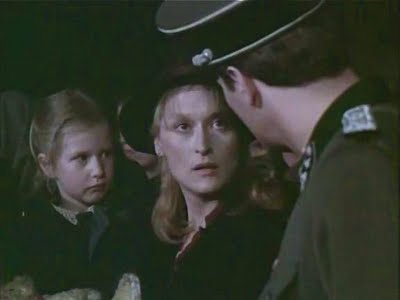
| What sacrifices will a mother make? |
Ideally, however you resolve the moral dilemma your character faces, the character should change as a result. One of the most important signs of real adulthood is the relinquishing of a black-and-white worldview. It’s comforting to think that every question has a clear right-or-wrong answer, and many stunted adults still cling to this childish notion. But a developed person (and character) understands that many choices are far from straightforward, and that clarity is rare. A satisfying story can show a character moving through the moral dilemma and coming out wearier but wiser: able to approach life with a more nuanced view. Another possibility is that the character is simply ruined by the dilemma. Sophie, of Sophie’s Choice, is such a character: she never recovers from the devastation inflicted on her. Faust is another classic example: he is offered a deal with the devil: give me your soul, and in exchange I give you unlimited knowledge and worldly pleasure. Tough choice, and it does him in.
What are your favorite moral-dilemma stories? Do you try to work those into your own writing? Can you think of other examples of characters ennobled — or ruined ‚ by the decisions they face?


