 |
| But you can write |
Bob Dylan had burned out. The young singer-songwriter had maintained a grueling tour schedule for the first half of 1965, and he was ready to give up. In fact, he did give up: he told his manager he was quitting the business. He left his guitar behind, drove his motorcycle out of the big city, and moved to an empty cabin. He was finished.
It was then that he had his real writing breakthrough. When he had turned his back on the business, when he was all alone in an empty cabin with nothing but a notebook and pencil, that’s when his mind opened up.
Dylan’s story unfolds in Imagine: How Creativity Works, an exploration on the curious workings of creativity by renowned science journalist Jonah Lehrer. After a few days of solitude, Dylan felt a creative tickle, and was compelled to pick up his pencil. An uncontrollable rush of creativity kept him scribbling for hours, until he’d filled twenty pages with lyrics. Dylan compared the impulse to “vomit,” it was so unstoppable. What he wrote was a kind of songwriting that had never been done before. It wasn’t a love song, or a straightforward story, but something loose and strange. He didn’t even know what the words meant. He’d written the first draft of “Like a Rolling Stone,” and the real Dylan was born.
This kind of creativity, says Lehrer, is called an “insight experience.” It’s the same kind of moment that Isaac Newton experienced under the apple tree, and Archimedes had in his bathtub. This is the “Eureka!” moment. Such moments are nearly always preceded by a “frustration experience,” and we don’t hear enough about this.
“Every creative journey begins with a problem. It starts with a feeling of frustration, the dull ache of not being able to find the answer,” Lehrer writes. “When we tell one another stories about creativity, we tend to leave out this phase of the creative process. We neglect to mention those days when we wanted to quit, when we believed that our problems were impossible to solve. Instead, we skip straight to the breakthroughs.”
 |
| Science writer Jonah Lehrer |
“The reality of the creative process is that it often requires persistence, the ability to stare at a problem until it makes sense,” Lehrer says. “It’s forcing oneself to pay attention, to write all night and then fix those words in the morning. It’s sticking with a poem until it’s perfect; refusing to quit on a math question; working until the cut of a dress is just right. The answer does not arrive suddenly, in a flash of insight. Instead, it will be revealed slowly, gradually emerging after great effort.” Lehrer calls this part of creativity “the unconcealing.”
 |
| Where insights happen |
Bipolar disorder, oddly enough, can give us a sense of the two kinds of soils needed for each type of creativity. Did you know that creative geniuses are twenty times more likely than the general population to have the brain disorder? Lehrer speculates that is because they have excesses of both kinds of necessary creative tools: the manic phases tend to give them bursts of sudden creativity and original insights: this is when their Eureka! moments happen, and the initial frenetic scribbling and sketching starts. But the mania wears off, and the work has to be edited. Pared down. Restructured. Mania is not good for this kind of slogging work.
Turns out, depressive phases can also help. The stereotype of the sad poet, staring gloomily into the rain as he composes his morose lines in his head, is kind of true. If the depressing isn’t utterly disabling, melancholy allows the creator to stick with her creation. People who are mildly depressed, Lehrer says, have demonstrated a marked ability to stick with tasks longer. A touch of blue makes you more persistent.
 |
| The insight of mania and the persistence of melancholy |
Lehrer is careful to note that nobody should envy the manic-depressive. “This doesn’t take away, of course, from the agony of the mental illness, and it doesn’t mean that people can create only when they’re horribly sad or manic,” he writes. “But it does begin to explain the significant correlations that have been repeatedly observed between depressive syndromes and artistic achievement.”
So, when is it time to take a bike ride and let your mind wander, and when is it time to glue your butt to the chair? “The good news is that the human mind has a natural ability to diagnose its own problems, to assess the kind of creativity that’s needed,” Lehrer says. Stick to your chair when you have a “tip of the tongue” feeling, that odd sensation of knowing that you know the answer to something, even if your brain can’t consciously recall it. But when you are utterly frustrated, and wandering in circles, take a break. Go on a long bike ride, let your mind wander.
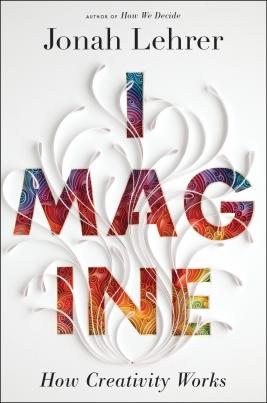 |
| Published in 2012 |
Lastly, Lehrer talks about how better to foster a spirit of creativity in the next generation: because we are going to need it. Not just for our individual creative projects, but for the serious challenges facing our civilization and our human lives on Earth.
*Lehrer says that many great writers, like W.H. Auden and Jack Kerouac, relied on Benzedrine and other amphetamines to keep their energy and focus for endless keyboard-pecking, but he doesn’t recommend it: stick to coffee.
New! See Lehrer on the Colbert Report

