
Recently,
my incessant quest for historical novels has led me to a delightful discovery:
the Historical Whodunit. It´s not surprising than in a decade when mysteries
and thrillers pack the bestsellers lists; the past provides an apt landscape for
gumshoes from yesteryear.
For the
last five years, I have been doing weekly checks on the New York Times
Bestseller lists, (Fiction). Thrillers and detective stories take more than half of its content. Apparently
those are the genres Americans favor. Not only Americans, as the worldwide craze
for Stieg Larsson’s novels proves. Writing about crimes, past and present, has
become a lucrative business thus the historical detective story is bound to be
welcomed. Even well established masters
of the craft like Baroness James (better known as P.D James) are giving it a successful
try. Her latest endeavor Death Comes to
Pemberley has made it to the NYTBL.
As any Jane
Austen fan would guess, this novel entails mayhem in the midst of the Darcy Family
of Pride and Prejudice fame. Elizabeth
Darcy (nee Bennett) has her Autumn Ball shattered when her brother in-law,
dastardly Wickham, is murdered. One of
the major appeals of the historical detective story lies in it having
historical figures, as well as famous fictional characters, in charge of the
investigation. In fact, this is the second historical mystery inspired by Pride and Prejudice. Last year, Regina Jeffrey
brought out The Phantom of Pemberley.
I cannot
tell the “why” behind worldwide obsession with crime fiction, but I can
approximate several reasons why the historical brand is doing rather well. For long, thrillers and mysteries were genres
mostly appreciated by men. Due to the rise of woman sleuths and subgenres like cozy
mysteries, ladies have become addicts as well as writers of both present and
past detective fiction.
Historical
mysteries also provide escape from reality. There is no need to identify with
characters or their problems. Such stories are made to feel out of the ordinary
and to give us a chance to flee away from everyday conflicts. So the
combination of both genres creates a fascinating mixture. For historical
fiction lovers, a murder thrown in the plot just makes the dish more palatable.
For thriller lovers, the period atmosphere adds up to the story’s exoticism.
There are
discrepancies about who started this subgenre. Many claim that it was Georgette
Heyer, mother of Regency Novels, who wrote the first actual historical whodunit
in 1936. Called The Talisman Ring the
plot takes place in Georgian England and it involves the dispute over a valued heirloom.
With the publication of this combination of mystery and historical novel, Heyer
set a path for suspense writers to imitate her. In 1944, Agatha Christie placed
the mystery of her Death Comes as the End
in Ancient Egypt and in 1950, John Dickson Carr followed suit with The Bride of Newgate, a suspense tale
set in Napoleonic England.
Common factors
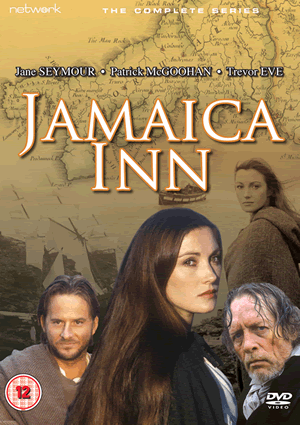
linked historical whodunits with Gothic Romances. Daphne Du Maurier’s Jamaica Inn (1936) set in 1820 Cornwall
is a historical suspense, making it a forerunner of the subgenre. Many have
seen Dame Daphne’s work as an attempt to recover the Gothic Victorian style,
but few have noticed her debt to Willkie Collins, one of the fathers of the
detective story. However, Du Maurier is considered a revivalist of the Gothic
style. Her followers which include well known Sixties and Seventies authors
such as Mary Stewart, Dorothy Eden and Victoria Holt were identified as Gothic
Romance or Romantic Suspense writers.
Such labels
were not applied to Robert van Gulick’s work. In the 30’s, at a Tokyo
bookstore, this Dutch diplomat came
across a Seventh Century Chinese detective story featuring a certain statesman and criminologist named Di Renjie. During
World War II, van Gulik translated into English that novel. It appeared in 1949
under the title of The Celebrated Cases
of Judge Dee. By 1959, Gulik was writing his own detective stories
celebrating the deeds of the sleuthing magistrate. This was the beginning of an
acclaimed series (Gulik also drafted a series of comics based on Judge Dee)
that lasted until the author´s death in 1967.
The person
who managed to dislodge the historical whodunit from its Gothic Romance or Period
Drama labels was Edith Mary Pargeter. Under her real name she had been writing historical
fiction since the Sixties, but her literary career dated back to the Thirties and
crime fiction was her specialty. Following an unwritten law, Miss Pargeter
penned her novels under masculine pseudonyms such as Jolyon Carr, John Redfern
and Ellis Peter.
It was under this last pen name that she would
create her most famous detective: Brother Cadfael, protagonist of The Cadfael Chronicles that began in
1977 with A Morbid Taste for Bones.
The novel took place in Shropshire in the Twelfth Century during a turbulent
period of British history. Cadfael was a monk with a taste for sleuthing, aided
by his immense knowledge of sciences and herbal lore learned from the Moslems
during his crusader´s stage. These hugely popular series encompassed twenty one
novels written between 1977 and the early Nineties.
Cadfael has
since then inspired the creation of a flock of inquisitive medieval members of
the clergy. There is Brother Athelstan, Sister Fidelma, Sister Frevesse and now
we have Nancy Bylieau’s Joanna Cross, a Dominican nun living in the days of
Henry VIII. But detectives of yesteryear do not necessarily have to be members
of the Church.
In 1979,
Juliet Humes under the pseudonym “Anne Perry” would publish her first
historical mystery, The Cater Street Hangman
featuring Victorian policeman Thomas Pitt. Perry, whose own life would be the subject of
Kate Winslet’s film “Heavenly Creatures,” legitimized the subgenre and inspired
several other writers to deal with detectives from the past. She has continued
writing into the current century, and Dorchester
Terrace, her latest Thomas Pitt novel, is due to appear in 2012.

More
respectability was granted to historical mysteries in 1980 with the publication
of The Name of the Rose; Umberto
Eco´s acclaimed novel dealing with gruesome homicides at an Italian medieval
monastery. There have been other attempts to turn historical mysteries into high
literature. Patrick Susskind’s The
Perfume comes to mind.
In the
Twenty-First Century, ancient murderers and law enforcers are alive and kicking
in books from all over the world. Famed Turkish novelist Orhan Pamuk has given
a try to the matter with his My Name is
Red (2000) a crime novel set in XVI century Istanbul, and Carlos Ruiz
Zafon’s bestsellers could be considered historical mysteries.

On the other
hand of the spectrum, stand Anthony Horowitz and Laurie R. King and their insistence
in reinventing Sherlock Holmes’s adventures. In the market you may find
Regency, Victorian and Edwardian cozies, Medieval and Elizabethan whodunits,
and detectives wearing togas or kimonos. There is a wealth of female amateur
private eyes of all ages from spinsterish archaeologist Amelia Peabody
investigating murders in the 1920’s to 11-year-old Flavia de Luce sleuthing in
the England of the Fifties.
If this
winter you run out of reading material, reach out and become acquainted with
the historical whodunit. But if you are already hooked in the subgenre, tell us
who is your favorite author and why do you do you think historical mysteries
have so many readers. Would you care to write a historical mystery? Which era
would you select?

