Friday, August 30, 2013

Cephalopod Coffeehouse Review: The Killer Angels

Welcome to August's Cephalopod Coffeehouse, a cozy gathering of book lovers who meet to discuss their thoughts on the best books they read the past month. My selection* for this month is The Killer Angels, by Michael Shaara. Published in 1974, it's considered the classic novel of the Civil War — look, it says so right on the cover!

Winner of the 1975 Pulitzer Prize
I picked this book up reluctantly, after having finished most of the rest of my self-assigned reading for 2013. I know next to nothing about the Civil War and haven't ever been terribly interested. But wow. What an incredible book. Shaara wisely focuses rather than trying to evoke the entire scope of that war: he narrows in on one battle (Gettysburg) and two primary characters, General James Longstreet on the Confederate side and Colonel Joshua Lawrence Chamberlain of the Union side. Other military leaders get to take the narrative helm from time to time, but these two men take center stage.

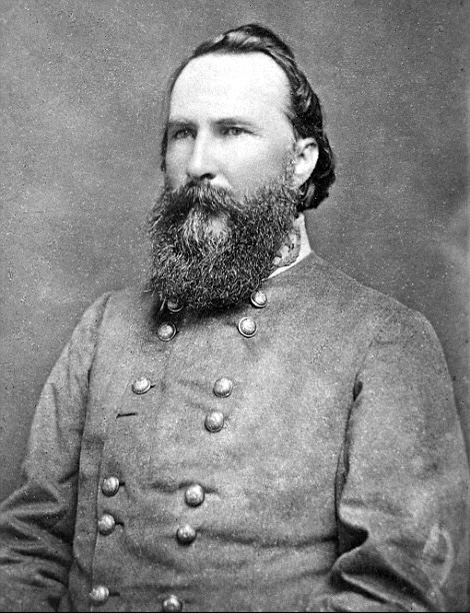
The melancholic Longstreet
Shaara's prose may be a little sentimental at times, but his characterization of those two officers is exceptional. Chamberlain in particular is so finely drawn that his character was revived from obscurity: virtually nobody had remembered his heroism at Little Round Top until this novel was published.

Robert E. Lee, however, does not come across well here. What image I had of him was of a tragic hero: wonderful leader, terrible cause. But by the time Gettysburg came around, Lee had been undone by success: he thought he couldn't lose, so he stopped strategizing. As my son said, while watching the Ken Burns documentary on the war, "Oh! I know what happened to him! Hubris." Lee's men loved him, but he was no tactician in Gettysburg and Pickett's charge led thousands to needless deaths. I mean, "needless" even in the context of war. In contrast, Longstreet seems both brilliant and practical, though he didn't inspire the same sort of love. I felt depressed after each Longstreet section, though — he was always hurtling into doom, and he knew it. He was gloomy anyway, due to the death of three of his children, and now he found himself on the wrong side of an unwinnable war. Life for Longstreet just sucks.

Bookish Chamberlain: before the war, he was a college professor
Chamberlain is really the hero of this book. I enjoyed all the time we spent in his head. He's human, he's frail, he's scared, he's almost unbelievably brave. It seems the way Shaara depicts the battle of Little Round Top is historically quite accurate, and so I have to accept it, even though Chamberlain is so amazing it seems like authorial overreach. On top of his superhuman calm and courage, he seems so ... sweet. His friendship with Kilraine and his protectiveness toward his brother are heartwarming — and heartrending. The scene with the escaped slave was more nuanced, but seemed refreshingly honest, even if it was (probably) invented wholesale. I loved the little bit of humanist philosophy Shaara inserts in the arguments between Kilraine and Chamberlain. They are opposites, but I believed them both.

Some readers come away feeling Shaara was pro-war, some that he was anti-war. But The Killer Angels isn't so neatly categorized. Shaara seems to feel the Civil War was a glorious folly: the bloody bits are there, but mostly the war is romanticized; at the same time, Shaara seems to think it was awful and pointless. I wonder about that juxtaposition. Maybe that's the way a lot of men feel about war? (Women seem less conflicted.)

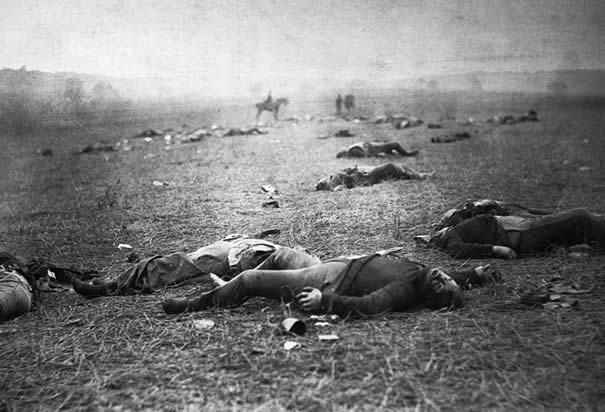
New estimates put Civil War deaths at 750,000

My daughter will be studying the Civil War this year in AP US History, and I'm going to recommend she read this book before that unit. It may just be Gettysburg, but it's a good human-scale intro to the war, and it certainly piqued my interest in that time period: we are now working our way through the Ken Burns documentary, and I've added the new, acclaimed Civil-War-era history Ecstatic Nation to my to-read bookshelf. I would highly recommend this book, even to those bored by history. Especially to those bored by history.

Edition note: The audiobook narration by Stephen Hoye was excellent. He's a slow reader and he practically sings the more lyrical parts, but that seems appropriate. He helped me get into the story — not that I needed much prodding. It's a page turner.

* I write for this blog and also for my own, Words Incorporated. I reviewed separate books for each.

Check out the other Cephalopod Reviews here:

1.The Armchair Squid2.Scouring Monk
3.Trisha @ WORD STUFF4.Counterintuitivity
5.Denise Covey, L'Aussie Writer6.The Random Book Review
7.Sally's Scribbles8.sharonhamiltonauthor.com
9.StrangePegs -- The Wizard of Oz10.Lara Schiffbauer
11.M.J. Fifield12.Julie Flanders
13.Nicki Elson14.Bird's Nest
15.Spill Beans16.Yolanda Renee
17.My Creatively Random Life18.Words Incorporated
19.Divine Secrets of the Writing Sisterhood20.Hungry Enough To Eat Six
21.Ed & Reub22.StrangePegs -- "Memories"
23.V's Reads24.Maryann Miller's It's Not All Gravy
25.Feather's Passion

Sunday, August 25, 2013

Spoiler Alert: Juliet Dies


Because we get most of our TV streamed from Netflix or Hulu, we are always behind on everyone's favorite shows. I am all caught up now on Downton Abbey, but we did not watch the season finale with everyone else. Only it almost felt like we did, because everyone was live-tweeting the thing as it unfolded. And when that big shocker ending happened, the entire Internet gasped in unison. I couldn't have missed it without going on a total information blackout till the hubbub died down. 

That said, most people were extremely careful not to reveal the exact nature of the shocker, because we've all been indoctrinated not to spoil endings — or at least to write "spoiler alert" before we give anything away. This rigid social training helps protect that delight we all feel at the totally-unexpected plot twist. After all, why do we keep turning the pages? To find out what happens next. Even if we're not anticipating a twist, we get invested in a story because we want to know how it all turns out.


But have we gotten a little too fanatical about spoilers? I got hollered at not long ago after I revealed a detail of Philip Pullman's His Dark Materials trilogy. For a few minutes I felt horribly guilty, then my guilt shaded into annoyance. That series was published in the mid-1990s: if you wanted to be kept in the dark about all the plot details, why have you waited so long to read the dang books? How long do we have to keep book contents secret? Guess what: Cleopatra hugs an asp (I just spoiled the ending of Antony and Cleopatra). The South loses at Gettysburg (I just spoiled the ending of The Killer Angels). Rosebud is a sled (I just spoiled one of the biggest — and weirdest — reveals of all; although I will refrain from mentioning which story I'm referring to in case you've been living off the grid since 1941).


I do get that big twists can "ruined" by a premature reveal, but surely there's a statute of limitations on spoiler alerts. If they are old enough and famous enough, stories are pre-spoiled for us — do Adam and Eve live happily ever after in the Garden of Eden? Shhh! Don't tell me! And yet, knowing how it ends, we read the story anyway. There's even some evidence that knowing how it ends adds to a story: think of the literary device that puts the epilogue as prologue: you start with the shocker ending, and the whole point of reading the story is to find out how we got there.

In addition to getting people mad at you, spoiler fanaticism has another downside: it prevents us from discussing the stories we love. I finished Jojo Moyes' Me Before You recently, and I so wanted to discuss it with friends who'd also read it. But I couldn't, because to do so might have "spoiled" the book for those who haven't read it. The only way around this is to create rigid book-discussion groups, either online or off, where select people seal themselves off to discuss a book. But the formality of these private groups kills something you get from a spontaneous public discussion. On Facebook or at a social gathering, I'd like to be able to say something about Nick and Amy in Gone Girl, or talk about who died in the last episode of Game of Thrones. (You know someone's going to bite it.) But I can't risk it. People get seriously upset. I've seen less rancor in religious debates than when someone accidentally mentions — spoiler alert! — what happens to Wash in Serenity.

"I'm a leaf on the — whoops, wrong show!"

In short, I think spoiler alerts are considerate, especially when a story is new and the twist is huge. But I don't think it's reasonable to expect all aspects of a plot to be completely sealed off from you until you get your lazy behind around to reading or watching the thing. (She says, with the utmost affection.) If you don't know that Wesley and the Dread Pirate Roberts are the same person, don't be angry at the person who let this slip at a dinner party. Be mad at yourself for not watching The Princess Bride sooner.

How do you feel about spoilers? Are you in the "never ever" camp, or do they not bother you so much? Do you think spoiler sensitivity has gone too far—or not far enough?


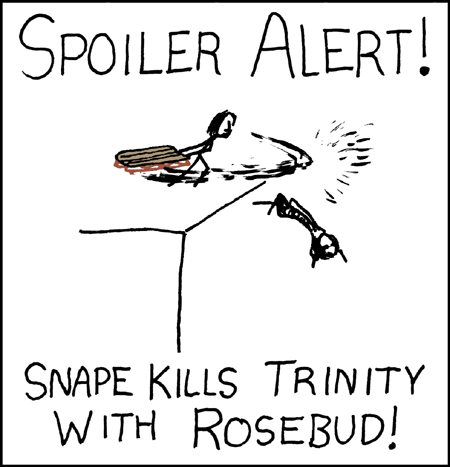
via the comic "xkdc"


Sunday, August 18, 2013

The Treasure Box of History

They say that truth is stranger than fiction. I’m here to testify to this. A lot of ideas for my novels come from real life. And this includes plots and characters. Not only do I recycle information that my family and friends (or even strangers) share with me, but I also look for inspiration in history. In fact, I sometimes wonder if I’m cheating. (And if everyone else can see it!)

The beauty of writing historical fiction, in my opinion, is that you don’t always have to think of a plot. History is there to guide you. It is amazing how a story can be built from one climactic moment from the past!

For my second novel, The Black Letter, I knew I wanted to write something that took place in the Galapagos Islands. You’re probably wondering why (or maybe not, but I’m going to tell you anyway!) I was born and raised in Ecuador. Us Ecuadorians take great pride in what we call the Enchanted Islands. I mean, this is the place where Darwin came up with his Theory of Evolution and the whole Survival of the Fittest idea was born! This is a place that attracts millions of visitors from all over the world and the scrutiny of scientists for its unique flora and fauna. Yet, how much is really known about its human history? About its supposed “curse”?

Yes, you read right: curse.

See, the Galapagos were initially ignored by the Spaniards in lieu of the vast and fruitful American continent. It actually made sense. Why would they bother with these volcanic islands that sometimes disappeared from view due to their endless fog—which earned them the name of “enchanted”—when there was so much land to exploit? After all, they weren’t sure these islands were real, and those who had visited them attested that they were filled with strange creatures and not enough sources of water. Only the pirates considered them useful spots to bury their treasures.

Fortunately, this poor perception of the islands started to change after Darwin pointed out their uniqueness and the continent became more populated. The Ecuadorian government finally claimed them in the early 19th century and sent adventurers and prostitutes to populate them. Many entrepreneurs saw an opportunity for profit, but invariably, those who tried to take advantage of its resources perished. People started calling it "the curse of the turtle" due to the near-extinction of this species. This so-called curse took place for about a century—until people learned to respect and preserve the Galapagos animals.

Among the legends and mysteries I devoured in books, chronicles and web pages, I came across two interesting facts: a) there had been a tyrant who ruled San Cristobal Island for about 30 years and created a sugar cane empire with the labor of convicts sent to the islands to serve their sentences, and b) an extremely religious Ecuadorian President—both hated and beloved—had done a cleansing of sorts by sending said "undesirables" to the islands.

I knew then that my protagonist would be among the exiled prostitutes and that she would have to meet the island’s tyrannical ruler.

How easy was that. An idea, an entire plot, was born from research. I started thinking about my protagonist—about who she was and the reasons for her exile. Maybe she wasn’t a prostitute after all. Maybe she was an affluent woman, a teenager mistaken for a prostitute. She could be running away from her family, from a marriage. Eloping. Maybe she was pregnant. It was amazing how, in just a few hours, the entire novel took shape.

What a contrast with my first novel which had taken years to plan, write and rewrite.

But that was just the beginning—the skeleton of my book. A novel is not just plot design, the challenge of historical fiction is in the details. My research took a variety of forms. I read memoirs and chronicles of earlier settlers, history books about Galapagos’ most notorious visitors and its most important events. I also read about the islands’ flora and fauna and Darwin’s visit. Since my story also takes place in two other cities: my hometown Quito (the capital) and Guayaquil (the largest port in the country), I visited both and noted the smells, the quality of the air, the architecture, the people around me. (I had already visited the Galapagos three times during my teenage and college years.) And then there were other vital details every historical novelist must face: fashion, transportation, language. Not only did I have to think of how a person in the late 19th century would think, but also, how they took care of their hygiene, what they did for leisure, what they ate and what tools they used for cooking, among other things. Perhaps the hardest thing was to learn about 19th century ships—since a big chunk of my story takes place in one. Fortunately, I had the opportunity to visit a ship during my trip to Guayaquil. Other tourists must have thought I was crazy when I was taking pictures of the floor and the kitchen!

At first glance this may look like an ordinary box, but it's actually a passage to the ship's hold
and a very handy hiding spot for my heroine.

 The church where the first scene of my novel takes place
(La Iglesia de La Compañía, Quito.)

But back to the treasure box. Just this summer, after I handed over my third novel to my beta readers (a contemporary one, for a change), I found myself in a restless state. I didn’t want to sit around and wait for their feedback or for news from my agent regarding The Black Letter. I wanted to write again. I started my restless search for ideas, and I looked at the history of my country one more time. This time, it took me to another little-known, but fascinating fact about Ecuador. It took me to the world of chocolate, of cacao plantations and of women inventors.

And it’s starting to take shape.

Who wouldn't find inspiration from a place like this?

What do you use as inspiration for your own writing? What drives you to write historical fiction and how do you go about doing it? Do you think we're “cheating” by using history as our guideline?