This morning I was idly flipping through my freshest New Yorker when I came across the story "A Christmas Miracle," by Rebecca Curtis. It's an odd, funny story about a dysfunctional family trying to make it through the holidays without strangling each other. (In a bit of heavy, undisguised symbolism, the family's cats are being picked off one by one by prowling coyotes.) Reading the story made me think about the whole genre of The Christmas Story, and how funny it is that it exists. I'm not sure there are equivalents for other religious holidays ... you don't see Easter stories proliferate in the same way, or Rosh Hashanah stories, or Eid al Fitr stories. Or heck, maybe you do, and I'm too culturally isolated to know it.
The original Christmas story is the best-known, of course, but also may be the least typical of the genre. The archetypal Christmas story to me is Charles Dickens' "A Christmas Carol," which sets the stage for all the Christmas stories henceforth: you need something about family, something about charity, something about forgiveness and/or redemption. Often you have a character (like Scrooge) who is isolated in some way, a solitude that is most profoundly experienced at the holidays. Christmas both highlights the isolation and then fixes it. In "A Christmas Carol" it's literal spirits (ghosts, specters) who do the mending; in most other Christmas stories, it's a more figurative Christmas spirit that brings the isolated person back into the fold.
My own favorite this-time-of-year stories include fairy tales, short stories, movies, and ballets. Here's my list of 10 Best Christmas Stories:
1. A Christmas Carol: May as well start right here. We watch this movie every Christmas Eve, and it has to be the George C. Scott version, because if Christmas is about nothing else, it's about tradition. My kids used to be so scared of Marley's ghost that they'd press against me and hide under the blankets, and last year may be the first year my son was able to watch that whole scene all the way through. But I'm still not sure he's uncovered his eyes when the Ghost of Christmas Future makes its creepy appearance. I love this movie, love Scott's droll portrayal of Scrooge. I also love the message.
Then let him die, and decrease the surplus population
2. Christmas is a Sad Season for the Poor: A short story by John Cheever (you can read it here), which is both hilarious and touching. Charlie is an elevator operator who feels terrible self-pity Christmas Eve, and manages to hoodwink the entire population of the building where he works into feeling even sorrier for him than he feels for himself. He winds up almost literally buried in charity.
3. The Nutcracker: Tchaikovsky didn't like his own music for this ballet, or the story, but whatever. What does Tchaikovsky know? I can't tell whether I love this ballet because it's just so familiar, or if the story and music actually does have some intrinsic value ... I just know I love it. I've watched the ballet many times (a number of them as the mother of a ladybug or bumblebee).
4. It's a Wonderful Life: Because Jimmy Stewart. I could watch him read a phone book. Like most stories in this genre, one of the central messages is that "stuff" is not what it's all about. It's funny how drawn we are to that anti-consumerist message at this, the most shoppingest time of year.
5. The Loudest Voice: A short story by Grace Paley (which you can read here) about a group of Jewish schoolchildren, recently immigrated, who are given the major parts in their school's Christmas pageant. The protagonist gets the part of Jesus narrating (looking back on the story) because she has the loudest, clearest voice. The narrator is quite pleased to have the job and, as children usually are, does not share the concerns of her mother, who feels the school has been culturally insensitive. After the play the child listens to the families talk.
They debated a little in Yiddish, then fell in a puddle of Russian and Polish. What I understood next was my father, who said, "Still and all, it was certainly a beautiful affair, you have to admit, introducing us to the beliefs of a different culture."
"Well, yes," said Mrs. Kornbluh. "The only thing ... you know Charlie Turner — that cute boy in Celia's class — a couple others? They got very small parts or no part at all. In very bad taste, it seemed to me. After all, it's their religion."
"Ach," explained my mother, "what could Mr. Hilton do? They got very small voices; after all, why should they holler? The English language they know from the beginning by heart. They're blond like angels. You think it's so important they should get in the play? Christmas ... the whole piece of goods ... they own it."
6. A Charlie Brown Christmas: Christmas is not complete without Vince Guaraldi's score, which is sweet but a little melancholy — like everything else about Peanuts. And how many of us have come home with one of those kind of trees? Pretty much every one we cut ourselves from the local forests looked like this:
7. The Little Match Girl: Hans Christian Andersen was not a cheery man. And this is not a cheery tale. Written around the same time "A Christmas Carol" was written, it has a similar theme: remember those less fortunate, especially at this, the coldest time of year. Actually, don't just think about those less fortunate, do something about it. When I read this to my daughter, who was about five at the time, she got very angry at the end and said, "That is a terrible story!" That was one of those moments I realized fairy tales are not necessarily children's stories.
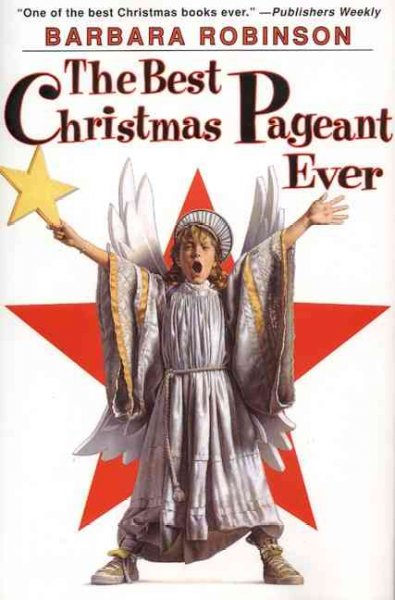
8. The Best Christmas Pageant Ever: A very funny children's book by Barbara Robinson about a group of hellish siblings who almost ruin the annual Christmas pageant. If you have kids in elementary school, this is a great read-aloud for this time of year.
9. Santa Claus is Comin' to Town: My husband and I both grew up with this movie and we can't separate our love for it from our nostalgia for it. It just presses so many wonderful buttons. I love the stop motion, I love the abominable snowman (although he scared the heck out of me as a kid), and I especially love Burgermeister Meisterburger.
10. Love Actually: A movie starring everyone. It should be a mess, with so many characters and so many storylines, but somehow it works. Everyone has a favorite bit: while I do love the vignette pictured below, the character that has stuck with me is Laura Linney's Sarah, who is struggling to deal with her mentally-ill brother. I wish that story would get a movie of its own (especially if it kept Rodrigo Santoro as Karl, because yum), and sometimes I toy with writing a fanfic version of it myself.
What are your favorite Christmas stories? Do you work any of them in to your holiday traditions? If you celebrate a different tradition, does it come with its own stories?
Good dialogue is a delight to read. Bad dialogue is deadly. -Stephen King
Of the many aspects of fiction writing — character development, plot, description, scene structure — dialogue writing is often considered one of the trickiest. I am lucky, I suppose, in that it’s an aspect I find relatively easy. I can tie myself up in knots over how to move from Scene 1 to Scene 2, but dialogue flows for me and is pleasurable to write. Unfortunately, for those who struggle with it, bad dialogue is easier to spot than other writing bugaboos, and is especially likely to make a reader turn away from a book. I read an interview with an agent who said dialogue is her primary litmus test. With each manuscript she receives, she skips straight to the first bit of dialogue, and if it’s bad—off to the slush pile it goes.
Lesson: it’s really worth brushing up on your dialogue-writing skills.
Why is dialogue so important? It’s fast moving, keeping readers engaged where long chunks of text will lose them. Dialogue visually breaks up a page, adding necessary white space. Writers can use dialogue to efficiently deliver exposition. Dialogue reveals character better than description, and often better than action. Dialogue is, when done correctly, fun to read. And if you don’t have a knack for it, never fear: it’s not magic. It’s a skill that improves with study and practice. The easiest thing to get wrong is also the simplest thing to fix: formatting. Hardly any articles, blog posts, or book chapters on writing deal with the mechanics of dialogue, which is a shame. Because very few beginning writers get it right — and they’re going to get rejected by agents. Let’s fix that.
Wrong: She said: “You’re formatting this dialogue incorrectly.”
Better: She said: “You’re formatting this dialogue incorrectly.”
Still better: She said, “You’re formatting this dialogue incorrectly.”
Best: “You’re formatting this dialogue incorrectly,” she said.
Keep dialogue on the same line as the dialogue tag. (“Dialogue tag” is the “he said” part — more on this later.) See how the first example above had a paragraph return between the tag and the quote? That’s incorrect. Furthermore, do not use colons in your tags, and avoid starting with the tag. Note the final, “best” example. The speech ends with 1. a comma, 2. a close-quotation mark, and 3. a lowercase “she said.” This is the default, at least for American English. This is what you should be doing most of the time; obviously there are exceptions to these rules. Don’t think you can get away with the exceptions, though, until you’ve understood and mastered the rules. If you think you’ve mastered them already, do a quick check. I mean, really, right now: go look. Find a section of your own dialogue and note whether you are mostly sticking to the default — and when you have departed from it, ask yourself if you did so deliberately and consciously for a particular effect. Based on the number of first drafts I have looked over, and based on my own learning curve, I’d guess there’s some brushing up to be done.
Many dialogue rules are picked up intuitively by writers who do a lot of reading. If you are getting feedback that you’re formatting incorrectly, you may not be reading enough, or you may be reading stories with bad dialogue. I find the best way to train my writerly intuition is not to study the formal rules, but to find writers who do it well and literally copy them: pick up a book by one of these authors and copy out dialogue-intensive passages. I will continue to repeat this advice, because I truly believe transcribing is one of the best tools to improve your fiction. Transcribing is an exercise that rewires your writing brain on a level much deeper than rule-memorizing will ever do.
“Do not,” hollered the editor, “ever have your characters holler scream, whisper, or moan what they could just say!”
The use and abuse of dialogue tags, beyond what I discuss above, is more subject to controversy. First, there’s the question of “said.” Most editors agree that this tag is preferable to any other tag, such as “shouted” or “sighed.” This latter kind of tag is called a said bookism, and editors hate those. Unfortunately, elementary-school teachers have for decades instructed students to avoid “said” and instead use bookisms, so a lot of us have to be retrained to go back to good old “said.” The reason editors recommend “said” is that it is less colorful: bookisms are terribly distracting, and interrupt the flow of dialogue. You can use them occasionally to break up the steady march of “he saids,” but you want “said” to predominate.
Almost as loathed as said bookisms are adverbial dialogue tags: “Take that!” she said scornfully. This is one I have a harder time avoiding, as I do love me my adverbs. We are told time and time again to keep our adverbs to a minimum, but they keep creeping back into tags — at least, into mine. Often these tags are redundant, as we can tell from the context how the speaker is speaking. If you don’t think it’s clear, consider finding another way to evoke the mood.
“You can also leave off tags entirely.” “How do you know who’s speaking, then?” “Let readers sort it out from context.”
It’s fine to skip tags occasionally when you’ve got a long page of dialogue; you don’t need “he said” after every line. Some schools of thought go further and treat tags as if they were volatile little bombs: icky things you use only when absolutely necessary. You know these authors: you flip open a book and it’s just this endless wall of dialogue. You have to go back three pages to sort out who’s speaking, and then count lines to keep track. Cormac McCarthy not only does this, but foregoes quotation marks altogether. Hint: unless you are Cormac McCarthy, do not write dialogue like Cormac McCarthy. Use dialogue tags. And punctuation.
To move from the abstract to the concrete, let’s take a look at some dialogue from an actual published novel. I’ll flip open Lorrie Moore’s novel A Gate At the Stairs, because it’s chock full of excellent examples:
“So,” said Mrs. McKowen, “have you met the birth mother?” “Yes,” said Sarah. “And you’re sure you want that woman’s child?” Edward began to cough. “Excuse me—is there a bathroom I might use?” “Why do you say that about the birth mom?” asked Sarah. “Oh, I don’t know,” said Mrs. McKowen. “I guess, well, the lady’s not the sharpest tool in the shed.”
In the first sentence, we see how Moore uses the dialogue tag in the middle of the sentence: this is my own preferred way to tag, at least for dialogue that’s longer than a dozen words or so. The second speaker, Sarah, has the default tag: statement, followed with a comma and simple “she said.” Edward arrives on the scene without a true dialogue tag, but rather introductory action: he does something on the same line as his dialogue, so we know he is the speaker: this is another good dialogue option, which you can use more frequently as the defaults become automatic for you. (Use a period, not a comma, in this construction.)
When Sarah speaks again, she gets the tag “asked Sarah” because it’s a question: notice that “asked” is lowercase. Many writers understand that “he said” is lowercase because they see the comma, but when there’s a question mark they mistakenly revert to capitalization. However, the formatting remains as if it were a comma: remember your defaults, which here is, “use lowercase with dialogue tags.”
Finally, the last line repeats the middle-of-the-sentence dialogue tag, with the default “she said” but in reverse. “Said” should generally be the second word in a tag, not first, but you can use this construction for variety.
Variety. Look how well Moore plays with the default. She shifts her tags around from beginning, to middle, to end, and back. Why? Because of flow. If you always place your dialogue tags at the end, your dialogue can sound programmed and monotonous. The default is a good one: dialogue tags at the end, stick with “he said,” but Moore shows how variation can ensure flow.
If you feel overwhelmed by the technicality of this explanation, don’t worry. You will pick it up intuitively if you study good dialogue. Remember, though, that you’ll get much more out of the masters if you copy out their work, word by word and comma by comma, than if you simply read it.
“I was thinking, um, that, well, maybe, you know—” The writer fiddled with her earrings. The editor scowled. “Get to the point!” “But this is, like, kinda, how people—how people, actually, you know, talk.” “That nice,” he said. “But it’s not how writers should write.”
Drilling further down into style: There’s an irony of writing good dialogue, in that the most natural-sounding written dialogue is not much like actual speech. Read an exact transcript from a radio or television interview to see what I mean: note all the stammers, ums, self-interruptions, start-overs, and banalities. When I was a journalist and did interviews, I had to clean this sort of thing up for the final product; all journalists do this, which is why you don’t see “uhhh” and “I mean” in written interviews. You don’t see the stops and starts as the interviewee finds her point. This is even truer for fictional dialogue: Your characters should speak more economically than people actually do. The flipside of this is that dialogue shouldn’t be too clean. The grammar in dialogue can be incorrect, and should be incorrect when that’s true to your character. You can get away with “gonna” and “woulda” in dialogue; you can say, “Me and her gone shopping” if that’s how your character — say, a three-year-old — would speak. You clean up the distractions, the ums and stumbles; you don’t hide personality, age, or education. Here’s an example from John Steinbeck’s novel “Of Mice and Men”:
“Aw Lennie!” George put his hand on Lennie's shoulder. “I ain't takin' it away jus' for meanness. That mouse ain't fresh, Lennie; and besides, you've broke it pettin' it. You get another mouse that's fresh and I'll let you keep it a little while.”
George is a migrant worker with little formal education. Note that while his grammar is true to his character, Steinbeck has kept his speech economical. No unnecessary words are used. (Bonus points if you noticed that Steinbeck does not use a formal dialogue tag here, but uses a line of action to indicate the speaker, as Lorrie Moore had her character Edward do in the earlier excerpt.)
Not exactly Steinbeck, but really. Is this not fabulous dialogue?
In addition to Steinbeck, one of my favorite writers of dialogue is John Cheever, who manages to create sparkling characters with pinpoint use of dialogue. Let’s meet Mrs. DePaul, a character from John Cheever’s short story “Christmas Is A Sad Season for the Poor.”
“Oh, Charlie!” Mrs. DePaul was a stout woman with an impulsive heart, and Charlie’s plaint struck at her holiday mood as if she had been caught in a cloudburst. “I do wish we could share our Christmas dinner with you, you know,” she said. “I come from Vermont, you know, and when I was a child, you know, we always used to have a great many people at our table. The mailman, you know, and the schoolteacher, and just anybody who didn’t have any family of their own, you know, and I wish we could share our dinner with you the way we used to, you know, and I don’t see any reason why we can’t.”
She carries on like this for another few sentences. Her repeated use of the phrase “you know” is as much a representation of her character as her stoutness and her impulsive heart. It gives us a quick, intense impression of her, like a black-and-white photograph with a few details colored in. The repeated phrase would be maddening in a novel if she were a primary character, but Mrs. DePaul is a sketch. Cheever can use this device with her because this is a short story, and she only has a few lines. Another dialogue-savvy author I’d recommend is Flannery O’Connor. When I do my transcribing exercises, I usually pick Flannery. (I’m not sure if it’s a coincidence that these writers are both from the mid-20th century: perhaps that was a heyday for dialogue writing.)
“I don’t know. It just started shuddering and then steam —” I began. “Eee, cabron, I told you she was a girl!” the woman shouted at her husband, interrupting. “Sorry, mija,” she added to me. The man stepped back, looked me over skeptically, shrugged, then went back under the hood.
Ready to drill a little deeper? The next step is to get your dialogue to perform multiple functions. In the above excerpt, from one of my works-in-progress, the viewpoint character is dealing with a broken-down car, and the dialogue appears to be focused on that. But if I did it right, I also let the reader know that this setting is not your typical American setting and that the point-of-view character is a girl who looks like a boy. We also can see that in spite of being a tomboy, the viewpoint character doesn’t know cars, that the shouting woman is kinder to strangers than she is to her husband, and that the husband is not much of a talker. My intention was to pack a lot of information into a small bit of dialogue—without the reader noticing what I was doing.
Your characters will sound wooden if you give their dialogue only one job, especially if that job is “transfer info to reader.” Your characters are not robots. They are, or should seem like, real people. They need dimension. As your character delivers plot information to the reader, she should also be delivering other subtextual information, such as her personality (is she bubbly? Clipped?), her relationship with the person to whom she’s speaking (does she love him? Fear him?), and her reaction to the events around her (is she excited? Bored?). As you add these layers, you’re going to find yourself excited at how real your dialogue suddenly sounds. Your characters will have more life than you’ve ever given them. One exercise you can do right now is to look over a few pages of your dialogue and rework it to reflect the speaker’s unique personality. Look at the Moore excerpt above: See what Edward is doing? He coughs, then tries to flee the room. He is startled by the previous comment, and uncomfortable with conflict. We learn a lot about Edward from this tiny bit of dialogue.
As much as I’ve covered here, I’ve only touched on the basics of writing dialogue. Entire books are written on the subject; courses are taught. You can read the books, you can sign up for the courses; you can memorize everything I’ve written here. But if you want to write dialogue that sings, that will grab the attention of every agent out there, read the works of excellent writers. Read closely. Transcribe, and while copying out their work, notice what they are doing. Think about what they were thinking about when they chose those words. Smoke that stuff, get it into your bloodstream, into your DNA, and it will become your own. You’ll have the skills to let your own voice — what is uniquely yours — come through.