Showing posts with label Genre. Show all posts

Monday, April 23, 2012

When “The Exotic” becomes “ The Bizarre”


I have finally understood the flaws in my first and forsaken novel. I wrote it in the wrong language, I targeted the wrong public (add wrong agents to that) and I selected themes and settings, that despite their glamour, were not easy to appreciate or relate to. In our urgency to be original, we may force our audience to waddle through the peculiar, the unfamiliar and the bizarre, and that applies to foreign cultures, as well as exotic settings and customs.

Identification is crucial to establish a connection between reader and story. Any plot or character quirk that shocks, alienates or angers the reader gives excuse to throw the volume into the garbage can. Therefore, no matter how exotic the milieu is, a familiar element must always be present.  This not only applies to American readers, it´s a universal phenomenon.  To enjoy a good reading we need to feel comfortable with the material. Without friendly crutches, we cannot wander too deep into unrecognizable territory.

Unlike films, books lack visual props that turn the exotic into the” known.” This is why epic fantasy writers go through pains to explain to their audience every little detail of the alien civilization they have fabricated, sometimes even adding maps to establish a geographical location. I am no friend of “high fantasy.” The reason I made an exception with Song of Ice and Fire was George R.R. Martin´s genius in basing his mythical lands and cultures in historical or earthly references. Thus The War of Five Kings is inspired by The War of the Roses, the North resembles Iceland or other Scandinavian lands, and Winterfell is based on old Celtic kingdoms.  As I read the series, I visualize the Night Watch as the French Foreign Legion or The Templar Knights, The Dothrakis as Huns or Mongols, and Robb Stark as Bonnie Prince Charlie.

"Bonnie Prince" Robb


Novels, even historical fiction, may include factors that could prove too outlandish for the reader to swallow. Historical romances are sometimes discarded if considered racist or presenting other offensive ideologies. We know child brides, sibling marriages and good Christians owning slaves are disturbing topics even if set in days of old.

Foreign cultures, including those that are part of the Western civilization, have to be treated wisely. For centuries, the British looked with distrust upon the French, branding them as a hedonistic and depraved people.  A  Victorian habit (later picked up by Americans) was to use French terms to euphemize anything dealing with sex or intimacy. Ladies spoke of their hygienic habits as doing “their toilettes”, miscarriages were known as faux accouchements, condoms became “French letters” and a deep kiss was described as “a French kiss.” The French became “The Other” as dangerous and bizarre as the Sioux or Zulu.

To make the English-speaking world familiar with European decadence and immorality, writers used the “innocents abroad” subterfuge. Many Americans who couldn´t afford a trip to Europe got to know all its glitter and wickedness  through  the  works of Henry James, Edith Wharton, Scott Fitzgerald and Hemingway . Although their prose was guided by different styles, purposes and ideologies, the aforementioned writers shared a common bond: their protagonists were Americans that, despite their wealth or background, had much more in common with the reader than the European characters they mingled with. Just think of the bunch of expatriates in The Sun also Rises.


Take a look at recent New York Times Bestseller lists and you´ll see the formula alive and kicking. Paula McLain’s The Paris Wife describes the trials of poor all-American Hadley Richardson struggling with husband Ernest Hemingway’s philandering in Jazz Age Paris.  In The Expats, Chris Pavone depicts the efforts of an American wife to go native in Luxembourg after her husband moves the family to Europe. I am not surprised that these two novels are among the most read in modern day America. What would surprise me would be a bestseller about the trials of a Luxembourg wife in her native land.


The principle of pitting the Anglo protagonist against bizarre cultures has been widely used in stories set in the Third World which was culturally-speaking much more alien than Europe, therefore, more treacherous. When writing about their vast colonial empire, The British made sure  to have at least one Caucasian (ergo English) protagonist usually involved in a doomed relationship with a member of the foreign culture. You see the formula in E. M. Forster’s A Passage to India, in John Masters’ The Bhowani Junction, and in Paul Scott’s The Raj Quartet.


This way of describing the exotic became such a cliché pattern that when Louis Bromfield wrote The Rains Came he had as protagonist an expatriate half-American, half- English nobleman who divides his affections between the teenage daughter of a Southern missionary and a British aristocrat. The latter, Lady Edwina Esketh  (faithful to the other cliché) dooms herself by falling in love with an Indian doctor. Even Ruth Prawer Jawhalah, an Austrian Jewish refugee married to a Hindu, relied on the familiar formula in Heat and Dust, the story of two British women that, on different generations, travel to India and get pregnant by Indian men.


Many English authors have made careers abusing the “innocent abroad” formula, from John Le Carre´s British spies gallivanting over Eastern Europe to Graham Green’s proper English gentlemen meeting danger in some Latin American spot. This applies to Australian authors as well. James Clavell uses it to expose Japanese Sixteenth-Century culture in Shogun and Nineteenth-Century China in Tai-Pan. To interpret the Indonesian Revolution, Christopher Koch does it through the viewpoint of an Australian journalist in The Year of Living Dangerously.


                                         Mel Gibson and Sigouney Weaver in The Year f Living Dangerously

Despite how sympathetic the authors were to foreign culture, or how much they loved the landscape, they always reverted to the safe recourse of exposing it through Caucasian eyes. This was not racism, but the need to describe the bizarre through familiar eyes. It´s why bestsellers like The Godfather and The Joy Star Club can safely foray into alien cultures because the main plot deals with Italo-Ameticans and Chinese-Americans living in United States. It reminds me of the first agent I approached. I picked him because his advertisement said he was desperately seeking novels dealing with Italian characters. I sent him my manuscript, the story of an Italian girl growing up in Fascist Italy. He rejected it politely saying he was looking for something “about Italo-Americans.”

                                                   The Godfather-Sicilian sojourn

There are some exceptions to the rule, but beware! Under scrutiny we find that same prototype underneath “exotic” bestsellers such as The Kite Runner, and Lisa See’s novels about old China. Both Khaled Hosseini and See are American-born, they write in English, and are familiar with the culture, way of thinking and language of their target audience. They have ways to make the exotic familiar and avoid the hazards of the bizarre.


The exotic does not only refer to other cultures, it could even be a genre. Traditionally, military fiction and spy novels target a masculine audience. According to statistics, in United States more women read and buy books than men. How to make “masculine” subjects attractive to them? Well, it´s a little like making children eat their spinach. The plot has to disguise the bizarre aspects of the offensive subject and present it in ways The Readerhood finds familiar and appetizing such as having a female protagonist. 

When doing research for my previous entry on military fiction, I went through American bestsellers of the past five years. I found that the few that actually dealt with war had women as protagonists (War Brides, The Piano Teacher and currently The House at Tyneford). In these stories, the battlefield becomes a peripheral subject. What matters in War Brides is the clash between British women and the culture they spouse after marrying American soldiers. In The Piano Teacher, an English woman in Hong Kong is involved with an enigmatic countryman marked by his World War II experiences and in Tyneford, a Jewish girl, fleeing the Nazis, finds shelter as a servant at an aristocratic British manor.


How different from another war novel that briefly passed by the NYT list. I am talking about David Benioff’s City of Thieves (2008).  Benioff is a very famous screenwriter, telling you that his credits include “Troy,” “The X Men,” “The Kite Runner” and “Game of Thrones” (which he also produces) tells you all. Aside from his brilliant scriptwriting career, Benioff has also written and screen-adapted The 25th hour, another bestseller and a bit of a cult book. With those impeccable credentials, he adventured  himself into historical fiction with City of Thieves.
David Benioff


Set in besieged Leningrad during the Second World War, the novel follows the adventures of a teenage boy and a much older deserter throughout the city´s underworld and further into partisan land and eventually the German lines. Full of tragedy and black humor, this combination of coming-of-age novel and war- buddy drama reminds me of the great masterpieces of the picaresque novel with this blend of humor and horror. The naïve hero and his rogue companion become a sort of Russian Huckleberry Finn and Tom Sawyer.
I love City of Thieves but I sincerely doubt the book would have made it to the bestselling lists if Benioff had not authored it. The subject matter and setting are too foreign to appeal to the average reader. While praising the novel, reviewers concur that Americans know little (and care less) about the Eastern Front or Russian experiences during WWII. A telling sign is that despite Benioff’s clout in Hollywood, the novel has not merited a film version.


As I said at the beginning, this form of ethnocentrism is not an American trend only. Just as Hollywood needs to remake foreign films, in Latin America, successful telenovelas will merit different versions from country to country. “Ugly Betty” was originally  created in Colombia for a Colombian audience, but now it has versions from Mexico to Israel, from Russia to India.

Yo soy Betty La Fea (The original)


Ugly Betty  (the remake)


The principle behind this remake fever is the same one that has Hollywood creating a local version of “The Girl with The Dragon Tattoo.”  Some members of the audience will need to see a good story reenacted by their own actors, speaking in their own language or accent, and expressing their cultural idiosyncrasies. That is conductive to create the relaxed and cozy atmosphere needed to enjoy a film or a book.


Going back to literature, it is my experience that only two genres bypass the formula and safely waddle into exotic cultures: mysteries (historical and others) and the late Twentieth Century bodice-ripper because they turn around universal subjects: murder and sex. 

In your reading habits, have you noticed this need to blend the exotic with the familiar? Do you seek stories or characters that you can identify with? Do you reject novels that deal with subjects that are so alien to the point of making you uncomfortable? Gives us examples.

Monday, February 20, 2012

Writing Romance: An Interview (And a Giveaway!)


Like many English majors, I was brainwashed in college against reading any genre fiction. Growing up as a reader has involved letting go of that arbitrary prejudice and learning to enjoy a variety of genres: in the last year alone I've read a fantasy, a mystery, several YAs, and a thriller. Excellent writing exists across genres, and the tagline “literary” is no guarantee of artistic merit, much less reading enjoyment. This week, I’m delighted to introduce our readers to Gabi Stevens, author of the Time of Transition series, classified as “paranormal romance” and described by one Amazon reviewer as “a mix between contemporary romance and Harry Potter.” (Ms. Stevens has also kindly offered a book giveaway: see end for details.)

Q: When you tell people you write romance novels, what kind of reaction do you get?

A: Here are some of the actual quotes I’ve received and the answers I wish I could say in parentheses:
“When are you going to write a real book?” (As opposed to the fake one you’re holding right now?)
“When are you going to write something serious?” (You mean the ones that leave you feeling like you need Prozac?)
“How can you write such trash?” (I’m sorry you have such an opinion on novels celebrating love. How sad you’ve never experienced it.)

Here are some of the more positive ones:
“Oh, I love trashy novels.” (Then you won’t like mine because it isn’t trash.)
“Did your husband pose for the cover?” (Sure, because a middle-aged engineer is just who readers want to see.)
“Is it based on real life?” (Yes, just like Agatha Christie’s many murders and Stephen King’s encounters with preternatural beings and events. What part of fiction don’t you understand?)

I have to say that those reactions come from non-romance readers. People who read and enjoy romance are excited to meet an author. I’ve never had anything but a truly wonderful experience with readers. And it’s a large community. Romance comprises the largest segment of the fiction market. With sales exceeding 1.3 billion dollars in 2010, romance beats the next largest segment (religious/inspirational) by nearly 600 hundred million dollars.

The word is getting out however. There are now academic conferences on the romance novel, books on romance (Beyond Heaving Bosoms by Sarah Wendell and Candy Tan), articles and web sites.These examples are only a small sampling of information on Romance. Romance Writers of America (RWA) is a national organization with over 10,000 members with local chapters across the US and online.

Q: For a genre that has such strong and enthusiastic support, romance seems awfully misunderstood. What would you say is the most common misperception about this genre?

A: I’d like to address three misperceptions actually. The first is that writing romance is easy. Nathaniel Hawthorne said, “Easy reading is damn hard writing.” Authors who have never attempted it seem to think that they can pop out a romance novel in a weekend. Sorry, folks. We study our craft. We worry about characterization, plot, theme (I’m giving a talk on theme this summer at the RWA national conference in Anaheim in July), story arc, turning points, wordsmithing, conflict, etc. What one discovers if one studies the market, editors, and agents is that romance authors, especially the members of RWA are better prepared than other authors. They understand the business and the craft side of writing. Be prepared to learn a lot before you write romance.

The second is that the books are formula. And here it is: a romance is the story of two individuals in a central love story with a satisfying ending. Okay, genre romance tends to have the HEA—happily ever after, and that’s what people object to: that all the books are the same. What non-romance readers don’t realize is that the novels aren’t about whether the two characters get together; they’re about how the two characters get together. Within the genre are such varied subgenres as historical, which has its own subgenres such as regency, British, Scottish, western, medieval, etc; contemporary; romantic suspense; paranormal, including vampires, werewolves, ghosts, time travel, sci fi, and my own, fantasy; inspirational; category; and single title. There are light romances and dark ones, humorous and serious, short and long. One last thing about formula: I defy you to name a genre that isn’t formulaic. When was the last time you read a mystery where the detective ends the book by saying, “Oh well, I couldn’t solve it. Better luck next time”? A better word for formula is reader expectation. All genres, including literary fiction, have reader expectations, and if those expectations aren’t fulfilled, the book fails.

The third misperception is that romance novels are all about the sex. Porn for women. In my last book, As You Wish, the story is told in 306 pages. Of those, ten pages describe sex. That’s approximately three percent of the novel. And the rest is describing the characters’ clothing. Just kidding. There is an actual story. (I know. You’re shocked.) Depending on what type of book you pick up, the level of sensuality and the amount of sex will vary from having events occur behind closed doors to explicit erotic romances. And besides, what’s wrong with sex?

Q: As a big fan of Diana Gabaldon’s (quite sexy and wildly popular) Outlander series,  I wholeheartedly agree! Next question: In researching sci-fi and fantasy, I discovered a number of rules, such as “each magical ability must come at a cost.” Each genre has such properties and peculiarities: what can you tell us about the romance genre?

A: If you are writing for the romance market, the book must have a couple and a happy ending. A book can be romantic but not be a romance (think Nicholas Sparks or Danielle Steele), or have a happy ending and not be a romance. Otherwise the parameters are wide open. I would contend that the best romance novels hold their own against the best novels in any genre. Yes, there are bad ones, but, really, every genre has bad ones. Great romance novels are sublime, just as any great novels are. Books one considers great comes down to taste (after grammar, sentence structure, etc.). We all have different tastes, which is as is should be. I would hate to have only one type of book to read. If you want to learn more about the genre, do check out rwanational.org. And if you’re planning on writing a romance novel, love them. It’ll show up in your writing if you don’t.

Q: When one of my manuscripts developed a strong romantic subplot, I went to the library and checked out a few books on writing romance. I think this is one thing that sets romance apart from the other genres: non-romance writers can turn to this genre for ideas on their own plots, because so many novels have a romantic element. This can't really be said for westerns, sci-fi, fantasy, or horror.

A: The point you bring up is why I find the critics’ and (snobby) readers’ reaction to romance so baffling. Love is such a central and deeply ingrained human emotion. So many, many stories focus on love of all kinds. So many great books have strong romantic subplots—look at Stephen King’s latest book, 11/22/63. Suzanne Brockmann gave a keynote speech that I was privileged to hear. She left us in tears. In the speech she said, when the towers were falling on 9/11, people didn’t call their banks, or their businesses. They called their loved ones to say that they love them. JK Rowling’s great villain (Voldemort for those of you living under rocks) is defeated because he cannot understand love.

Q: The process of deciding which genre to write in is rather mysterious to me. I am still genre-hopping, myself, trying to find the best fit. I've toyed with YA, fantasy, historical fiction, and that vague category known as "women's fiction." Paranormal romance is such a specific subcategory: what led you there? Is it because that's what you enjoy reading, or was it something else? 

A: I loved reading since I was tiny, and romances specifically since I was 16 (I can still distinctly recall the first romance I read. My mother gave it to me—Johanna Lindsey’s Captive Bride. The second one I read was Kathleen Woddiwiss’s The Flame and the Flower. Woddiwiss’s book is widely acknowledged as the birth of the modern romance novel and changed women’s fiction forever). I also have a degree—two actually—in literature. I’ve always preferred genre fiction or 19th century fiction, and, well, one can’t write 19th century fiction in the 21st century, can one? Paranormal romance is a logical choice for me because I’ve studied the Grimm fairytales extensively, and many of the books I loved as a kid were paranormal—The Chronicles of Narnia, The Lord of the Rings, The Borrowers, The Phantom Tollbooth, the E. Nesbit and Edward Eager books, etc. (Just stop me now.) I’ve always loved mysteries as well, and went through a long period of reading horror, and still love science fiction. But romance remains my favorite and I have written historical romance as well under a different name.


The greatest thing about being unpublished is that you can genre-hop. You have the freedom to write whatever you wish. Once you sell a book, the publisher will want to see similar books from you. That doesn’t mean that you can’t someday write in other genres—many authors do—but bottom line is that writing is a business once you’re published (and should be before as well) and some of that freedom disappears.

Q: One thing my writer friends sometimes say is that they won't, or can't, consider themselves Real Writers™ until they get published. When did you first self-identify as a writer?

A: I finished my first manuscript after five years of picking it up and putting it down. It was a hobby, nothing more. I was still so far from being published, but having finished a manuscript was such a thrill, I immediately started on a second. Only after finishing my third did I really consider that writing was something I could see myself doing as a career. At that point I started a fourth manuscript, actively sought an agent, and joined writers’ groups.

While getting published is certainly one of a series of steps with different goals, I believe you must identify yourself as a writer before that event. Why? Because if you aren’t taking yourself seriously, taking your craft seriously, making goals for yourself, then you won’t get to the step of publication. Even before I was published, my kids knew that when I was writing, I was working. My husband respected my need to spend money I hadn’t earned from writing on writing. Because I was a writer. After publication, you’re just a published writer.

Q: What was the process of getting your first novel published? For example, was it the first novel you'd actually written, or did you have abandoned projects? How many queries did you send out before you got a bite, and how did you decide which agents to contact?

A: The first novel I sold was in fact my first manuscript, but it’s not that simple. I went back to my first manuscript and rewrote it after my fourth manuscript. And revised it more times than you can count. So really, it no longer resembled my first manuscript by the time I sold. I definitely have unsold manuscripts (three complete, four partials). They aren’t abandoned—due to changes in editors, the market, different stages in my career, they remain unsold or unfinished, but definitely not abandoned.

Once you’ve decided what type of novels you write, the agent search can begin. There are all sorts of databases to explore—on line and off. Make sure to do research. You don’t want to send a children’s book to someone who doesn’t represent that genre or fiction to a non-fiction agent. Look at the acknowledgments and dedications of books you love. Very often the authors will mention their agents. And join a writers’ group. Talk to other writers and find out their agent stories.

As for the queries themselves. . .I always laugh when an article appears about a best selling book and the writer drags out the number of times the author was rejected. Kathryn Stockett, author of The Help, was rejected sixty times and people are shocked by that number. I’ll tell you right here, that number is common and higher numbers are just as common. The opportunities for rejection abound. In one of my outings in this business, I was rejected closer to eighty times. What I give Ms. Stockett credit for is perseverance. My first agent gave me the following words of wisdom: There are three elements in a successful writing career—luck, talent, and perseverance. Of the three you need only two, but one of them must be perseverance.

Q: Regarding famous rejections, like Kathyrn Stockett’s and JK Rowling’s: I, too, have marveled that so many agents could turn down such obviously well-written manuscripts. Is there really such a glut of fabulous fiction out there that agents can afford to be so choosy? Then someone pointed out that these manuscripts may not have been nearly so polished when the authors first began pitching them. Perhaps the rejections came with feedback that helped the authors slowly revamp their stories into the current bestseller incarnations. What are your thoughts on that?

A: Frankly, editors and agents don’t have the time to give much feedback these days. Your manuscript has to be almost publishable when it comes across their desk because they don’t have the time to teach you. There are exceptions of course, but really you have to know the craft before you think of submitting. Learn, learn, learn. Write, write, write. This doesn’t mean that my agent or my editors haven’t helped me, but I do know the craft.

A large number of competent manuscripts cross editors’ and agents’ desk these days, and I can’t think of a worse adjective than “competent.” They want a manuscript that sings. And a manuscript that sings to one editor won’t to another. So much is subjective.  So editors and agents choose what they like. I’ve heard enough editors and agents say exactly those words—they choose what they like—that I absolutely believe it. I also believe most of the stuff that hits their desks is terrible and not ready for publication. Not to sound mean or superior, but a lot of writers have an unrealistic opinion of their abilities. That doesn’t mean they can’t learn; it just means they aren’t ready.


Gabi Stevens writes paranormal romances. Her next book, Wishful Thinking, is the third book in a series featuring fairy godmothers and will be released April 24, 2012. The first two books, The Wish List and As You Wish are available now. Gabi would love to share her books with new readers. One lucky winner will receive a copy of The Wish List  and another will receive As You Wish Just leave a comment here and a way to contact you. Winners will be chosen March 1.

You can find Gabi at www.GabiStevens.com, www.GabiStevens.blogspot.com, or on Facebook or Twitter.

Sunday, January 1, 2012

Detectives from the past: The Charm of Historical Mysteries


Recently, my incessant quest for historical novels has led me to a delightful discovery: the Historical Whodunit. It´s not surprising than in a decade when mysteries and thrillers pack the bestsellers lists; the past provides an apt landscape for gumshoes from yesteryear.

For the last five years, I have been doing weekly checks on the New York Times Bestseller lists, (Fiction).  Thrillers and detective stories take more than half of its content. Apparently those are the genres Americans favor. Not only Americans, as the worldwide craze for Stieg Larsson’s novels proves.  Writing about crimes, past and present, has become a lucrative business thus the historical detective story is bound to be welcomed.  Even well established masters of the craft like Baroness James (better known as P.D James) are giving it a successful try. Her latest endeavor Death Comes to Pemberley has made it to the NYTBL.


As any Jane Austen fan would guess, this novel entails mayhem in the midst of the Darcy Family of Pride and Prejudice fame. Elizabeth Darcy (nee Bennett) has her Autumn Ball shattered when her brother in-law, dastardly Wickham, is murdered.  One of the major appeals of the historical detective story lies in it having historical figures, as well as famous fictional characters, in charge of the investigation. In fact, this is the second historical mystery inspired by Pride and Prejudice. Last year, Regina Jeffrey brought out The Phantom of Pemberley.

I cannot tell the “why” behind worldwide obsession with crime fiction, but I can approximate several reasons why the historical brand is doing rather well.  For long, thrillers and mysteries were genres mostly appreciated by men. Due to the rise of woman sleuths and subgenres like cozy mysteries, ladies have become addicts as well as writers of both present and past detective fiction.

Historical mysteries also provide escape from reality. There is no need to identify with characters or their problems. Such stories are made to feel out of the ordinary and to give us a chance to flee away from everyday conflicts. So the combination of both genres creates a fascinating mixture. For historical fiction lovers, a murder thrown in the plot just makes the dish more palatable. For thriller lovers, the period atmosphere adds up to the story’s exoticism.

There are discrepancies about who started this subgenre. Many claim that it was Georgette Heyer, mother of Regency Novels, who wrote the first actual historical whodunit in 1936. Called The Talisman Ring the plot takes place in Georgian England and it involves the dispute over a valued heirloom. With the publication of this combination of mystery and historical novel, Heyer set a path for suspense writers to imitate her. In 1944, Agatha Christie placed the mystery of her Death Comes as the End in Ancient Egypt and in 1950, John Dickson Carr followed suit with The Bride of Newgate, a suspense tale set in Napoleonic England.


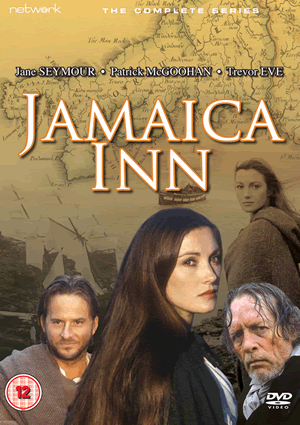
Common factors linked historical whodunits with Gothic Romances. Daphne Du Maurier’s Jamaica Inn (1936) set in 1820 Cornwall is a historical suspense, making it a forerunner of the subgenre. Many have seen Dame Daphne’s work as an attempt to recover the Gothic Victorian style, but few have noticed her debt to Willkie Collins, one of the fathers of the detective story. However, Du Maurier is considered a revivalist of the Gothic style. Her followers which include well known Sixties and Seventies authors such as Mary Stewart, Dorothy Eden and Victoria Holt were identified as Gothic Romance or Romantic Suspense writers.

Such labels were not applied to Robert van Gulick’s work. In the 30’s, at a Tokyo bookstore, this Dutch diplomat  came across  a Seventh Century  Chinese detective story featuring a certain  statesman and criminologist named Di Renjie. During World War II, van Gulik translated into English that novel. It appeared in 1949 under the title of The Celebrated Cases of Judge Dee. By 1959, Gulik was writing his own detective stories celebrating the deeds of the sleuthing magistrate. This was the beginning of an acclaimed series (Gulik also drafted a series of comics based on Judge Dee) that lasted until the author´s death in 1967.


The person who managed to dislodge the historical whodunit from its Gothic Romance or Period Drama labels was Edith Mary Pargeter. Under her real name she had been writing historical fiction since the Sixties, but her literary career dated back to the Thirties and crime fiction was her specialty. Following an unwritten law, Miss Pargeter penned her novels under masculine pseudonyms such as Jolyon Carr, John Redfern and Ellis Peter.

 It was under this last pen name that she would create her most famous detective: Brother Cadfael, protagonist of The Cadfael Chronicles that began in 1977 with A Morbid Taste for Bones. The novel took place in Shropshire in the Twelfth Century during a turbulent period of British history. Cadfael was a monk with a taste for sleuthing, aided by his immense knowledge of sciences and herbal lore learned from the Moslems during his crusader´s stage. These hugely popular series encompassed twenty one novels written between 1977 and the early Nineties.


Cadfael has since then inspired the creation of a flock of inquisitive medieval members of the clergy. There is Brother Athelstan, Sister Fidelma, Sister Frevesse and now we have Nancy Bylieau’s Joanna Cross, a Dominican nun living in the days of Henry VIII. But detectives of yesteryear do not necessarily have to be members of the Church.

In 1979, Juliet Humes under the pseudonym “Anne Perry” would publish her first historical mystery, The Cater Street Hangman featuring Victorian policeman Thomas Pitt.  Perry, whose own life would be the subject of Kate Winslet’s film “Heavenly Creatures,” legitimized the subgenre and inspired several other writers to deal with detectives from the past. She has continued writing into the current century, and Dorchester Terrace, her latest Thomas Pitt novel, is due to appear in 2012.


More respectability was granted to historical mysteries in 1980 with the publication of The Name of the Rose; Umberto Eco´s acclaimed novel dealing with gruesome homicides at an Italian medieval monastery. There have been other attempts to turn historical mysteries into high literature. Patrick Susskind’s The Perfume comes to mind.


In the Twenty-First Century, ancient murderers and law enforcers are alive and kicking in books from all over the world. Famed Turkish novelist Orhan Pamuk has given a try to the matter with his My Name is Red (2000) a crime novel set in XVI century Istanbul, and Carlos Ruiz Zafon’s bestsellers could be considered historical mysteries.


On the other hand of the spectrum, stand Anthony Horowitz and Laurie R. King and their insistence in reinventing Sherlock Holmes’s adventures. In the market you may find Regency, Victorian and Edwardian cozies, Medieval and Elizabethan whodunits, and detectives wearing togas or kimonos. There is a wealth of female amateur private eyes of all ages from spinsterish archaeologist Amelia Peabody investigating murders in the 1920’s to 11-year-old Flavia de Luce sleuthing in the England of the Fifties.

If this winter you run out of reading material, reach out and become acquainted with the historical whodunit. But if you are already hooked in the subgenre, tell us who is your favorite author and why do you do you think historical mysteries have so many readers. Would you care to write a historical mystery? Which era would you select?

Sunday, July 17, 2011

She Says, He Says: Gender and the Writing Craft


We do know there is such a thing as “Women’s Literature” and it is known that romance fiction targets a feminine audience. Does the author’ sex influence its characters? Are male novelists guilty of stereotyping female characters? Are their feminine counterparts still hooked in idealized masculine protagonists?

In a near future, gender might become an obsolete term. Until then, we accept that men and women (regardless of their sexual preferences) react in different ways to situations and emotions. Just as religion, family life and past romantic history reflect on a particular writer´s work, gender does play a part in his/her craft.

Indeed, certain genres are associated with gender. As much as I try, I cannot remember a war novel written by a woman. Women can describe the effect conflicts have on civilians, but they don´t write battlefield scenes. Perhaps because until recently few women were on the battlefield and none was too eager to fictionalize her experiences. Think of how Margaret Mitchell describes soldiers in Gone with the Wind. They are either in hospital beds, on leave or marching away form Atlanta. She doesn´t show them actually engaged in war games as Stephen Crane does in The Red Badge of Courage.

Wounded Confederate soldiers in Gone with the Wind

There are hardly any women writers specializing in thrillers, adventure novels, epic fantasy or science fiction. I don´t know if there is a predisposition against them doing it or if those are not subjects women care for. This is why the few women who have achieved success in those genres (e.g. Ursula Le Guin) are twice as famous. Precisely why Nicholas Sparks is much lauded for being one of the small number of men who dare to write romance. In fact there are plenty of male romance authors but they hide under pseudonyms. Just as Nora Roberts signs her futuristic murder stories as “J.D. Robb.”

Beyond the question of prejudice in the publishing universe, I’m interested to know if readers notice a difference in voice when comparing genre written by novelists of either sex. Do women authors “feminize” their science fiction and mysteries? Do men authors rely on negative archetypes when it comes to feminine protagonists? Just think about those wonderful hardboiled detective classics and their femme fatales, as dangerous as tarantulas.

Barbara Stanwyck playing femme fatale in Double Idemnity based in a James Cain story

Nineteenth-century literature was full of novels with feminine names as titles, all written by men, all depicting nasty protagonists: unfaithful wives like Madame Bovary or Anna Karenina; prostitutes like Camille and Balzac´s Nana; fallen women like Tess of D’Urbervilles and ambitious schemers like Thackeray’s Becky Sharp. Thank you gentlemen, but you did us a disservice. Only Dickens stepped aside from the Scarlet Women-Makers Circle, but he used a worse stereotype: the victim, the damsel in distress that always needs a knight to fight for her virtue.


Women writers are also guilty of stereotyping. In The Time Traveler’s Wife, Audrey Niffenegger creates a leading man who is a metaphor for guys unable to commit and who drift in and out of their women’s lives. At least, Henry De Tamble has an excuse. He suffers a genetic disorder that forces him to time travel, but that’s little comfort to Clare, the wife he is constantly deserting. Although the novel should be about Henry, we are hooked on Clare and her plight. He is just a nuisance, an object, and although Niffnegger alternates Henry and Clare’s perspectives, sometime he feels like a cardboard character.

Rachel McAdams and Eric Bana in The Time Traveler's Wife

It might sound as a generalization, but biographical data shows us that most romance authors base their masculine characters in “The Man that Got Away” (a former lover), or some approximation to the ideal man they dream to find. Sometimes they combine both and give an impossible happy ending to their botched down affairs. Although it´s legitimate to draw on our own emotional experiences to create characters, sometimes we concentrate so much in developing a leading man or woman that their counterpart ends up being a one-dimensional shadow.

Afraid to fall into that trap, many men writers have qualms about delving too deep into the feminine universe, and some female novelists wouldn’t dream of writing from a man’s point of view. This is particularly true in romance.

When I first started to write “seriously”, my story had a supposedly dead protagonist who resurrected around chapter fourth. Therefore, the first three chapters were written from her bereaved husband’s POV. My Beta Reader wisely said that no woman reader would care for a romance written from a man´s perspective. I went over my collection of bodice-rippers and saw her point. And yet we now have romantic bestsellers like Water for Elephants with a powerful sensitive hero, and he comes from the imagination of a woman, Sara Gruen.

Robert Pattinson and Reese Witherspoon in Water for Elephants

Ideas such as “real men don´t read romance” (so far I haven’t met any who dare come out of the closet and confess to enjoy that genre) and women readers shying away from “masculine” genres are hard to kill. That is why to attract female viewers, movie versions of Jules Verne classics or Conan Doyle’s The Lost World insert token ladies that never existed in those books.
What is Arlene Dahl doing in the Center of the Earth? Certainly Jules Verne didn't put her there

I must confess I am an odd duck that don´t need girls in a tale to appreciate it. I have watched the Band of Brothers miniseries about twenty times and never minded the absence of female characters. Moreover, although I concede that women are at their best in the creation of female characters, some men authors are masters in that same craft.
Band of Brothers. Wo needs girls with such gorgeous soldiers?

I enjoy the Sookie Stackhouse Novels (The Southern Vampire Mysteries) but I hate her! She is irksome, silly, and loud. Vampires, get her! On the other hand, I have fallen in love with the women in George R.R. Martin’s saga A Song of Ice and Fire since as characters they are vigorous, varied and they hold up their own in a world terribly biased against their sex.
Sookie and one of her vampire paramours

However, I constantly hear men complaining about the manner in which female writers portray their sex. They say that most male protagonists penned by women are feminine fantasies or nightmares. Even when it comes to “macho territory” such as detective stories they point out to me that Patricia Highsmith‘s Tom Ripley is homosexual and Agatha Christie´s Hercule Poirot is a fuzzy old bachelor, far from the manly private eye epitome created by men authors. I happen to think that P.D. James’ Inspector Adam Dalgliesh is a pretty strong masculine character, but then as a woman, my judgment could be clouded.

Could you give examples of authors who are experts in developing characters of the opposite sex? Do you find it hard to create them? As a reader, do you notice how the author imposed his/her voice to the text? Do you think gender dominates certain genres?