Showing posts with label Controversial subjects. Show all posts

Sunday, September 30, 2012

The Freedom to Offend


“What is freedom of expression? Without the freedom to offend, it ceases to exist.”  ~ Salman Rushdie

Sir Salman Rushdie
Salman Rushdie’s free speech is easy to defend. He writes award-winning literature with clear artistic merit. The author bravely suffered for his art, having spent a decade in hiding after an Iranian fatwa was issued against him for his 1988 novel, The Satanic Verses. The novel was considered an insult to Islam, and in addition to the fatwa, protests erupted all across the Muslim world. For years Rushdie lived under a pseudonym, the Joseph Anton of his new book’s title.

The hero and villain are clear in this story: Rushdie, on the side of democratic values and free expression, is the good guy. The Ayatollah Ruhallah Khomeini, who called for Rushdie’s head? Bad guy. We can all rally behind Rushdie. We champion his right to offend without breaking a sweat … mostly because he doesn’t offend us.

But what about the case of Nakoula Basseley Nakoula?

Several weeks ago, a trailer for a low-budget film went viral on YouTube. The film was reportedly made in the US by Nakoula, an Egyptian-born Coptic Christian, and was intended to do what it accomplished: really upset Muslims. Riots and protests have broken out all over the world in response to the clip, often from people who haven’t seen it. As with Rushdie’s novel, the protesters just know that their religion was insulted: they don’t ask for details.

Most of us in the US are appalled by Nakoula and his film. We want nothing to do with him. Thanks, but we’ll stick to defending Rushdie. The problem? This easy-out allows those who are most easily offended, who are least reasonable, to decide what everyone else gets to say. That’s not the point of living in a democracy. We went through that whole Enlightenment thing not just to defend the likes of Rushdie (easy) but to defend the likes of Nakoula (ick). We can, and should, denounce the content of Nakoula’s film: it was, according to virtually all who have seen it, obnoxious and incendiary. But we should also, and more loudly, denounce the protesters who hold an ideological gun to our heads, and tell us we better speak the proper speak or the world will go up in flames. We cannot allow their outrage to control our tongues.
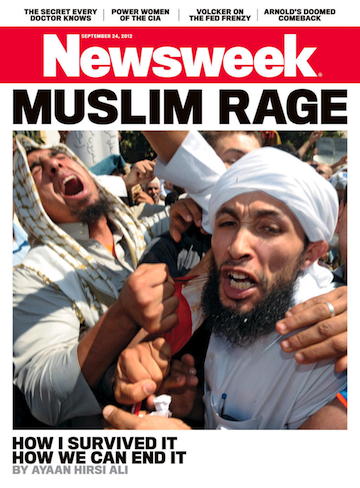
A loud minority
I should take a moment to emphasize here that most of those engaging in violent protests are the Muslim equivalent of Neo-Nazis or the Westboro Baptist Church: they are fringe, they are not representative of Islam. But they are loud and they make magazine covers. However, moderate Muslims are also upset, if not violently so. They are confused about how such a film was allowed to exist. They have blasphemy laws: where are ours?

The United States indeed has no blasphemy laws per se, and fewer hate-speech laws than, say, Europe, where Holocaust denial is illegal. In contrast, many Islamic countries have no free presses at all, only government-controlled media. Blasphemy is criminalized and strictly enforced. It is difficult for people in such places to understand that anyone can say pretty much anything in a democracy: the government doesn’t vet or sponsor the speech of its citizens.

While many in the western world accept the notion of free speech, we can be a little muddier on how it plays out. I am free to tell my Scientologist friend* that her beliefs are ridiculous, that Xenu the Intergalactic Overlord is a sham, a joke, a way to part fools from their money. And by “I am free” I mean my friend cannot have me arrested for hate speech or blasphemy. The government can’t censor me. I am not, however, free from my friend’s reaction to my opinion. My friend can argue with me, delete my posts, unfriend me. When I decide to question her beliefs, I have to deal with these potential consequences. As obvious as this may seem, it’s a concept too many free-speech advocates struggle with: Our freedom to offend doesn’t protect us from anger. This is quite a serious limit on speech, actually: we have to live alongside other people. Just because we can’t be jailed by an action doesn’t mean it’s consequence-free.

As a writer, I frequently self-censor for this reason. I worry that my autobiographical fiction might upset a family member or friend, and I take pains to disguise an anecdote to avoid offense. I worry that a liberal use of foul language or sexuality, appropriate and honest as it may be for the scene or character, will cause an agent, editor, or audience to turn away from me. Writers may also self-censor if their viewpoints on religion, sex, class, and war stand apart from their peers, and this is more insidious. We may feel we must bend to the mainstream in order to have a voice. But if we do that, what are we really saying? In fact, we have nothing to say at all. We’re just parroting the zeitgeist: we end up in an echo chamber. The most influential and important voices are those that can break out of those restrictions and say something new, uncomfortable … and possibly offensive.

This is not to say that offensive speech equals useful speech. Rushdie and Nakoula may both have offended Muslims, but only one had anything constructive to say. Offensive speech can be quotidian or game-changing: the offense in itself isn’t the point. The content is the point. To be a game-changer, you’d better have more than just the ability to piss people off. You had better be able to make them think.

Gay Talese, Susan Sontag, Norman Mailer, and Gore Vidal 
As worried as Rushdie is about the fatwa, and this new tide of offense sweeping the radicalized world, he seems almost more worried about the silencing effect this manufactured outrage has had on potential provocateurs. Is fear of offense causing people to be silent, where they used to speak up? “If you look at America, for instance, there is a generation older than mine in which writers like Susan Sontag and Norman Mailer and Gore Vidal would have a significant public voice on issues of the day,” he said in an interview with Reuters news agency a few days ago. “Now, there's virtually no writers. Instead you have movie stars.”

I think that point is debatable, as we do have the Sam Harrises and Richard Dawkinses of the world—but they are not novelists. I recently reread Margaret Atwood’s 1985 novel The Handmaid’s Tale, which imagines future America as a tyrannical theocracy, and Steinbeck’s grim call for reform, The Grapes of Wrath, and I wonder where we can find such impassioned, daring novels today. The subject doesn’t have to be religion: it can be politics or economics. Steinbeck and Ayn Rand each vehemently criticized economic systems, though in completely different ways. A quick glance through the past decade’s literary standouts fails to reveal anything similar. Novelists can have an enormous impact on culture: Conservative politicians today cite Rand as if she were an actual economist, and Orwell’s novels serve as an admonition across the political spectrum. Today, when we want to warn against the dangers of government surveillance, we still have to say “Big Brother is watching you!” We’ve come up with nothing better on that front since 1949.

Not banned from MY bookshelf
But perhaps Rushdie and I are looking in the wrong place. Perhaps there are some boundary-pushing novels hiding somewhere other than the Pulitzer and Man-Booker shortlists. If you want to know which novels are getting people thinking, which are a bit subversive, you go to the banned-book list. Lately, there aren’t too many lofty literary books on there. But you know what we do find? Kid lit. That’s right, the American Library Association’s “most-challenged books” list is dominated by books written for children and teens. Kids’ books are prone to being banned for a number of reasons, of course: first, they are read by kids. You know, those innocent little people with fresh untainted minds. We don’t want ideas getting in those minds. Second, you can actually ban kids’ books, by having them removed from school libraries. It’s much harder to ban books written for grown-ups in this way.

At its peak, Phillip Pullman’s series His Dark Materials was ranked second in the top-ten books people have tried to ban in the US. The series has a question-dogma message buried within its exciting adventure plot—buried, but not deeply enough. The easily-offended caught wind of blasphemy and pounced right on the series, denouncing it and demanding it be removed from libraries.

In response, Pullman told the Guardian newspaper, “Of course it's a worry when anybody takes it upon themselves to dictate what people should or should not read. The power of organized religion is very strong in the US, and getting stronger because of the internet.” Possibly the most famous challenged author of recent years is, of course, JK Rowling, for her Harry Potter series. Before he was made Pope, Joseph Ratzinger himself condemned the books, writing that their “subtle seductions, which act unnoticed ... deeply distort Christianity in the soul before it can grow properly.” One cannot imagine Ratzinger read the series any more than the Ayatollah read Rushdie. At least nobody asked for Rowling’s head.

Burning blasphemous books at a church in Shreveport, LA
Number three on the current most-challenged list is yet another series, the wildly popular Hunger Games trilogy by Suzanne Collins. As Collins’ main political message is “tyranny is bad,” this seems especially bizarre. The ALA lists reasons pro-censorship people have given for banning this series, and they include “anti-ethnic; anti-family; insensitivity; offensive language; occult/satanic; violence.” Violence, okay. The rest—what the heck? How did anyone find “occult” or “satanic” messages in the Hunger Games? It goes to show that the easily-offended, which seems primarily to consist of the most-religious, will find any reason to ban almost any book. While there is an enormous difference in the methods used, it is clear that the book-protestors in the Middle East and the book-protestors in the west have one thing in common: they don’t want unsettling ideas to get out there.

At last week’s UN General Assembly, many Muslim leaders called on the international community to tighten restrictions on free speech and to ban blasphemy. Egypt’s new president said that his country “respects freedom of expression” unless it is “used to incite hatred against anyone [or is] directed toward one specific religion or cult." In other words, free speech is great as long as it’s totally inoffensive. The president of Yemen opened his speech to the UN by demanding similar limits to free speech: “These behaviors find people who defend them under the justification of the freedom of expression,” he said. “These people overlook the fact that there should be limits for the freedom of expression, especially if such freedom blasphemes the beliefs of nations and defames their figures.” The Arab League’s secretary-general went further still, proposing a binding “international legal framework” to “criminalize psychological and spiritual harm” caused by statements that “insult the beliefs, culture and civilization of others."

Criminalizing “spiritual harm?” One can only imagine what George Orwell, Ayn Rand, and Margaret Atwood would have had to say to that. It is up to us, as writers, not to allow the outraged to silence us. If we aren’t actively writing “blasphemous” books, we ought to be doing everything we can to stand up for those who do.

*My “Scientologist friend” is purely rhetorical: i.e., nonexistent.

OK! I'm done! I'm done!


Monday, March 7, 2011

Age and blood-ties: Do readers impose their taboos on the industry?


Oscar Wilde did not believe in "dangerous" books


The publishing industry claims there are no forbidden themes in fiction, agreeing with Oscar Wilde´s quip that there is no such thing as bad books, only badly-written ones. But we, readers, know very well what topics disturb us. What happens when the public refuses to read novels dealing with controversial topics? Won´t the industry budge to its clientele´s tastes? What are the once safe subjects that now upset modern sensibilities?

I begin by saying that my comments are on the American scene, since the United States is still the leader in book-publishing in the world. Other publishing industries have their own idiosyncrasies and prohibited subjects, but to all of us who write in English, it´s the American industry that matters.

I am fifty-one years old, and like most people my age, I am painfully aware of the distinction between Twentieth Century’s and contemporary cultures. Our way of thinking has evolved tremendously and that applies to literary tastes as well. A Third Millennium reader might be shocked and offended by the way classical works of literature dealt with love in times when spousal rape, underage sex, and sibling marriage used to be the norm.


As modern critics applaud the erasure of racist epithets in Huckleberry Finn, so they show antipathy towards certain subject matters in current fiction. Exploring user´s comments on Amazon and other sites, I have come to recognize what issues are considered “icky” and elicit the most “how gross!" and ”eeews!” from readers. Among those controversial scenarios are cousin-marriage and May-December affairs, even when they take place in historical settings.


From Jane Austen to Louisa May Alcott, “kissing cousins” were frequent romantic elements in Victorian novels. Over a hundred years, and several medical and social misconceptions later, marriage among cousins disgusts American audiences. Unless it is shown as illegal, incestuous and negative, such a relationship in modern literature is unthinkable. Not surprising since the only Western country that bans those unions is the United States (and it´s unlawful just in thirty states).

Cousin-marriage a la Austen


The British YA novel How I Live Now, has been widely criticized on the Internet for depicting a love affair between a fourteen-year old and her first cousin. Users and critics agree that books should carry warnings signs to alert readers about unsavory content. Not even children’s literature is safe from such displeasure. I heard that copies of the well-loved Babar series now have been censored so there is no mention that Celeste, the elephant’s wife, is also his first cousin. Are they doing the same with Beatrix Potter’s Peter Rabbit? Because if I don’t ill recall, Peter married his first cousin, Topsy.


The same distaste applies nowadays to that old romantic staple: May-December love affairs. Even if it happened in days of yore, the idea of an underage wife makes readers flinch. It’s no use telling people that until World War I, men married old and women married in their teens. Just remember Scarlett’s fear of becoming a spinster like 20-year old India Wilkes. But perhaps, Gone with the Wind is, by present standards, a dangerous novel.

May-December romance in GWTW

I was nine-years old when I came across my first copy of Gone with the Wind. It took me two days to finish it and less than fifty pages to turn it into my favorite novel of all time. It might come as a surprise that Melanie marrying her first cousin or Scarlett marrying the much older Rhett Butler did not shock me. I am embarrassed to say, I was not even offended by Rhett raping the heroine. I guess, many felt that way because in 1987, conducting a poll among my high-schools students, I found that GWTW was still a YA bestseller. I wonder if that would hold true today. Do teen readers, and adults, still fall in love with GWTW, or are they uncomfortable with it´s racism and sexism, not to mention the odd matrimonial customs of the Old South?


Gigi and her much older paramour

With that in mind, I can understand why modern sensibility cringes at films like Gigi, based on Colette´s novel, which has a fourteen-year old reforming and marrying a bored womanizer. How do people feel about Jo March marrying old, but loving, Professor Baher? And how many complaints have I read about Twilight because 100-year old Edward is a tiny bit older than teenaged Bella? The fact that Bella is an “Old Soul”, who would much rather cook and read Jane Austen than do drugs at the nearest disco, should be taken into consideration.

Bella messing around with an "older man"


As I wrote once, Fantasy and Science Fiction offer great refuges for taboo-breaking. George R.R. Martin became a bestselling author after creating a world, in his saga Song of Ice and Fire, where incest is not a crime, thirteen-year-old brides are acceptable. The hottest craze for vampire romances lets May-December thrive as long as, quoting a reader, “the hundred-year old vampire looks good!”


Must add, so this doesn´t sound like an attack on people´s preferences, that certain novels do disturb me , even if set in fabled worlds or historical settings. Today, many of us are uncomfortable with early bodice-rippers that dealt with “rape fantasy” romances (i.e. heroine raped by hero). Visiting a romance forum, I sympathized with comments repudiating Rosemary Rogers and Kathleen Woodwise’s works for including that scenario, but then I was appalled when the same readers embraced Diana Gabaldon’s Outlander that has the villain raping the hero. Talk about a double standard!


To anyone that asks, I wholeheartedly recommend Jacqueline Carey´s Kushiel series. It offers elegant prose, plenty of intrigue and adventure stories, and Carey has created a wonderful parallel world that mirrors the European Middle-Ages. Having said that, I confess that after reading the first book in the series, I gave up on it. I found it excessive , not to mention sickening, to read about a society that made sex the number-one priority, where girls were trained to become sacred prostitutes , and where the heroine’s greatest gift was to experience pleasure through pain.


I realized that only the “Historical Fantasy” label permitted the Kushiel series to become part of mainstream literature. I don’t believe it would have worked if masochist Phedre had been the protagonist of a contemporary romance or a historical novel, because reader tolerance does not encompass historical settings. And one of the best examples is The Kindly Ones, Jonathan Littel’s award-winning novel.


American- born Littell chose to write this novel in French, he had it published by the prestigious Gallimard publishing house, and eventually went on to get Le Prix Goncourt, the French equivalent to the Pulitzer Prize. The Kindly Ones is an exploration of the Holocaust written from the point of view of an SS officer, a highly educated, but deeply-disturbed human being.


Although vastly praised, The Kindly Ones has come under fire by several critics that begrudge its historical inaccuracies, the handling of the Holocaust, and last but not the least, the almost pornographic juxtaposition of sex and violence. Add to the fact that the protagonist is homosexual and has this obsession with somodizing his sister, and you´ve said it all.

There´s even a story that Littell, having been rejected initially by many American publishing houses, eventually rewrote his novel in French. What fuels the possibilities of this rumor being true is that The Kindly Ones’ translation, bought by HarperCollins, did very poorly in the American market. Which shows the industry knows its readers and their likes and dislikes.

Now it´s your turn to tell us what subjects you find repellent? What novels have made you cringe? And should the industry stay away from controversial themes?