Friday, June 27, 2014

Cephalopod Coffeehouse: Outlander

Welcome to this month's round of the Cephalopod Coffeehouse hosted by the illustrious Armchair Squid! Pull up a chair and pour yourself a mug of coffee or tea!

This month I chose Diana Gabaldon's very first novel Outlander. This wasn't really a random choice. A little over a month ago I attended a event put on by the local library called "A Word With Writers." The featured speakers were Diana Gabaldon and George R.R. Martin. If you'd like to read about the event, visit Sister Lorena's post here.

Once upon a time I had tried to read Gabaldon's novel, but never finished. I knew why. I'd found it incredibly boring. But, after hearing her speak about her work, I thought I'd give Outlander a second chance. I dug around my bookshelf until I found my copy. The front cover was just as dated as I remembered and certainly didn't make me think that the lovely, delicate Claire was much of a beauty.


The cover of my copy. If you open the front
flap you'll find an equally unflattering
picture of Jamie with a late-80s
hairdo.

I flipped my book open to where I'd left off all those years ago, which was less than a quarter of the way through the novel. I even had an old, faded receipt I was using as a bookmark. It's from World's of Fun in Kansas City and says I purchased the amusement park ticket for $28.54 on July 3, 2000. So, yeah, it's been a while since I last cracked this book open.

What did I glean from reading Outlander this time around?

First off, although still boring for most of the story, I managed to get through almost the entire novel. I have to admit that I still have about 100 pages to go, but I've skimmed to the end and have a general idea of what happens. If you don't know how long Outlander is, it clocks in at 850 pages.

Next, I realized that Gabaldon has a certain beauty to the way she writes. I love how she describes Claire's surroundings in the novel. Or even some things that we take for granted. Like giving birth. Near the end, when Jenny, Claire's sister-in-law describes to Claire, who has never had a child, what birthing a baby feels like it becomes such an intimate moment filled with descriptions I never even thought about when I was pregnant. With scenes like that, Gabaldon has a magical touch to the way she writes.

Going back to the boring bit, I was disappointed to find that I felt like I never really got to know the main character, Claire. So many things that would be questions in anyone's head if they fell through time and into a strange world they knew nothing about are not raised. It's as if Claire knew exactly what to expect as soon as she fell through those rocks. No toilets? Not a problem. No bathing? Not a problem. Expected to wear suffocating clothing? Not a problem. Questionable sanitary practices in the 1700s? Not a problem. There were times when I wanted to shake Claire and ask, "Now, tell me how you really feel about the absence or lack of..." How do you go from having toilet paper to none at all and not feel just a bit nervous about the prospect? Claire never seems to mind not having modern-day amenities. And if the argument is because Frank, her modern-day husband, and all his historical research prepared her for something like this, I don't buy it. Simply put, she had no interest in what Frank did. That was apparent in the beginning of the novel. So, because I felt like I didn't really know Claire, all the strings of lovely descriptions, sex, and bits of adventure seemed to drag in many places.

On that note, the novel didn't pick up for me until around page 500 and the witch trial. Now, that I liked, and the next 200 pages were exciting. I didn't know what would happen to Claire. Would she be drowned just to find out if she was a witch? Would her knight in shining armor (a.k.a. Jamie) show up at the last minute? What I was hoping and waiting for throughout the entire novel was whether Claire would end up back at the ring of stones. If you've not read the novel, I won't spoil it for you. Her final decision between choosing Frank or Jamie was the right one, I believe.

Finally, there are some final tidbits that stopped me while reading. Claire spots Geillis's inoculation scar, but, again, she doesn't think one thing about it, and only on a side note brings it up to Jamie. What? I think my mind would be racing with all kinds of questions. Claire, from the modern world of 1945 knows an awful lot of older vocabulary from the 1700s. Somewhere I heard that Gabaldon wrote the time travel aspect because she couldn't get Claire to curb her modern-day tongue. Um, no. As soon as she's back in the 1700s, Claire seems to know all the lingo. I actually wanted more of her worldly tongue in the novel, and just felt disappointed it wasn't there. There's also an awful lot of spanking or talk of spanking going on throughout the novel. Just a head's up.

In the end, if you're debating about whether to read Outlander or not, then keep a few things in mind: 1) Gabaldon is truly a lovely writer, 2) 850 pages was way too long for something that could have used some extra editing, 3) Claire almost seamlessly fits into the 1700s, and 4) after all that, you may or may not be inclined to read the next novel in the series. I have no desire to read the next novel at the moment. But, who knows? Maybe I'll change my mind in, say, fourteen years!

Check out other reviews on the Cephalopod Coffeehouse bloghop:


Sunday, June 22, 2014

Postcards Tell a Story

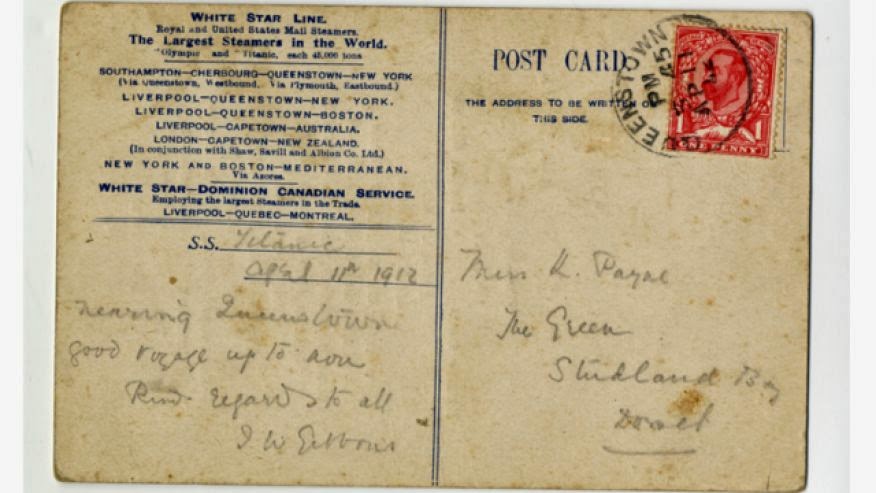
Recently I came across this article about a postcard from the Titanic that went up for auction. The postcard was reportedly expected to fetch $140,000. Why so much? Because this postcard is a rarity, and it tells a story.

The postcard to be auctioned off.
It says:
"S.S. Titanic, April 11th, 1912. Nearing
Queenstown. Good voyage up to now.
Kind regards to all.
J.W. Gibbons."

You see, the Titanic wasn't any different than the hotels of today. They plastered advertisement on just about anything, including the postcards that served as menus for each class. In this case, Gibbons, a second-class saloon steward, dashed off a quick message to his family back home before the final leg of Titanic's voyage. This postcard offers a rare glimpse into what the second-class passengers had for their breakfast:  "Yarmouth bloaters; grilled ox; kidneys and bacon; American dry hash au gratin; grilled sausage; mashed potatoes and Vienna and Graham rolls." I don't know about you, but that sounds like a filling and hearty breakfast! Very few second-class menu postcards are known to exist, so this one is especially a treasure for any collector.

Front image of the Titanic postcard.

As you can also see, this postcard also tells a story. I bet you're sitting there, wondering whether one Mr. Jacob Gibbons survived the sinking? I'll get to that in a minute.

Postcards have recently taken me on a strange trip down the avenues of history. This postcard story of the Titanic probably wouldn't have sparked much interest in me, if not for the fact that I've been researching some of the largest ocean-liners ever built. By the turn of the 20th century, immigration was at an all-time high for the United States. More and more immigrants were leaving oppressed or violent circumstances in Europe in search of a new beginning elsewhere. The number one destination for most immigrants became the U.S. and most notably, Ellis Island.

I had created a character for my story, but I didn't know where to start or where to place this certain individual. I decided to do what is often given as the first instruction to new writers: "Write what you know." At the turn of the 20th century most immigrants came from eastern Europe, from places like Germany and Austria. There were also many Italians and Irish flooding in. But I don't have much knowledge of those countries, so I went back to the one country I know best, which is France. France was more known for trying to slip prostitutes into the U.S., but they also had many immigrants who came seeking a new life like so many others. I got tangled up in researching French history and soon found myself immersed in the Champagne Riots of 1911. And guess what? I found postcards!


Revolution in Champagne -- 12 April 1911
This is a champagne house that was burned by rioters.
It was located in the city of Äy, which is found in the
Champagne region.
These postcards present some of the best lasting images of a time come and gone. They are like gold to any writer looking for historical information on a topic. 

Yes, it seems a bit strange that someone would pick up a postcard showing a burned out champagne house and decide that it was a good choice on which to write a message back home. History is strange, though. We don't always understand the mindset of the time or why things turned out the way they did. One thing we do have, if it's well-preserved, is a photographic history to offer us some insight into what once happened. That's why I like these postcards. There aren't many photos around about the Champagne Riots, but there are these snippets that are up for sale to avid collectors. They chronicle an important page in France's history.

Speaking of chronicling history, some of the very first "news" footage was filmed during the Champagne Riots. That's the only thing police had when it came to arresting those who partook in the destruction of Äy. I have no idea if the footage exists today (I've had no luck doing some simple online searches), but if anyone does know if the film is out there, I'd love to see it!

So, back to Mr. Jacob Gibbons. You can breathe a little easier, because he survived. He ended up getting rescued from a life boat. As soon as he could, he sent a brief telegram back home that read, "Saved, well, Daddy."

Do you have an interest in historical postcards?

Friday, June 13, 2014

Then and Now

For this month’s post, I decided to participate in a fun blog hop hosted by The Armchair Squid, Suze, Nicki Elson and Nancy Mock called Then and Now, where we’re supposed to watch a movie we loved when we were younger and see what we think of it now. Little did I know that the exercise would prove to be a lot more challenging than I expected. Why? You ask. What could be so hard about watching a movie and talking about it?

Well, first of all, there was the issue of choosing the film. My first impulse was to select a movie from one of my favorite directors, John Hughes, but as you can see here, I’m pretty much obsessed with the man, so how could I rewatch his films with fresh eyes when I never outgrew them? I went through a list of non-Hughes films and there were a few that I recalled fondly that I hadn’t seen in ages, but I was confronted with another problem: FEAR.

As I mention in this post last year, I have become a lot more critical of films and books since I started to write. As my expectations have grown, it’s increasingly difficult to find stories where I can lose myself and not think about what the director or writer were trying to do. My fear when watching a once-beloved film was that I would realize that it was not as wonderful as I remembered, and that nostalgia wouldn't be enough to forgive all the film’s flaws.

I pondered for a few days about movies that I used to like but wouldn’t be overly devastated if I discovered all their imperfections and I finally picked one that:

1) I was desperate to watch when it came out, but had to wait a few years due to my age;
2) was incredibly popular during my childhood years; and,
3) I hadn’t seen in a VERY long time.

So without further ado, I bring you...


Flashdance, for those who haven’t seen it, is the story of an 18-year-old girl who is a welder by day and dancer by night. She lives in a warehouse-turned-apartment with her massive dog and dreams of becoming a ballerina. The problem is she’s a self-taught dancer who doesn’t have the education nor the references to enter the prestigious dance school of her dreams. Her best friends also have goals of their own: one longs to be a professional ice skater while another one is a short-order cook who wants to become a stand-up comedian. As Alex witnesses her friends’ dreams collapse, she must find the strength to go along with hers, even it means swallowing her pride and having to face rejection.

My first reaction when I watched the film again was excitement over the soundtrack. My friends and I used to sing these songs to the top of our lungs (even though we didn’t know what exactly we were saying) and we used to play the tape over and over again during our first dance parties. I am convinced that a big part of Flashdance’s appeal was the music.

The second thing I noticed was how young Jennifer Beals was (I'd thought the character was in her twenties, but she was only eighteen). I also questioned details I'd never considered before: Where is Alex’s family? How did she become so independent at such a young age? How did she meet her mentor, Hanna, the lady who encourages her to apply to dance school? And how and why did her elder friend die? Last but not least, how did she learn to weld (and what on earth was she building)?

 
Another interesting observation is that this time around, her love interest Nick (Michael Nouri) didn’t seem as ancient as I remembered. When I first watched the film in my early teens, I was extremely disappointed with the actor selection (my apologies, Mr. Nouri) mainly because he was SO MUCH OLDER than the protagonist, but now I realize he HAD to be older in order to be her boss and help with her audition.

The other detail that blew my mind was how many sexual comments between Alex and Nick I had missed when I first saw the film (and how I may have been too young when I watched it!). I didn’t even think it was weird that she removes her bra in front of him!  (She probably wants to be more comfortable, I thought.)
 

Plot wise, it’s not the most complex or unpredictable story, but it follows a familiar underdog/Cinderella journey that pleases most audiences. It also offers a few positive messages. One, the 80s became a turning point for women’s fitness. In Flashdance, not only does Alex ride her bike everywhere, but she also works out at her home-gym (an impressive routine which I tried to mimic once but somehow was not as graceful as she was) and lifts weights with her friends. Two, Alex is a good role model. Despite her youth, she has a clear sense of right and wrong (something her best friend doesn’t always have). She initially declines Nick’s invitations because she “doesn’t date the boss,” she’s self-sufficient, doesn’t allow men to disrespect her and saves her best friend from ending up in a strip club for the rest of her life. In addition, she has sophisticated tastes like going to the ballet with her elder friend and eating lobster (in a very provocative manner!) But the best thing is that the film sends an encouraging message about following our dreams no matter how far-fetched and difficult they may seem.

In the end, I’m happy to report that I still found this film enjoyable.

 
What do you think of it?